Can Students Access Turnitin Without Their University? Here Is the Truth

There is no way to create your own Turnitin account, because the company sells only to universities, schools, and publishers. If you do not have a university login, the only safe route to a genuine report is a verified third-party service that submits your file through the real Turnitin engine, then returns the official similarity and AI results without storing your work. Why you cannot just sign up Plenty of students search for a personal Turnitin login, then hit a wall. The reason is simple. Turnitin is an institutional product. It is bought by universities, colleges, schools, then connected to their learning systems. There is no consumer plan, no free student tier, no upload box on the homepage. That design is deliberate, because the value of the database depends on it being controlled by institutions rather than open to anyone, and because the student paper repository that powers collusion detection only works if submissions come through verified institutional channels. So, when a classmate says they checked their own work in Turnitin, what they almost certainly used was a draft assignment their tutor set up, a practice folder, or a feature called Draft Coach that their university switched on. None of those are things you can activate yourself. What Draft Coach actually gives you, and its limits Draft Coach is a genuine Turnitin feature, built into Word and Google Docs, that some institutions enable for their students. When it is switched on, it lets you run a limited number of similarity checks on a draft before the real submission, usually capped at three attempts per assignment, and it shows you matching sources directly inside your document rather than through a separate report screen. It solves the visibility problem neatly where it exists, but three limits matter. First, your institution has to have paid for and enabled it specifically for your course, and a huge number of universities have not. Second, it typically shows similarity only, without the full AI writing breakdown you get on the final submission. Third, the three-check limit is easy to burn through early in the drafting process, leaving you blind to the version you actually intend to submit. If your course does not offer Draft Coach, or you have used up your checks, an independent pre-check fills the same gap without a cap. The routes people try, and why most fail A few methods circulate online. It is worth knowing why they are risky before you trust your dissertation to them. Free plagiarism tools. These compare against the open web only. They never touch Turnitin’s private database of student papers, so the number they give bears little relation to your real score, and it will not catch overlap with a classmate’s paper the way the real repository check does. Shared or borrowed logins. Using someone else’s institutional account breaks the university’s terms, can get the real account holder in trouble, then exposes your work to a stranger. Fake report generators. Many sites produce something that looks like a Turnitin report but is just a template filled by a generic checker. A marker or publisher will spot it instantly, so it is worse than useless. The one legitimate route The dependable, ethical option is a verified third-party check. DoMyWork’s Turnitin check submits your file through the genuine engine, then returns the official report: similarity score, AI writing score, plus the source breakdown that shows where each match came from. Crucially, your paper is not added to the student submission database, so your final submission will not later match against this earlier copy. That last point trips up more students than any other. Picture a 4,000-word essay checked once as a rough draft through a service that stores submissions, then revised and resubmitted as the real thing six weeks later with maybe 15% of the wording changed. The final submission can come back showing 80% to 85% similarity against a single source, and that source turns out to be the student’s own earlier draft sitting in the same database. Nothing was copied from anyone, yet the report looks like the worst kind of red flag until someone works out what actually happened. A proper pre-check sidesteps this entirely by keeping your file out of the repository in the first place, so no earlier version of your own work is ever sitting there waiting to match against the final one. What you actually get from a real report A genuine Turnitin report gives you three things a free tool cannot. The similarity score against the full database, including the student papers archive. The AI writing score, split into AI-generated and AI-generated-then-paraphrased categories. The colour-coded source list, so you can see whether a match is a properly cited quote or an uncited passage that needs fixing. With that in hand you can act before the deadline rather than after. If the report shows trouble in a specific chapter, our dissertation writing help team can rework that section while keeping your research intact. Is using a third-party check allowed? Checking your own work for originality before submission is a normal, responsible step. You are reviewing your writing for accidental similarity, weak paraphrasing, or missing citations, then fixing it. That is the opposite of academic misconduct. The thing universities object to is submitting work that is not yours, or hiding copied material. Spotting your own mistakes early, then correcting them honestly, sits firmly on the right side of that line. Keep the receipts, keep your drafts, then use the report as a guide to improve rather than a trick to hide problems. Markers respect students who take originality seriously. The report simply gives you the visibility universities do not hand you by default. How to spot a fake Turnitin service Because real Turnitin access is locked to institutions, a market of imitation services has grown around students who do not have a login. Some are genuine resellers running real institutional accounts. Many are not. Knowing the difference protects both your money and
How to Check Your Turnitin Score Before Submitting

You cannot see your official Turnitin score until after you submit, because student access is controlled entirely by your university. The workaround is a private pre-check through a verified third-party service that runs your file through the genuine Turnitin engine, so you can read the same report your tutor will see, fix what needs fixing, and only then submit for real. The moment every student dreads You have spent weeks on your assignment. You have read the sources, written up your arguments, and formatted your references. You hit submit, and then, a few hours later, your inbox pings with a Turnitin similarity report showing a score you were not expecting. For thousands of students every year, this is a genuine nightmare. Not because they copied someone else’s work deliberately, but because they had no way of seeing their score beforehand. The good news is that you do not have to go in blind. With the right tools, you can check your Turnitin score before submitting and fix any issues while there is still time. This guide covers exactly how to do that, what the score actually means, and what you should do if you find something unexpected. Check your Turnitin score for UK universities, US Universities, Australian universities, European universities, and Canadian universities. What is Turnitin and why does it matter? Turnitin is an academic integrity platform used by over 15,000 institutions globally, including the vast majority of UK universities. When you submit an assignment through your university’s learning management system, whether that is Canvas, Moodle, or Blackboard, your work is almost certainly being run through Turnitin automatically. The platform does two things. First, it checks your text for similarity against a database containing billions of web pages, published academic journals, and a vast collection of previously submitted student papers. Second, and this is increasingly important in 2026, it checks for AI-generated content, flagging sections that appear to have been written by tools like ChatGPT or run through a paraphrasing tool afterwards. The problem is that as a student, you typically do not see your full Turnitin report until after you have submitted. By that point, it is too late to make changes. Can You Access Turnitin Directly? No, not through the official platform. Turnitin sells its licences exclusively to institutions, not to individual students. If you visit turnitin.com directly, there is no option to create a personal student account or upload a document for checking. Three routes exist for students who want to see a report before submitting. Some tutors enable a draft submission point, or the built-in Draft Coach tool, letting you check a limited number of times before the deadline, though this depends entirely on whether your course has switched it on. A third-party Turnitin check service, such as DoMyWork’s Plag Check, runs your document through the actual Turnitin engine and returns the same report your lecturer will see. The key advantage is that your paper is not stored in Turnitin’s student submission database, so checking your work this way does not create a self-plagiarism risk on your final submission. The third route, a generic free plagiarism tool, only checks the open web and will not show you what your real institutional report contains, so treat any number it gives as a rough sense check rather than a prediction. Understanding your Turnitin report When you get your report, whether through a draft submission or a pre-check service, you will see two separate scores. The similarity score is a percentage representing how much of your text matches content elsewhere in Turnitin’s database, calculated as Similarity Score = (Matched Words ÷ Total Words) × 100. So if your dissertation runs to 10,000 words and 1,200 of those words sit inside passages that match something in the database, your score is (1,200 ÷ 10,000) × 100, which is 12%. A key thing to understand here: the similarity score is not a plagiarism verdict. It is a tool for flagging potential issues that a human will then review. A paper with a 35% similarity score made up entirely of properly cited direct quotes is unlikely to be a problem. A paper with a 9% score containing one uncited paragraph lifted from a website could absolutely lead to a misconduct investigation. Those two examples share almost nothing except the fact that both would produce a number, which is exactly why the score matters far less than what is generating the matches behind it. The AI writing detection score is a separate measurement covering how machines like your writing reads. Since Turnitin updated its detection model, it now identifies two categories: content that appears to be AI-generated, and content that appears to have been AI-generated and then processed through a paraphrasing tool. This is a significant development. It means that running ChatGPT output through a paraphraser is no longer a reliable way to avoid detection. AI detection only displays sentence-level highlights and an exact percentage when the overall score reaches 20% or above. Below this threshold, an asterisk is shown instead of a number, because Turnitin’s own testing found scores in that range less reliable. What is a safe similarity score? There is no single fixed threshold, and different universities, or even different departments within the same university, apply different standards. As a general guide across most institutions, a score under 15% is normally low-risk and unlikely to prompt review beyond a brief glance. A score between 15% and 25% is typical for well-referenced academic writing, and your tutor will check the sources behind the matches rather than the number itself. A score above 25% usually attracts a closer look, though it can still be entirely explainable depending on the assignment. What changes this picture is subject and assignment type, not a fixed cutoff. A law essay that extensively quotes case law can legitimately sit well above 25% with no issues, because statutes and judgments are quoted in fixed wording by every student citing them correctly. A business essay at the same
How to Reduce Plagiarism in a Dissertation
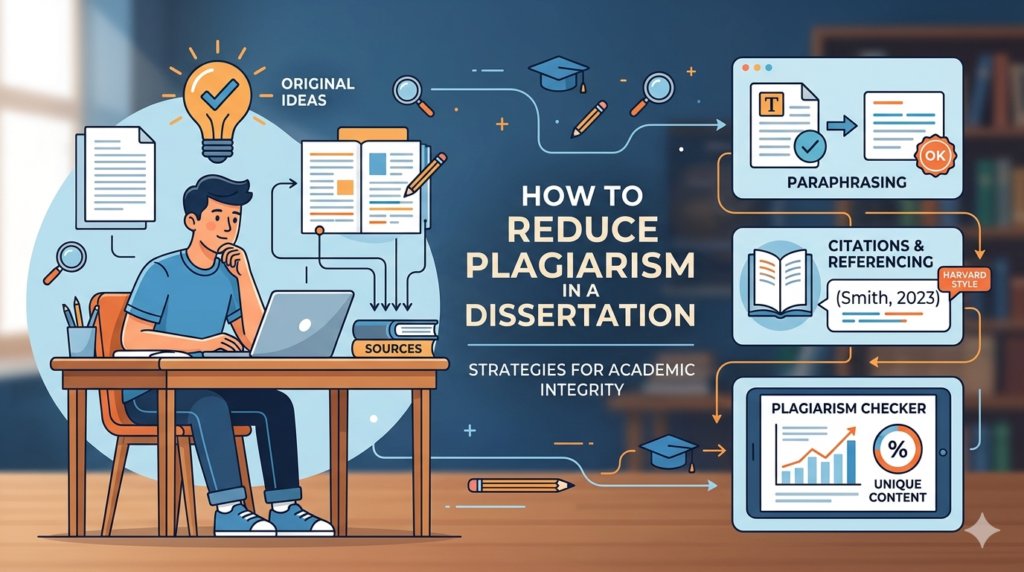
To reduce plagiarism in a dissertation, cite every source as you write, paraphrase from memory rather than editing the original sentence, quote sparingly with quotation marks, then run a genuine Turnitin check before submission. A long project naturally carries some similarity, so the goal is honest attribution and original analysis, not a zero score. Why dissertations flag more than essays A dissertation runs for thousands of words across a literature review, a methodology, results, then discussion. It cites dozens, sometimes hundreds, of sources. That volume alone pushes the similarity score up, because every reference, every standard method description, every common phrase in your field can match something in the database. A small percentage on a long document is normal. The trick is making sure the matches are the harmless kind. Harmless matches are properly cited quotes, reference list entries, plus standard terminology. Risky matches are passages you paraphrased too closely, or text you pulled in without attribution. Reducing plagiarism really means converting the risky matches into honest, original writing before anyone reviews them. Cite as you write, never after The single biggest cause of accidental plagiarism in dissertations is leaving citations until the end. You copy a useful passage into your notes, plan to reference it later, then forget which idea came from were. By submission you cannot tell your own thinking from a source. Fix this by citing the moment you use a source, every time, even in rough drafts. A reference manager helps, yet even a simple habit of bracketing the author and year as you type prevents most problems. If you’re referencing itself is shaky, our Harvard referencing guide walks through in-text citations and reference list formatting with examples for books, journals, then websites. Paraphrase properly, from memory Weak paraphrasing is the most common reason a cited passage still flags. Swapping a few words for synonyms while keeping the original sentence structure fools nobody, least of all Turnitin. The reliable method is to read the source, understand it, close the document, then write the idea in your own words without looking. Open it again only to check you got the facts right. The result reads as your own voice, because it is, while still crediting the original author with a citation. This matters even more in 2026, because Turnitin now detects AI text that has been run through a paraphrasing tool. Genuine human paraphrasing, written from understanding, is the only approach that holds up under both the similarity check and the AI check. Quote sparingly, format correctly Direct quotes have their place, in law especially, where exact wording matters. Used well they are fine, even at higher volumes. Used lazily, as filler instead of analysis, they inflate your score while weakening your argument. Every quote need quotation mark, a page number, then a sentence of your own explaining why it matters. If a quote is not earning its place through analysis, paraphrase it instead. Structure protects originality A well-structured dissertation naturally contains more of your own words, because each section demands your interpretation. A literature review that only summarises sources will flag heavily. A literature review that compares, contrasts, then critiques those sources reads as analysis, which is original by definition. The same is true of your discussion chapter, where linking results back to your research question is your work, not anyone else’s. If structuring the project feels overwhelming, our dissertation writing help supports you chapter by chapter, from the proposal through to the conclusion, with a free originality report on every order. A worked example of fixing a flagged passage Imagine your literature review contains this line, flagged at high similarity: “Social media has been shown to have a significant impact on the mental health of young people, with studies indicating a correlation between usage and anxiety.” The report shows it matches a journal article almost word for word, with no citation. That is a risky match, the kind that triggers a misconduct review. The weak fix is to swap a few words: “Social media has been proven to have a notable effect on the wellbeing of younger people.” The structure is identical, so Turnitin still flags it, then the AI check may catch it too if a tool did the rephrasing. The proper fix is to read the source, understand the finding, close the document, then write what you actually took from it: “Several studies link heavy social media use among teenagers to higher reported anxiety, though the direction of that relationship remains contested (Author, 2023).” Now it is your sentence, your framing, your citation, then it even reads as stronger analysis because you noted a limitation. Do that across every flagged passage, then the score falls naturally without a single trick. That is the whole method in miniature: understand, rewrite from memory, cite, repeat. Tools that help, then tools that hurt A reference manager such as Zotero or Mendeley genuinely reduces accidental plagiarism, because it keeps every source attached to its citation from the moment you save it. You never lose track of where an idea came from, which is the root cause of most accidental copying in long projects. These tools are free, then worth the hour it takes to learn one before a dissertation rather than during it. The tools that hurt are the ones that promise to lower your score without changing your understanding. Spinners, paraphrasing bots, then so-called humanisers rewrite sentences mechanically, which Turnitin’s 2026 model is specifically built to catch. Worse, they often introduce subtle errors into your meaning, so a passage that scanned fine becomes factually wrong. A marker reading nonsense dressed in fancy words spots it immediately. There is no shortcut that beats understanding your own sources, then writing about them in your own words. Every reliable method in this guide comes back to that single principle. Check before you submit Guessing your score is a gamble on the most important piece of work in your degree. Run a genuine Turnitin check on the finished draft,
How Student Content Creators Can Get Paid Brand Deals in 2026

Being a student today is very different from what it was a few years ago. Alongside studies, many students are now building a presence on platforms like Instagram, TikTok, and YouTube. What started as a way to share daily life or study tips has now become a real opportunity to earn money. The idea of getting paid brand deals as a student content creator is no longer limited to influencers with large followings. In 2026, even students with a small but engaged audience can earn through collaborations, referrals, and content partnerships. In this guide, you will learn how student content creators can start earning, what brands look for, and how to turn your content into a reliable income stream. Why Brands Work with Student Creators Brands are increasingly interested in working with student creators because they offer something that traditional advertising cannot. Students create relatable and authentic content that connects directly with their audience. Most student creators share real experiences about university life, study routines, and challenges. This makes their recommendations more trustworthy. For example, when a student talks about managing deadlines or finding support for assignments, their audience is likely to relate. Many students look for services such as coursework help or dissertation help during stressful academic periods. When such services are shared naturally through content, they feel more genuine. You Do Not Need a Large Following One of the biggest misconceptions about brand deals is that you need thousands of followers to start earning. In reality, many brands prefer micro creators with smaller but highly engaged audiences. If you have a focused audience of students who trust your content, you already have value. Engagement matters more than numbers. Students with even a few thousand followers can start earning by: This is why many platforms now offer dedicated opportunities for student creators. Ways Student Creators Can Earn Money There are several ways to monetise your content as a student. You do not need to rely on just one method. Paid Brand Collaborations Some brands pay creators directly for promoting their services. This may include posts, videos, or stories. However, these opportunities often depend on your niche and audience engagement. Referral Based Income Referral programs are one of the most accessible ways for student creators to earn. Instead of being paid per post, you earn commission when someone takes action through your referral. For example, students often search for subject specific support such as maths assignment help at, finance assignment help, or programming assignment help. By sharing these resources with your audience, you can earn money whenever someone uses your referral link. Content Creator Partnerships Many platforms now offer structured programmes for student creators. These programmes combine paid opportunities with referral income. One example is the content creator programme which allows students to earn through collaborations and referrals while maintaining creative freedom. This type of programme is ideal for students who want a consistent and scalable way to earn. What Type of Content Works Best If you want to attract brand deals, your content needs to be relevant and helpful. Here are some content ideas that perform well for student creators. Study Related Content Sharing study tips, productivity techniques, and exam preparation strategies is highly popular among students.You can also talk about how students manage academic pressure and find support when needed. For instance, many students explore assignment writing services in the UK to manage tight deadlines. University Lifestyle Content Content about daily student life, routines, and experiences can attract a wide audience. This type of content is relatable and easy to engage with. Problem Solving Content Content that addresses common student problems performs very well. For example: During busy periods, some students even look for options where experts can do my assignment in the UK to reduce stress. When you create content around these topics, you naturally connect with your audience. How to Start Getting Brand Deals Getting your first brand deal may seem challenging, but it becomes easier when you follow a clear approach. Build a Consistent Presence Post regularly and focus on a specific niche. Whether it is study tips, university life, or productivity, consistency helps build trust. Understand Your Audience Know who your audience is and what they need. If your audience consists of students, focus on content that solves their problems. Start with Referral Programmes Referral programmes are the easiest way to begin. They do not require a large following and allow you to earn based on performance. You can explore opportunities like join & earn which are designed specifically for students. Create Value Driven Content Instead of focusing only on promotion, create content that provides value. When your audience trusts you, they are more likely to engage with your recommendations. Common Mistakes to Avoid Many student creators make mistakes that limit their growth. Avoid these to improve your chances of success. Over Promotion Posting too many promotional posts can reduce engagement. Balance your content with helpful and informative posts. Ignoring Audience Needs If your content does not address your audience’s needs, it will not perform well. Focus on what your audience is searching for. Lack of Consistency Posting irregularly can slow down your growth. Consistency is key to building trust and visibility. Can You Turn This into Long Term Income Yes, many student creators turn this into a long term income stream. As your audience grows, your opportunities increase. You can: Over time, this can even lead to full time opportunities in content creation or digital marketing. Final Thoughts Becoming a student content creator is one of the most flexible and rewarding ways to earn money while studying. You do not need a large following to start. What matters is consistency, authenticity, and providing value. By sharing useful content and connecting your audience with relevant services, you can build a steady income stream. Programmes like Join & Earn for student content creators make it easier for students to get started and earn through content. If you are already active on social media, this
Campus Ambassador Programs That Actually Pay Students in the UK

Many students in the UK are constantly looking for ways to earn extra money without taking on a traditional part time job. With increasing academic pressure and rising living costs, flexible earning opportunities are becoming more important than ever. One of the most popular options today is joining a campus ambassador program. These programs allow students to represent a brand or platform within their university while earning money through referrals, promotions, or collaborations. However, not all campus ambassador programs are the same. Some offer real earning potential, while others focus only on experience without financial rewards. In this guide, we will explore campus ambassador programs that actually pay students and how you can choose the right one. What Is a Campus Ambassador Program A campus ambassador program is a role where students promote a brand, service, or platform within their university. This can include sharing information with classmates, posting on social media, or helping others discover useful services. In return, students receive benefits such as commission, incentives, or paid opportunities. Unlike traditional jobs, these programs are designed to be flexible. You can work in your own time and earn based on your effort. Why Campus Ambassador Programs Are Growing The popularity of campus ambassador programs has increased significantly in recent years. There are several reasons for this shift. Students already have strong networks within their universities. They are part of groups, societies, and online communities where information spreads quickly. At the same time, brands and platforms want to reach students in a more authentic way. Instead of traditional advertising, they rely on students to promote their services. This creates an opportunity where students can earn while helping others discover useful resources. Types of Campus Ambassador Programs Not all ambassador programs are designed the same way. Understanding the different types can help you choose the right one. Commission Based Programs These programs pay students based on performance. You earn a percentage for every successful referral or action. For example, many students join the student ambassador programme where they can earn by referring classmates who need academic support. This type of program has the highest earning potential because your income grows with your effort. Paid Collaboration Programs Some programs offer fixed payments for specific tasks such as posting content or promoting campaigns. These are more common for students who are active on social media or have a growing audience.Students can also explore content creator opportunities where they can earn through collaborations and referrals. Experience Based Programs Some ambassador programs focus more on building experience rather than paying students. While these can be useful for your resume, they may not provide immediate financial benefits. If your goal is to earn money while studying, it is better to focus on programs that offer real income opportunities. How Much Can You Earn as a Student Ambassador Earnings vary depending on the program and your level of activity. Some students earn a small side income, while others build consistent monthly earnings. In commission based programs, students can earn by referring to services that are already in demand. For example, during peak academic periods, many students look for support such as coursework help or dissertation help. By connecting students with these services, ambassadors can earn a percentage from each referral. Some students manage to earn between a few hundred pounds per month, especially during busy academic seasons. Why Students Choose Ambassador Programs Over Part Time Jobs Many students are now choosing ambassador programs instead of traditional part time jobs. The main reason is flexibility. Part time jobs often require fixed working hours, which can clash with lectures and deadlines. In contrast, ambassador programs allow you to work whenever you have time. You can share information, create content, or connect with students at your convenience. This makes it easier to balance academics and earning. What Makes a Good Campus Ambassador Program Not every program is worth your time. Here are some key factors to consider before joining. Clear Earning Structure A good program should clearly explain how you will earn money. Commission based models are often the most transparent. High Demand Services Programs that promote services students actually need perform better. For example, services like maths assignment help at finance assignment help, or programming assignment help are always in demand. Flexible Work The program should allow you to work on your own schedule without strict targets or pressure. Support and Resources Good programs provide guidance, tools, and support to help you succeed. How to Succeed as a Campus Ambassador Joining a program is only the first step. To earn consistently, you need a simple strategy. Use Your Existing Network Start with your friends, classmates, and university groups. Share useful resources in a helpful way. Focus on Value Instead of just promoting services, explain how they can help students. For example, during deadlines, many students look for options where experts can do my assignment in the UK to save time. Be Consistent Consistency is key. Regular sharing and engagement can help you build trust and increase referrals. Use Social Media Platforms like Instagram and WhatsApp are powerful tools for reaching more students. Is It Worth Becoming a Campus Ambassador For most students, the answer is yes. Campus ambassador programs offer a unique combination of flexibility and earning potential. They allow you to: When combined with your studies, this can be a valuable experience that benefits both your finances and your future career. Final Thoughts Campus ambassador programs are one of the smartest ways for students in the UK to earn money while studying. They provide flexibility, scalability, and the opportunity to grow your income over time. Whether you choose to promote academic services, create content, or build your network, the key is to stay consistent and focus on helping others. If you are looking for a program that offers real earning potential, you can explore the Join and Earn programme and start your journey as a student ambassador. With the right approach, this can become more than just
How to Make Money as a University Student in the UK

Being a university student in the UK can be one of the most exciting phases of life. You meet new people, explore new opportunities, and start building your future. However, it also comes with financial pressure. Rent, groceries, travel, and daily expenses can quickly become overwhelming, especially if you are living in cities like London, Manchester, or Birmingham. This is why many students actively look for ways to earn money while studying. The challenge is finding something flexible that does not interfere with lectures, coursework, or exams. The good news is that students today have access to more earning opportunities than ever before. In this guide, we will explore practical and realistic ways to make money as a university student in the UK without affecting your studies. Why Students Look for Extra Income Student life is not just about academics. It is about managing independence, responsibilities, and finances. Many students rely on part time jobs, but these often come with fixed hours and limited flexibility. At the same time, academic pressure continues to increase. Students frequently look for support with tasks like coursework help or dissertation help to manage their workload more effectively. Balancing both academics and income becomes essential. This is why flexible income options that can be managed alongside studies are becoming more popular. Become a Student Ambassador One of the most effective ways to earn money as a student today is by becoming a student ambassador. This role allows you to promote useful services or platforms within your university network. As a student, you already have access to WhatsApp groups, classmates, and social media networks. Many students use these channels daily. By sharing useful resources, you can earn commission through referrals. For example, many students join the student ambassador programme available on where they can earn by referring classmates who need academic support. This type of earning model works well because it does not require fixed working hours. You can work at your own pace and increase your income over time. Help Other Students Academically If you are strong in a particular subject, you can help others and earn money at the same time. Many students struggle with specific topics and look for guidance. Subjects like mathematics, finance, and programming often require extra support. This is why services such as maths assignment help, finance assignment help, and programming assignment help are in high demand. Instead of working a traditional job, you can: Some students also connect others with reliable academic platforms offering assignment writing services in the UK. This not only helps students meet deadlines but also creates an opportunity to earn through referrals. Freelancing and Online Work Freelancing is another flexible way to earn money. Many students develop skills such as writing, designing, or managing social media. Popular freelancing options include: If you are studying marketing or management, freelancing can also help you gain practical experience. Over time, you can build a portfolio and even turn it into a full time career. Freelancing allows you to work on your own schedule, which makes it ideal for students who want flexibility. Monetise Your Social Media Presence Social media is no longer just for entertainment. Many students are now using platforms like Instagram and TikTok to build personal brands and earn money. Even if you have a small following, you can still start monetising your content. Students often share: By promoting useful services and platforms, you can earn through collaborations and referrals. For instance, the content creator programme allows students to earn by sharing content related to student life and academic support. This is one of the fastest growing income streams among students today. Sell Notes and Study Materials If you take well organised notes, you can turn them into a source of income. Many students are willing to pay for high quality notes, especially during exam periods. Subjects like law, nursing, engineering, and accounting often have complex topics. Students prefer notes that simplify these concepts. You can: This is a simple way to earn money online from something you are already doing as part of your studies. Flexible Part Time Jobs Part time jobs are still a common option for students. Roles in retail, hospitality, or campus jobs can provide a stable income. However, these jobs often come with fixed schedules. This can sometimes clash with lectures or assignment deadlines. This is why many students combine part time work with flexible income sources such as referral programmes or freelancing. Referral Based Income Opportunities Referral based earning is becoming increasingly popular among students. Instead of working fixed hours, you earn by connecting people with services they already need. For example, students frequently search for: By referring them to trusted platforms, you can earn a percentage from each successful referral. Programmes like Join & Earn provide students with the opportunity to earn through referrals without any upfront investment. This model is flexible and scalable. The more you share, the more you can potentially earn. Choosing the Right Earning Method Every student has a different schedule and skill set. The best earning method depends on what suits your lifestyle. If you prefer flexibility, referral programmes and content creation are ideal.If you want a stable income, part time jobs may be suitable.If you want to build long term skills, freelancing is a great option. It is also possible to combine multiple methods. For example, you can work part time while also earning through referrals or social media. Final Thoughts Making money as a university student in the UK is no longer limited to traditional part time jobs. Today, students have access to smarter and more flexible ways to earn. From becoming a student ambassador to helping others with academic needs, there are multiple opportunities available. The key is to start with something simple and build consistency over time. If you are looking for a flexible way to begin, you can explore the Join and Earn programme and see how students are already earning alongside their studies. Even a small additional
120+ Marketing Dissertation Topics and Ideas for 2026
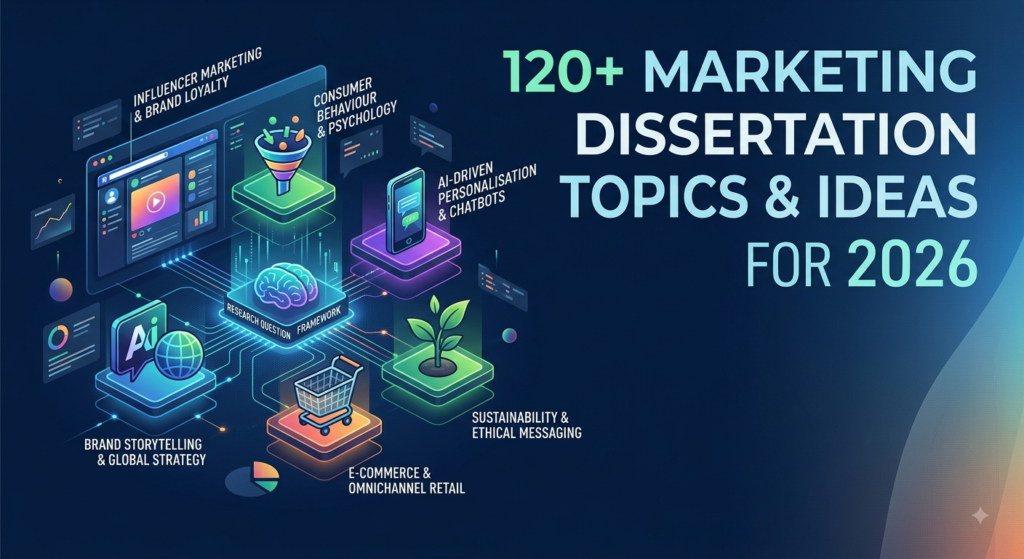
A strong marketing topic is specific, researchable with data you can realistically gather, and tied to a current shift in how brands reach and keep customers. This guide gives more than 120 marketing dissertation topics for 2026, grouped by field, from digital and social media marketing to consumer behaviour, branding, retail and sustainability. The featured topics below each come with a research aim to help you turn an idea into a clear question. Featured marketing dissertation topics with research aims These 14 topics span the main areas of marketing. Each includes a short research aim showing what the study would set out to do. 1. The Effect of Social Media Marketing on Brand Loyalty Research aim: This study investigates how social media engagement influences brand loyalty among a chosen customer group, aiming to identify which activities most strengthen the customer relationship. 2. Influencer Marketing and Purchase Intention Research aim: This study examines how influencer credibility and content affect purchase intention, aiming to identify which influencer characteristics most drive consumer action. 3. Personalisation and the Customer Experience Research aim: This study evaluates the effect of personalised marketing on customer experience and trust, aiming to establish where personalisation adds value and where it feels intrusive. 4. The Impact of Online Reviews on Consumer Trust Research aim: This study analyses how online reviews shape consumer trust and choice, aiming to identify which review characteristics most influence buying decisions. 5. Green Marketing and Consumer Scepticism Research aim: This study investigates how consumers respond to green marketing claims, aiming to identify the factors that build or undermine trust in sustainability messaging. 6. Content Marketing Effectiveness for Small Businesses Research aim: This study evaluates how content marketing affects engagement and lead generation for small firms, aiming to identify the most cost-effective content approaches. 7. Emotional Branding and Consumer Decisions Research aim: This study examines how emotional branding influences consumer decision-making, aiming to identify which emotional appeals most strengthen brand preference. 8. The Role of AI-Driven Recommendation Systems in E-Commerce Research aim: This study analyses how recommendation systems affect online purchasing behaviour, aiming to assess their effect on conversion and customer satisfaction. 9. Omnichannel Marketing and the Customer Journey Research aim: This study evaluates how omnichannel strategies affect the customer journey, aiming to identify how brands create a seamless experience across touchpoints. 10. Cause-Related Marketing and Brand Perception Research aim: This study investigates how cause-related campaigns affect brand perception, aiming to assess when social causes strengthen rather than dilute a brand. 11. Consumer Behaviour and the Cost of Living Crisis Research aim: This study analyses how the cost of living crisis has changed consumer spending, aiming to identify how brands can adapt their value proposition. 12. Social Media Advertising and Ad Fatigue Research aim: This study examines the effect of ad frequency on engagement and ad fatigue, aiming to identify the point at which social advertising loses effectiveness. 13. Brand Storytelling and Customer Engagement Research aim: This study evaluates how brand storytelling affects customer engagement, aiming to identify the narrative elements that most resonate with audiences. 14. The Effect of User-Generated Content on Brand Trust Research aim: This study investigates how user-generated content influences brand trust and purchase intention, aiming to assess its value compared with brand-produced content. How do you choose a marketing dissertation topic? Start with the area of marketing you find most interesting, then test each idea against three practical checks. Once you have a shortlist, sketch each idea into a rough aim, as the featured topics above do, and see which holds up. For related business themes, our business dissertation topics hub is a useful companion, and our assignment structure guide keeps the write-up clear. Digital marketing dissertation topics Social media and influencer marketing dissertation topics Consumer behaviour dissertation topics Branding dissertation topics Content marketing and SEO dissertation topics Retail and e-commerce dissertation topics Advertising dissertation topics Services and relationship marketing dissertation topics Sustainability and international marketing dissertation topics AI and marketing technology dissertation topics B2B, analytics and experiential marketing dissertation topics Marketing analytics and metrics Experiential and emerging marketing How do you turn a marketing topic into a research question? A topic is a theme; a research question is something you can answer with evidence. Take one idea above, fix the audience, platform and outcome, and decide whether you are describing a relationship, comparing groups or evaluating a campaign. Much marketing research works well as a consumer survey, a content analysis or a focused case study. Our business dissertation topics hub covers overlapping themes, and our assignment structure guide keeps the writing clear. Ready to take your dissertation further? Get specialist support. From refining your research question and literature review to methodology, analysis and final structure, dissertation work requires careful planning at every stage. Explore our dissertation writing support for your research project. Explore dissertation writing support Frequently asked questions How do I choose a marketing dissertation topic? Pick an area of marketing you find interesting, then check you can realistically gather the data. Narrow the theme to a single question set around one brand, platform or audience, tied to a current shift in the field. Should a marketing dissertation use primary or secondary research? Both are common. Primary studies use consumer surveys, interviews or experiments; secondary studies use published market data and content analysis. Choose the approach your question needs and confirm any ethics requirements with your programme. What are good marketing dissertation topics for 2026? Strong current areas include AI-driven personalisation, influencer and social commerce, sustainability messaging, short-form video, and consumer behaviour during the cost of living crisis. Each of the featured topics above sets out a ready research aim. Can I get help with my marketing dissertation? Yes. If you would like a subject expert to help you shape a topic, gather the evidence and structure the work, our MBA assignment writing help and dissertation writing help services provide that guided support.
Finance and Accounting Dissertation Topics You Can Actually Research

A strong finance or accounting dissertation topic uses data you can actually access, usually public company reports or market data, and applies a financial model to answer a clear question. The best current areas are ESG and financial performance, fintech, risk management, and corporate governance. Narrow each to a sector and a time period. Finance and accounting dissertations often worry students more than other subjects, not because the topics are impossible, but because they need precision and confidence with data. Many students start with a vague idea like studying financial performance, then realise the topic feels too broad and the data feels overwhelming. The fix is to choose a topic built around data you can genuinely reach. What makes a good finance dissertation topic? The single biggest factor is data access. A finance dissertation lives or dies on whether you can get the numbers, so the best topics are built around data that is public and reliable. 45 finance and accounting dissertation topics for 2026 Grouped by area, with research questions on several. Every one is built around data you can realistically reach. Narrow each to a sector and a time period before you start. ESG and sustainable finance Fintech and digital finance Risk management Corporate governance and reporting Investment and markets Corporate finance Accounting and audit Banking and public finance Do you need to be good at statistics? This worries finance students more than almost anything, but the honest answer is reassuring. You need to be comfortable with the specific methods your question uses, not an expert in all of statistics. Most undergraduate and master’s finance dissertations use a small set of techniques, such as regression, ratio analysis, and comparison over time. You can learn the ones you need well rather than trying to master everything. What matters more than advanced maths is choosing a method that suits your data and explaining clearly why you used it and what it can and cannot show. A simple method applied correctly beats a complex one applied badly, every time. Where do you get finance dissertation data? Data source What it gives you Annual reports Company financials, free from investor relations pages Stock market databases Share prices and returns over time Published financial databases Ratios and comparisons across many firms Central bank and government data Interest rates, inflation, and economic indicators Most of this is public and reliable, which is why secondary data works so well for finance dissertations. You rarely need to run your own fieldwork. Why does data access decide a finance topic? In finance more than any other subject, the data decides the dissertation. A brilliant question with no reachable data is worthless, while a solid question backed by clean public data can produce an excellent piece of work. This is why experienced supervisors tell finance students to confirm the data source before finalising the topic. Check that the companies you want to study publish the figures you need, that the time period you want is covered, and that you can access any database your method relies on. Once you know the data is there, the rest of the dissertation becomes far more predictable, because you are analysing figures rather than hunting for them. How do you turn a finance topic into a question? Add a sector, a measure, and a time period. Studying financial performance is not answerable. Whether ESG scores predicted profitability among UK listed retailers between 2020 and 2025 is a dissertation, because it names what you will measure, where, and when. Most finance dissertations rely on existing data, so the choice between fieldwork and secondary sources is usually easy, but primary versus secondary research covers it if you are unsure. What methods do finance dissertations use? Finance and accounting dissertations lean heavily on quantitative methods, because the data is numerical and the questions are about relationships between figures. A few approaches cover most projects. Pick the method your question needs, and make sure you have enough data points to support it. A regression on a handful of firms will not hold up. What are common mistakes in finance dissertations? Finance dissertations fail for a small set of predictable reasons, most of them about data and scope. The strongest protection is to confirm your data source before you commit to the topic. In finance, the data decides the dissertation. How do you avoid the most common finance dissertation trap? The most common trap is starting with a method or a dataset instead of a question. A student finds an interesting database, decides to use it, then tries to invent a question to fit. This almost always produces a weak dissertation, because the question is an afterthought rather than the driver. The better order is always question first, then data, then method. Decide what you genuinely want to find out, check that the data to answer it exists and is reachable, then choose the method that suits both. This keeps your dissertation focused on a real financial question rather than on showing off a technique. It also makes your analysis chapter far easier to write, because every number you produce is there to answer a question you actually care about. Ready to take your dissertation further? Get specialist support. From refining your research question and literature review to methodology, analysis and final structure, dissertation work requires careful planning at every stage. Explore our dissertation writing support for your research project. Explore dissertation writing support Frequently asked questions What is a good finance dissertation topic? One built around data you can access, usually public company reports or market data, that applies a financial model to a clear question. ESG, fintech, risk, and governance are strong current areas. Where do I get data for a finance dissertation? Annual reports, stock market databases, published financial databases, and central bank data are all public and reliable. Most finance dissertations use this secondary data. Do I need to collect my own data? Usually not. Finance and accounting dissertations mostly use existing
120+ Business Dissertation Topics and Ideas for 2026

A strong business topic is specific, researchable with data you can realistically gather, and tied to a current management challenge. This guide gives more than 120 business dissertation topics for 2026, grouped by field, from strategy and marketing to HR, operations, finance, entrepreneurship and sustainability. The featured topics below each come with a research aim to help you turn an idea into a clear question. Featured business dissertation topics with research aims These 14 topics span the main areas of business and management. Each includes a short research aim showing what the study would set out to do. 1. Corporate Strategy and Firm Performance in a Chosen Sector Research aim: This study examines how competitive strategy choices relate to performance across firms in one sector, aiming to identify which strategic postures deliver the strongest results. 2. The Effect of Social Media Marketing on Brand Loyalty Research aim: This study investigates how social media engagement influences brand loyalty among a chosen customer group, aiming to identify which activities most strengthen the customer relationship. 3. Remote Working and Employee Productivity Research aim: This study evaluates the effect of remote and hybrid working on productivity and engagement, aiming to identify the conditions under which flexible working succeeds. 4. Supply Chain Resilience After Recent Disruption Research aim: This study analyses how firms have rebuilt supply chain resilience after recent global disruption, aiming to identify the strategies that best reduce vulnerability. 5. Barriers to Growth for Small and Medium-Sized Enterprises Research aim: This study investigates the main barriers SMEs face when scaling, aiming to identify the internal and external factors that most constrain their growth. 6. Transformational Leadership and Employee Motivation Research aim: This study examines the relationship between transformational leadership and employee motivation, aiming to establish which leader behaviours most influence engagement. 7. The Impact of Corporate Social Responsibility on Consumer Choice Research aim: This study evaluates whether CSR activity affects consumer purchasing decisions, aiming to assess how far ethical positioning translates into commercial advantage. 8. Digital Transformation in Traditional Businesses Research aim: This study investigates how established firms adopt digital technologies, aiming to identify the factors that make digital transformation succeed or fail. 9. Employer Branding and Talent Retention Research aim: This study examines how employer branding influences the attraction and retention of talent, aiming to identify the practices that most improve retention. 10. Consumer Behaviour and the Cost of Living Crisis Research aim: This study analyses how the cost of living crisis has changed consumer spending, aiming to identify how brands can adapt their value proposition. 11. Agile Working and Organisational Performance Research aim: This study evaluates the adoption of agile ways of working beyond software teams, aiming to assess their effect on organisational responsiveness and performance. 12. The Role of Innovation in Competitive Advantage Research aim: This study examines how innovation capability contributes to competitive advantage in a chosen industry, aiming to identify what sustains an innovative firm. 13. Sustainability Strategy and Firm Value Research aim: This study investigates the link between corporate sustainability strategy and firm value, aiming to assess whether sustainability is a cost or a source of advantage. 14. Artificial Intelligence and the Future of Management Decision-Making Research aim: This study explores how managers use AI-driven analytics in decision-making, aiming to identify the factors that drive trust and effective adoption. How do you choose a business dissertation topic? Start with the area of business you find most interesting, then test each idea against three practical checks. Once you have a shortlist, sketch each idea into a rough aim, as the featured topics above do, and see which holds up. If you are studying at postgraduate level, our MBA assignment guide covers overlapping strategy themes, and our assignment structure guide keeps the write-up clear. Strategy and management dissertation topics Marketing dissertation topics Human resource management dissertation topics Operations and supply chain dissertation topics Entrepreneurship and small business dissertation topics International business dissertation topics Finance and accounting dissertation topics Leadership and organisational behaviour dissertation topics Digital business and e-commerce dissertation topics Sustainability, CSR and business ethics dissertation topics Project management and business analytics dissertation topics How do you turn a business topic into a research question? A topic is a theme; a research question is something you can answer with evidence. Take one idea above, fix the population, setting and outcome, and decide whether you are describing a relationship, comparing groups or evaluating an intervention. Much business research works well as a case study or a focused survey supported by company data. Our MBA assignment guide covers overlapping frameworks, and our assignment structure guide keeps the writing clear. Ready to take your dissertation further? Get specialist support. From refining your research question and literature review to methodology, analysis and final structure, dissertation work requires careful planning at every stage. Explore our dissertation writing support for your research project. Explore dissertation writing support Frequently asked questions How do I choose a business dissertation topic? Pick an area of business you find interesting, then check you can realistically gather the data. Narrow the theme to a single question set in one company, sector or group, tied to a current management challenge. Should a business dissertation use primary or secondary research? Both are common. Secondary studies use published company and market data; primary studies use surveys, interviews or a case study. Choose the approach your question needs and confirm any ethics requirements with your programme. What are good business dissertation topics for 2026? Strong current areas include remote and hybrid working, AI in management decision-making, supply chain resilience, sustainability strategy, and consumer behaviour during the cost of living crisis. Each of the featured topics above sets out a ready research aim. Can I get help with my business dissertation? Yes. If you would like a subject expert to help you shape a topic, gather the evidence and structure the work, our MBA assignment writing help and dissertation writing help services provide that guided support.
110+ Nursing Dissertation Topics and Ideas for 2026

A strong nursing dissertation topic is specific, researchable in the time you have, and tied to current practice or policy. Below are more than 110 nursing dissertation ideas grouped by field, from adult and mental health nursing to public health, leadership and digital care, each written so you can shape it into a clear research question. How do you choose a good nursing dissertation topic? Start with a field you can stay interested in for months, because momentum matters more than a clever title. Then check three things before you commit. First, can you actually get the data? Many undergraduate nursing dissertations are secondary studies or literature reviews precisely because primary research in a clinical setting needs NHS or university ethics approval that can take longer than your timetable allows. Our guide on primary versus secondary research explains which route suits your question. Second, is the topic narrow enough to answer well, rather than a whole field you could never cover? Third, does it connect to something current, an NMC standard, a workforce pressure, a piece of policy, so your work feels relevant. Once you have a shortlist, sketch each one into a rough aim and see which holds up. The guides on writing a dissertation proposal and writing a nursing essay will help you test whether an idea has the shape of a real research question, and our wider healthcare assignment guide covers the academic conventions markers expect. Adult nursing dissertation topics Nurse decision making in the deteriorating adult patient: a literature review Mental health nursing dissertation topics Working on a nursing paper or assignment? Get subject-specific support. Nursing coursework often requires clinical reasoning, evidence-based research and accurate academic referencing. Explore our nursing paper writing support for university-level nursing work. Explore nursing paper writing help Child, paediatric and neonatal nursing dissertation topics Midwifery and maternal health dissertation topics Community, primary care and public health nursing topics Looking for Academic Support? Whether you are working on an essay, coursework, dissertation, presentation or subject specific assignment, having the right support can make the process easier. DoMyWork provides academic writing and research support for students across different levels and subject areas. Explore coursework writing help, essay writing help, dissertation writing help, or our assignment writing service depending on the type of work you are preparing. Older adult, dementia and end of life care topics Critical care, emergency and acute nursing topics Nursing leadership, workforce and education topics Patient safety, ethics and quality improvement topics Need Support With Your Nursing Assignment? Working on a nursing paper or university assignment? Explore Nursing Paper Writing Help from DoMyWork for additional academic writing and research support. Digital health, technology and innovation in nursing topics Chronic illness and long-term conditions topics How do you turn a topic into a research question? A topic is a subject; a research question is something you can answer with evidence. Take one idea above and narrow it by population, setting and outcome, then decide whether you are describing, comparing or evaluating. A structure like PICO, which sets out the population, intervention, comparison and outcome, turns a broad interest into a focused question a marker can follow. From there, a scoping search of the literature will show whether enough has been published to support a review, which is the point our literature review guide picks up. When you reach the design stage, our dissertation methodology guide walks through choosing and justifying your approach, and if you want ideas beyond nursing, our 150 dissertation topics guide covers the wider subjects. Ready to take your dissertation further? Get specialist support. From refining your research question and literature review to methodology, analysis and final structure, dissertation work requires careful planning at every stage. Explore our dissertation writing support for your research project. Explore dissertation writing support How do I choose a nursing dissertation topic? Pick a field you can stay interested in, check that you can realistically access the data, and narrow it to a single researchable question tied to current practice or policy. Testing each idea against a rough aim quickly shows which one holds up. Should my nursing dissertation be primary or secondary research? Many nursing dissertations, especially at undergraduate level, are secondary studies or literature reviews, because primary research in clinical settings needs ethics approval that can take longer than your timetable allows. Confirm what your programme expects before you commit. How long is a nursing dissertation? Length varies by level and university, but undergraduate nursing dissertations are commonly around 8,000 to 12,000 words and master’s dissertations longer. Always work to the word count in your own module handbook. Can I get help with my nursing dissertation? Yes. If you would like a subject expert to help you shape a topic, structure the work and reference it properly, our nursing paper writing help and dissertation writing help services are built around exactly that kind of guided support.