140 Communication Research Topics (2026)
A strong communication research topic focuses on how messages are created, shared or received in a specific context, and is narrow enough to study with evidence. Fruitful areas include interpersonal, mass media and journalism, digital and social media, organisational, intercultural, health and political communication. Narrow a broad theme to a researchable question. Communication studies spans everything from a private conversation to a global media campaign, so the field is rich but easy to get lost in. The best research topics focus on how communication works in a specific setting and what shapes its effect, which means the choice of method matters early, since analysing media content, surveying an audience and interviewing people answer very different questions, a distinction our qualitative vs quantitative research guide helps you weigh. This guide gives 140 topics grouped by area, then shows how to turn one into a research question. What makes a good communication research topic? A strong communication topic focuses on a specific relationship, such as how a type of message affects a particular audience, rather than a whole medium. It is grounded in communication theory and existing studies, so reading around your area first, much as you would when writing a literature review, is what reveals the gap your work can fill. And it is researchable in practice: you need to be able to reach the media, data or people the question requires, whether that means a set of adverts to analyse, an audience to survey, or professionals to interview. Narrow a broad interest such as ‘social media’ to a specific platform, group and effect, and the topic becomes something you can actually study. 140 communication research topics by area The topics below are grouped by area. Narrow any of them to a specific medium, group or setting you can study. Interpersonal communication Mass media and journalism Digital and social media Organisational communication Intercultural communication Health communication Political and persuasive communication Advertising and public relations Nonverbal communication and language Media effects and audiences How do you turn a topic into a research question? A topic is a starting area; a research question is what your study answers, so the next step is to sharpen one into the other. Focus your theme onto a specific medium, group or setting, and phrase it as a question evidence can answer, so ‘social media and politics’ becomes ‘how does exposure to political content on TikTok affect voting intention among first-time UK voters?’. From there you decide what evidence you need, whether that means analysing content, surveying audiences or interviewing people, and whether you draw on primary or secondary sources, then set the plan out in a research proposal. Grounding the question in communication theory is what makes it research rather than commentary. Choosing the right topic for your assignment With 140 options above, evidence and fit decide it. Favour a topic where you can reach the media, data or people it needs, since a question you cannot gather evidence for is not workable however interesting. Check it suits your course and the length you have been set, and narrow it to a specific context you can study. Once your question is set, the paper still needs a clear structure and an argument that analyses rather than describes, which our critical writing guide helps you build. Whichever area you choose above, the principle is the same: narrow it, match the method to it, and let the analysis carry the work.
How to Avoid Plagiarism: A Student’s Guide (2026)
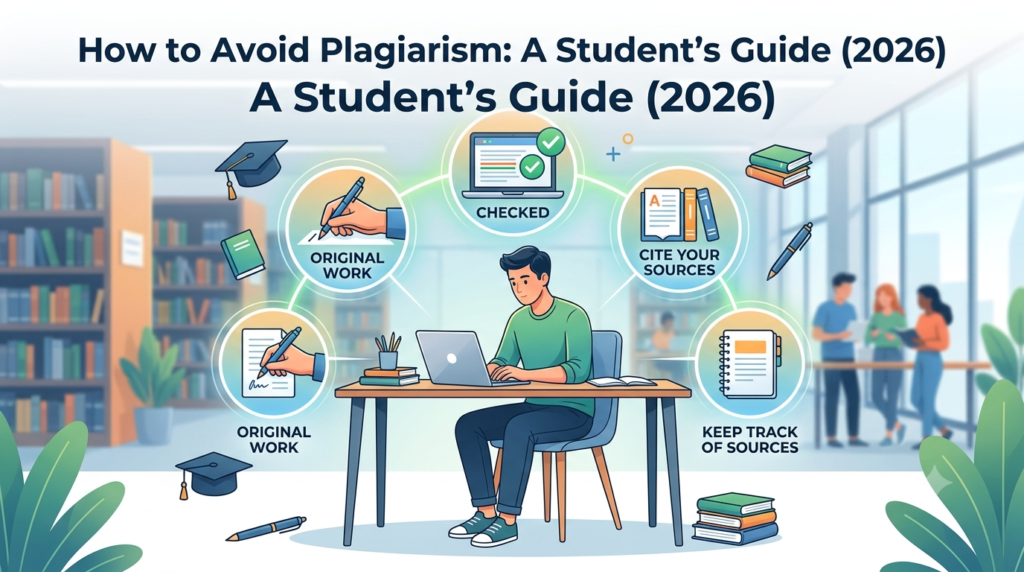
To avoid plagiarism, cite every source you use, paraphrase and quote properly, keep careful track of where your material comes from, and check your work before submitting. Plagiarism is presenting someone else’s words or ideas as your own, and most of it is accidental, caused by poor referencing rather than deliberate cheating. Plagiarism is one of the most serious academic offences, and one of the easiest to commit by accident. Most students who are penalised never set out to cheat; they simply referenced carelessly, paraphrased too closely, or lost track of which notes were their own words and which were copied. The good news is that avoiding plagiarism is a set of habits you can learn, not a matter of luck. This guide explains what plagiarism is, the different forms it takes, and the practical steps that keep your work original and properly credited, so you can use other people’s research confidently while keeping your integrity, and your marks, intact. What is plagiarism? Plagiarism is presenting someone else’s words, ideas or work as your own, whether on purpose or by accident. It covers copying text without quotation marks, using an idea without crediting its source, paraphrasing too closely, and even reusing your own previously submitted work. The key point is that it is about credit, not just copying: if a thought, finding or argument came from somewhere else and you do not say so, that is plagiarism, even if you have reworded it. Universities treat it as a form of academic misconduct because academic work is meant to show your own understanding, built openly on the work of others with proper acknowledgement. Understanding that it hinges on giving credit, not on intent, is the first step to avoiding it. What are the types of plagiarism? Plagiarism takes several forms, and most accidental cases fall into the middle of this list rather than the obvious first one. The table sets them out. Type What it is Direct plagiarism Copying text word for word without quotation marks or a citation Mosaic or patchwriting Changing a few words while keeping the source’s structure and phrasing Improper paraphrasing Restating an idea but staying too close to the original, or without a citation Uncited ideas Using someone’s idea, data or argument without crediting them, even in your own words Self-plagiarism Reusing your own previously submitted work without permission or acknowledgement Accidental plagiarism Any of the above caused by careless note-taking or referencing rather than intent Notice how few of these involve deliberate copying. The common thread is a failure to give proper credit, which is exactly why good referencing habits, rather than good intentions, are what actually protect you. A student who tracks sources carefully and cites everything is very unlikely to plagiarise, whatever their intentions; one who is casual about references can plagiarise despite meaning well. How do you avoid plagiarism? Avoiding plagiarism comes down to a handful of reliable habits. Build these into how you work and the risk largely takes care of itself. The habit that prevents the most accidental plagiarism is tracking sources as you go. Most careless plagiarism happens when a student cannot later remember whether a note was their own thought or copied from a source, so recording the origin of every note as you take it removes the problem at the root. Paraphrasing well is the other core skill, and our how to paraphrase guide covers exactly how to restate an idea without staying too close to the original. Does paraphrasing count as plagiarism? Not when it is done properly and cited. Paraphrasing is a legitimate and expected academic skill: restating someone else’s idea in your own words is exactly how you are meant to use most of your sources. It becomes plagiarism only in two situations: when the paraphrase stays too close to the original wording or structure, which is patchwriting, or when you leave out the citation, so the idea appears to be your own. Restate the idea fully in your own language and credit the source, and a paraphrase is not only allowed but encouraged. Getting this right is one of the most effective ways to avoid plagiarism, because paraphrasing is how most evidence enters an essay in the first place. How do you cite sources to avoid plagiarism? Accurate citation is the mechanical heart of avoiding plagiarism, so it is worth doing carefully. Every time you use a source, you give an in-text citation at the point of use and a full entry in your reference list, following the style your course requires. The two must match: every in-text citation needs a reference list entry, and vice versa. Our how to cite sources guide covers the general principles, and if your course uses Harvard, our Harvard referencing guide shows the exact formats. Using a reference manager to record sources as you find them makes this far easier and cuts the risk of a missing citation slipping through. What is self-plagiarism? Self-plagiarism is reusing your own previously submitted work in a new assignment without permission or acknowledgement, and it surprises many students, who assume their own writing is always fair to reuse. Submitting the same essay for two modules, or recycling large sections of a past assignment, can breach academic rules because each piece of work is meant to be produced fresh for its purpose. If you want to build on your earlier work, the safe approach is to ask your tutor whether it is allowed and to acknowledge the earlier piece. Treating your own past submissions as sources to be cited, rather than material to quietly reuse, keeps you on the right side of the rules. How do universities detect plagiarism? Universities use text-matching software, such as Turnitin, which compares your work against a large database of published sources, web pages and previously submitted student work, and highlights matching passages. It is important to understand what this means: the tool does not exist to be outwitted, and the way to produce a clean
130 Compare and Contrast Essay Topics (2026)
A compare and contrast essay examines the similarities and differences between two subjects and what those reveal. The best topics pair two things that are genuinely comparable but different enough to be interesting. Strong areas include literature, history, science, society, business, psychology and the arts. Choose a pair with a real basis for comparison, then analyse what the differences mean. A compare and contrast essay is one of the most common assignments across school and university, and the topic decides how well it can go. The two subjects have to share enough common ground to be worth comparing, yet differ enough to give you something to say, and the marks come from analysing what those differences mean rather than simply listing them, which is the same move from description to analysis that our critical writing guide develops. This guide gives 130 paired topics grouped by subject, then shows how to pick a pair and build the essay. What makes a good compare and contrast pair? The strongest pairs sit in the same broad category but differ in a meaningful way, so there is a genuine basis for comparison and a real point to draw out. A few examples show the idea: Avoid pairs that are so different they share no basis for comparison, or so similar there is nothing to contrast. A good pair lets you move past listing differences into arguing what they reveal, which is where the essay earns its marks. 130 compare and contrast essay topics by subject Each pair below is a starting point. Sharpen it around the specific angle you want to argue. Literature and language History and politics Science and technology Society and culture Business and economics Education and lifestyle Psychology, philosophy and the arts Media, sport and daily life How to structure a compare and contrast essay Once you have your pair, the structure is what makes the comparison land. Decide your basis for comparison first, the specific points you will weigh both subjects against, and state your overall line in a clear thesis statement so the reader knows what the comparison is for. Then choose one of two structures and hold it throughout: point by point, alternating between the two subjects for each criterion, or subject by subject, covering one fully and then the other. Whichever you pick, keep the essay organised around your points rather than letting it drift, which is where the wider principles in our how to structure an assignment guide help. Above all, analyse rather than list: for every similarity or difference, say what it reveals, because that analysis is the difference between a description and an argument, and it is what earns the marks. Choosing the right pair for your essay With 130 pairs above, choose on two grounds: a genuine basis for comparison, and your own interest. A pair you find interesting is easier to write well, and a pair with a real point of tension gives you something to argue rather than merely describe. Check the pair that suits your subject and the length you have been set, then narrow it to the specific angle you want to explore, since ‘two leadership styles’ becomes far stronger as ‘why transformational leadership suits startups better than a transactional style’. Whichever pair you choose, the same rule applies throughout: pick a comparison with real tension, and let your analysis of the differences, not a list of them, carry the essay.
Economics Dissertation Topics: 110+ Ideas with Research Aims (2026)
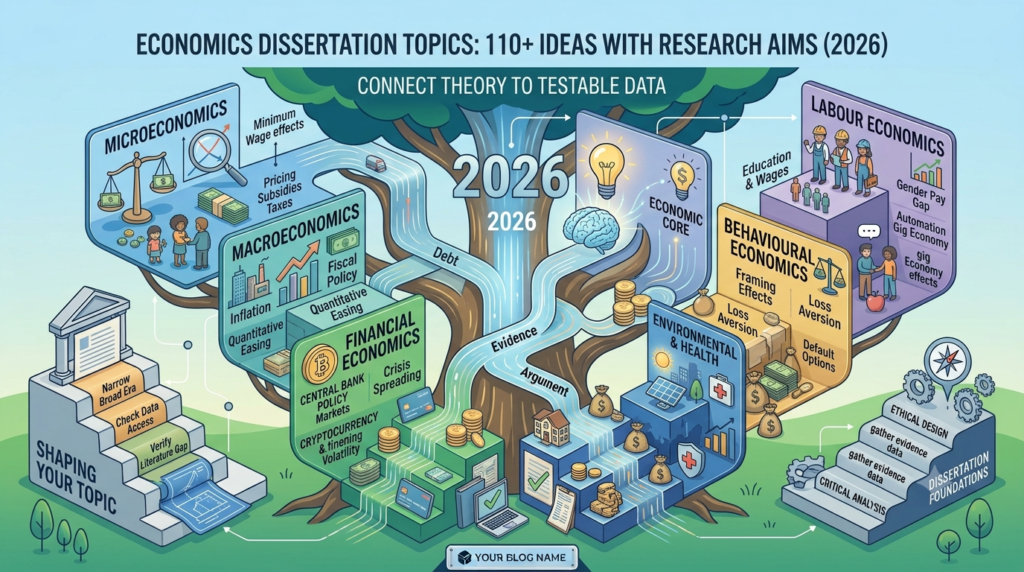
A strong economics dissertation topic is specific, researchable and current, focused on a clear relationship you can test, usually with existing data. Fruitful areas include micro and macroeconomics, labour, financial, behavioural, environmental and health economics, and public policy. This guide gives 110+ topics with six developed examples and a method for shaping any idea into a research question. Choosing an economics dissertation topic is the first real decision of your project, and it shapes everything that follows. Economics is a broad and data-driven field, so the best topic is not the most ambitious but the one you can research well: focused on a specific relationship, testable with data you can obtain, and connected to a current issue. Because so much economics research relies on existing datasets, the choice of data and method matters early, and our primary vs secondary research guide helps you weigh whether a public dataset will serve your question better than gathering your own. This guide walks through how to choose, develops six topics to full aim-and-objectives level, then lists more than 110 further ideas grouped by area. How do you choose a strong economics dissertation topic? A good topic meets several conditions at once. It should be relevant to your course and current, interesting enough to sustain you for months, and narrow enough to answer within a dissertation. Above all it must be researchable in practice, and in economics that usually means data: a topic is only workable if the figures you need exist and you can access them, whether from national statistics, central banks or established datasets. A strong topic also addresses a live debate or a gap, which reading recent studies, much as you would when writing a literature review, helps you find. The most common mistake is choosing something too broad: ‘inflation’ is a field, while ‘how inflation affects consumer spending in the UK since 2020’ is a question you can investigate with data. Six developed economics dissertation topics (with aims and objectives) The six topics below are worked to the level your proposal will need, each with a research aim and three objectives, so you can see how a broad idea becomes a defined study. 1. The impact of minimum wage increases on employment Research aim: To examine how increases in the minimum wage affect employment levels in low-wage sectors. 2. How inflation affects consumer spending Research aim: To investigate how changes in inflation affect patterns of consumer spending. 3. The relationship between education and economic growth Research aim: To analyse how investment in education affects economic growth. 4. How environmental policy affects economic outcomes Research aim: To examine how environmental policy affects economic outcomes such as growth and employment. 5. The effect of interest rate changes on investment Research aim: To investigate how changes in interest rates affect business investment. 6. How behavioural biases affect economic decisions Research aim: To examine how behavioural biases affect the economic decisions of individuals. 110+ economics dissertation topics by area The ideas below are grouped by sub-area. Treat each as a starting point to narrow around a specific context and dataset. For related fields, see our business dissertation topics and management dissertation topics guides. Microeconomics Macroeconomics International and development economics Labour economics Financial and monetary economics Behavioural economics Environmental economics Health economics Public economics and policy Economic growth and productivity Applied and current issues What makes a strong economics dissertation topic? Beyond meeting the practical conditions above, the strongest topics share a clear angle. They focus on a specific relationship, such as how one variable affects another, rather than describing a broad area, which gives you something to test rather than summarise. They are grounded in a definable context, a country, a period or a market, which keeps the scope manageable and, crucially in economics, the data available. And they connect to a current issue or a gap in the literature, which gives the work relevance. A topic that combines a focused relationship, a clear context and available data will nearly always make a stronger dissertation than a broad or descriptive one. How do you turn a topic into a research question? A topic is a starting area; a research question is what your dissertation answers, so the next step is to sharpen one into the other. Take your chosen area, add a specific context and a relationship to investigate, and phrase it as a question data can answer, so ‘inflation’ becomes ‘how has inflation affected consumer spending in the UK since 2020?’. In economics, the availability of data usually decides feasibility, so identify your dataset early, and because most economics dissertations are empirical, our qualitative vs quantitative research guide helps you frame the analysis before you set the plan out in a research proposal. Grounding the question in economic theory is what turns it into research rather than commentary. Tips for refining your topic Once you have a topic and question, the next steps are designing the analysis and organising the write-up. Our how to write a dissertation methodology guide covers the research design, and our how to structure an assignment guide helps you organise the whole piece. Before you submit, it is worth checking your own finished draft for originality, which you can do with our plagiarism check. Whichever area you choose above, the same principle holds throughout: narrow the topic, secure the data, and let a clear, evidenced analysis carry the work.
Education Dissertation Topics: 110+ Ideas with Research Aims (2026)
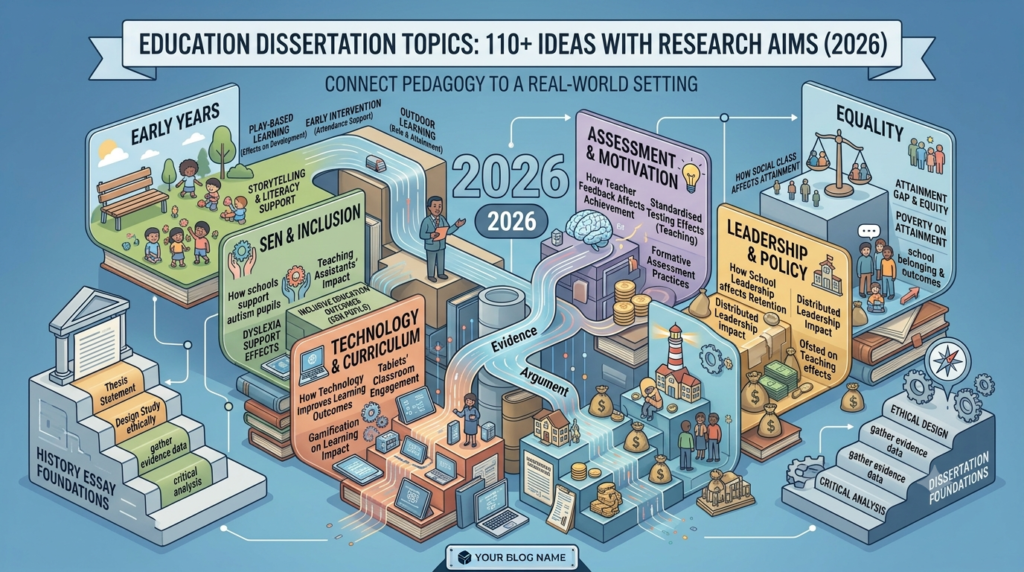
A strong education dissertation topic is specific, researchable and current, focused on a clear relationship you can study in a real educational setting. Fruitful areas include early years, pedagogy, assessment, special educational needs, educational technology, leadership and policy. This guide gives 110+ topics with six developed examples and a method for shaping any idea into a research question. Choosing an education dissertation topic is the first real decision of your project, and it shapes everything that follows. Education is a broad, practice-based field, so the best topic is not the most ambitious but the one you can research well: focused on a specific relationship, grounded in a setting you can access, and connected to a current issue. Access matters a great deal here, since much education research involves schools, teachers or learners, and the choice between measuring outcomes and understanding experiences shapes the whole design, which our qualitative vs quantitative research guide helps you weigh. This guide walks through how to choose, develops six topics to full aim-and-objectives level, then lists more than 110 further ideas grouped by area. How do you choose a strong education dissertation topic? A good topic meets several conditions at once. It should be relevant to your course and current, interesting enough to sustain you for months, and narrow enough to answer within a dissertation. Above all it must be researchable in practice, which in education usually means access to a setting: a topic is only workable if you can reach the pupils, teachers or schools it needs, and any research involving children raises ethical requirements you must plan for. A strong topic also addresses a live issue or a gap, which reading recent studies, much as you would when writing a literature review, helps you find. The most common mistake is choosing something too broad: ‘technology in education’ is a field, while ‘how tablet use affects reading engagement in Year 3 pupils’ is a question you can investigate. Six developed education dissertation topics (with aims and objectives) The six topics below are worked to the level your proposal will need, each with a research aim and three objectives, so you can see how a broad idea becomes a defined study. 1. The impact of technology on student learning outcomes Research aim: To examine how the use of digital technology in the classroom affects student learning outcomes. 2. How teacher feedback affects student achievement Research aim: To investigate how the quality of teacher feedback affects student achievement. 3. The effect of inclusive education on outcomes for SEN pupils Research aim: To analyse how inclusive education affects the outcomes of pupils with special educational needs. 4. How parental involvement affects academic achievement Research aim: To examine how parental involvement affects children’s academic achievement. 5. The impact of formative assessment on learning Research aim: To investigate how formative assessment affects student learning and progress. 6. How school leadership affects teacher retention Research aim: To examine how school leadership affects the retention of teachers. 110+ education dissertation topics by area The ideas below are grouped by sub-area. Treat each as a starting point to narrow around a setting and group you can access. The universal skills of designing and writing up research apply across all of them, and our how to structure an assignment guide helps with the write-up. Early years and primary education Secondary education Higher education Special educational needs and inclusion Educational technology Curriculum and assessment Teaching and pedagogy Educational leadership and management Equality, diversity and access Student wellbeing and behaviour Education policy and current issues What makes a strong education dissertation topic? Beyond meeting the practical conditions above, the strongest topics share a clear angle. They focus on a specific relationship, such as how one practice affects a learning outcome, rather than describing a broad area, which gives you something to study rather than summarise. They are grounded in a definable setting, a key stage, a subject, a type of school or group of learners, which keeps the scope manageable and the access realistic. And they connect to a current issue in education or a gap in the literature, which gives the work relevance. A topic that combines a focused relationship, a clear setting and realistic access will nearly always make a stronger dissertation than a broad or descriptive one. How do you turn a topic into a research question? A topic is a starting area; a research question is what your dissertation answers, so the next step is to sharpen one into the other. Take your chosen area, add a specific setting and a relationship to investigate, and phrase it as a question evidence can answer, so ‘technology in education’ becomes ‘how does tablet use affect reading engagement among Year 3 pupils?’. From there you decide what evidence you need and whether you will gather it yourself or draw on existing data, a choice our primary vs secondary research guide helps you make, remembering that research with children needs ethical approval, then set the plan out in a research proposal. Grounding the question in educational theory is what turns it into research rather than opinion. Tips for refining your topic Once you have a topic and question, the next steps are designing the study and organising the write-up. Our how to write a dissertation methodology guide covers the research design, including the ethics of researching in schools. Before you submit, it is worth checking your own finished draft for originality, which you can do with our plagiarism check. Whichever area you choose above, the same principle holds throughout: narrow the topic, secure your access, and let a clear, evidenced study carry the work.
Entrepreneurship Dissertation Topics: 110+ Ideas with Research Aims (2026)
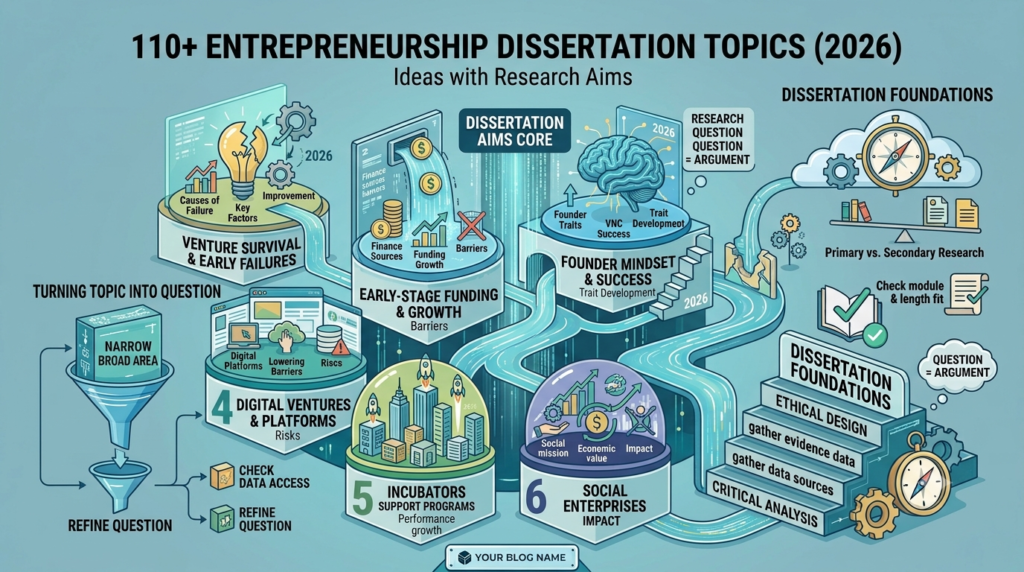
A strong entrepreneurship dissertation topic is specific, researchable and current, focused on a clear relationship you can test with data you can access. Fruitful areas include starting and funding ventures, the entrepreneurial mindset, small business growth, social, digital and technology entrepreneurship. This guide gives 110+ topics with six developed examples and a method for shaping any idea into a research question. Choosing an entrepreneurship dissertation topic is the first real decision of your project, and it shapes everything that follows. Entrepreneurship spans everything from a founder’s mindset to the funding of a venture, so the best topic is not the broadest but the one you can research well: focused on a specific relationship, grounded in a context you can reach, and connected to a current issue. That focus depends partly on an early decision about method, since entrepreneurship questions can call for interviews with founders, survey data, or existing datasets, a choice our qualitative vs quantitative research guide helps you weigh. This guide walks through how to choose, develops six topics to full aim-and-objectives level, then lists more than 110 further ideas grouped by area. How do you choose a strong entrepreneurship dissertation topic? A good topic meets several conditions at once. It should be relevant to your course and current, interesting enough to sustain you for months, and narrow enough to answer within a dissertation. Above all it must be researchable in practice: entrepreneurship research often relies on reaching founders and small business owners, who can be hard to access, so confirm that access before committing. A strong topic also usually addresses a gap or a live issue in the field, which reading recent studies, much as you would when writing a literature review, helps you find. The most common mistake is choosing something too broad: ‘start-up success’ is a field, while ‘how access to early-stage finance affects the growth of UK technology start-ups’ is a question you can investigate. Six developed entrepreneurship dissertation topics (with aims and objectives) The six topics below are worked to the level your proposal will need, each with a research aim and three objectives, so you can see how a broad idea becomes a defined study. 1. The factors influencing small business survival in the first five years Research aim: To identify the factors that most influence whether small businesses survive their first five years. 2. How access to finance affects start-up growth Research aim: To investigate how access to early-stage finance affects the growth of start-ups. 3. The role of the entrepreneurial mindset in venture success Research aim: To examine how an entrepreneurial mindset affects the success of new ventures. 4. How digital platforms enable new ventures Research aim: To analyse how digital platforms lower barriers to entry and enable new ventures. 5. The impact of incubators and accelerators on start-up performance Research aim: To evaluate how incubators and accelerators affect the performance of early-stage start-ups. 6. How social entrepreneurship creates social and economic value Research aim: To investigate how social enterprises balance and create social and economic value. 110+ entrepreneurship dissertation topics by area The ideas below are grouped by sub-area. Treat each as a starting point to narrow around a context and sample you can access. For related fields, see our business dissertation topics and management dissertation topics guides. Starting and funding a venture The entrepreneurial mindset and traits Small business growth and survival Innovation and technology entrepreneurship Social and sustainable entrepreneurship Digital and online entrepreneurship Entrepreneurial ecosystems and policy Women and minority entrepreneurship Family business and succession Failure, resilience and learning Entrepreneurial finance and strategy What makes a strong entrepreneurship dissertation topic? Beyond meeting the practical conditions above, the strongest topics share a clear angle. They focus on a specific relationship, such as how one factor affects a venture outcome, rather than describing a broad area, which gives you something to test rather than summarise. They are grounded in a definable context, a sector, a country, a type of founder or venture, which keeps the scope manageable and the data reachable. And they connect to a current issue or a gap in the literature, which gives the work relevance. A topic that combines a focused relationship, a clear context and a genuine gap will nearly always make a stronger dissertation than a broad or descriptive one. How do you turn a topic into a research question? A topic is a starting area; a research question is what your dissertation answers, so the next step is to sharpen one into the other. Take your chosen area, add a specific context and a relationship to investigate, and phrase it as a question evidence can answer, so ‘start-up funding’ becomes ‘how does access to early-stage finance affect the growth of UK technology start-ups?’. From there you decide what data you need and whether it is best gathered fresh or drawn from existing sources, a choice our primary vs secondary research guide helps you make, then set the plan out in a research proposal. Grounding the question in entrepreneurship theory is what turns it into research rather than commentary. Tips for refining your topic Once you have a topic and question, the next steps are designing the study and organising the write-up. Our how to write a dissertation methodology guide covers the research design, and our how to structure an assignment guide helps you organise the whole piece. Before you submit, it is worth checking your own finished draft for originality, which you can do with our plagiarism check. Whichever area you choose above, the same principle holds throughout: narrow the topic, match the method to it, and let a clear, evidenced argument carry the work.
150 History Research Paper Topics (2026)
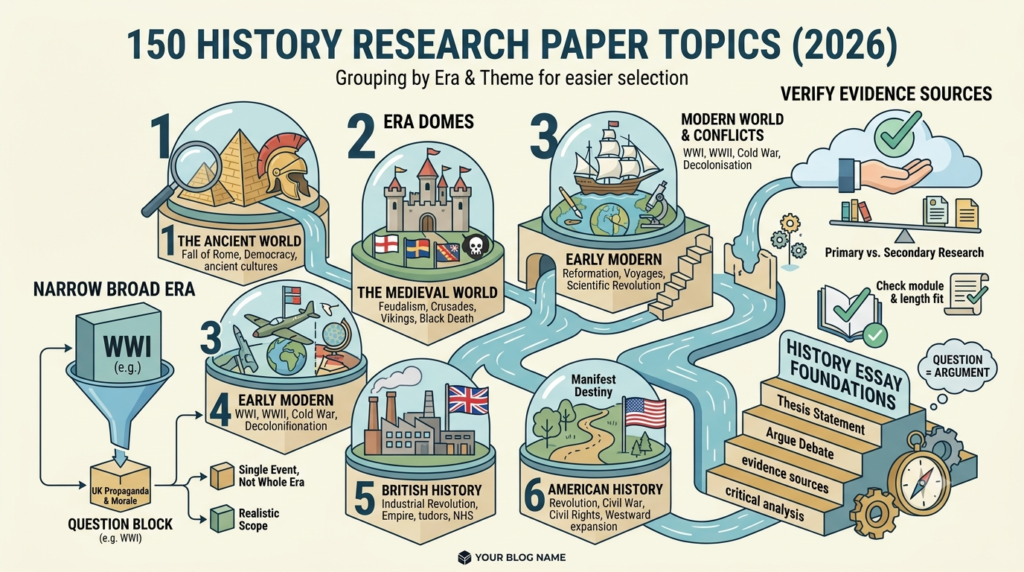
A strong history research topic is specific, supported by available sources, and focused on a question rather than a whole period. Fruitful areas include the ancient, medieval and early modern worlds, modern conflicts, British and American history, and social, political and global history. Narrow a broad era to a specific, arguable question you can evidence. History offers an almost limitless range of subjects, which is exactly why narrowing down is the real task. A good history paper focuses on a specific question, event or change and supports it with evidence, rather than surveying a whole era. Because history is built on sources, much of the work is deciding what evidence you can actually reach, which starts with understanding the difference between primary and secondary research, since a topic is only workable if the sources exist and you can use them. This guide gives 150 topics grouped by period and theme, then shows how to research and write one. What makes a good history research topic? A strong history topic does three things. It focuses on a specific question rather than a whole period, so ‘the Second World War’ becomes ‘how propaganda shaped civilian morale in wartime Britain’. It engages a genuine historical debate, which gives you something to argue rather than merely narrate. And it is supported by sources you can access, both the primary evidence of the time and the secondary work of other historians, which you weigh through a process much like writing a literature review. Narrow the time and place until the scope is manageable, and check the sources exist before you commit, because in history an unanswerable question usually means the evidence simply is not there. 150 history research paper topics by area The topics below are grouped by area. Narrow any of them to a specific event, place or period you can find sources on. The ancient world The medieval world Early modern history The modern world and conflicts British history American history Social and cultural history Political and economic history World and global history Historical debates and turning points How to research and write a history paper A history paper rests on sources and argument, so both need care. Begin by narrowing your topic to a specific, arguable question, then gather your evidence, distinguishing the primary sources of the period from the secondary work of historians, a distinction our primary vs secondary research guide sets out in full. Read the secondary literature to see where historians disagree, since that debate is what your paper contributes to, and build your answer as an argument supported by evidence rather than a narrative retelling, which is exactly the analytical habit our critical writing guide develops. Organise the whole thing within a clear structure, and because history depends so heavily on sources, reference every one carefully so you avoid plagiarism. Do that, and a good question becomes a strong paper. Choosing the right topic for your assignment With 150 options above, let sources and debate guide you. Favour a topic where the evidence is available to you and where historians genuinely disagree, since a settled question gives you nothing to argue and an under-documented one leaves you stranded. Check the topic suits your module and the length you have been set, and narrow the time and place until the scope is realistic. A focused question on a well-documented event will always beat a broad survey of an era. Whichever area you choose above, the same principle holds: narrow it, ground it in sources, and let your argument, not your narrative, carry the paper.
Research Proposal Example: Structure and How to Write One (2026)
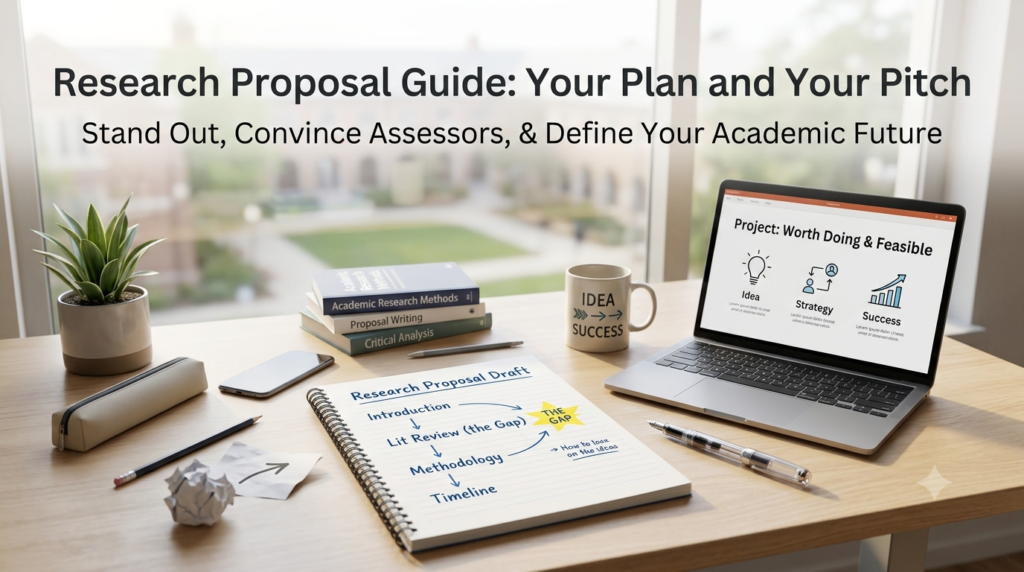
A research proposal sets out what you plan to research, why it matters, and how you will do it. A standard proposal includes a title, introduction, literature review, research questions, methodology, timeline and references. To write one, define a focused question, justify its importance, and explain a clear, feasible method for answering it. A research proposal is a plan and a pitch at the same time. It has to convince your supervisor or an assessor that your project is worth doing and that you have a realistic way of doing it, all before you have gathered a single piece of data. That dual purpose is why proposals are marked so carefully: a weak proposal usually signals a project that will struggle later. This guide sets out the standard structure of a research proposal, explains what each section needs to achieve, and gives a worked outline for a sample project so you can see how the parts fit together into a convincing whole. What is a research proposal? A research proposal is a structured document that describes a planned piece of research before it is carried out. It states the topic and the specific question you intend to answer, explains why that question is worth answering, reviews what is already known, and sets out the method you will use to investigate it. Proposals are required for dissertations, theses and funded research, and they serve two audiences at once: they help you think your project through properly, and they let a supervisor judge whether it is focused, original and feasible. A proposal is not the research itself; it is the argument that the research should happen, and it should read as a persuasive, well-reasoned plan rather than a vague statement of interest. The most important quality of a proposal is focus. A common reason proposals are sent back is that the question is too broad to answer within the time and resources available. A sharp, narrow question that you can genuinely investigate beats an ambitious one you cannot, and much of the work of a good proposal goes into narrowing the topic to something answerable within your timeframe and resources. What is the structure of a research proposal? Most proposals follow a recognisable structure, though the exact requirements vary by institution and level. The table sets out the standard sections and what each contains. Section What it contains Title A clear, specific working title that signals the topic and focus Introduction The topic, the problem, and why the research matters Literature review What is already known, and the gap your work addresses Research questions or aims The specific questions or objectives the study will answer Methodology How you will gather and analyse data, and why Timeline A realistic plan showing the project fits the time available References The sources cited, in the required style Some proposals also include a short section on expected outcomes, ethical considerations, or limitations, and research in some disciplines expects these as standard. Always work from your institution’s brief, but the core logic, what, why, and how, runs through every version. How do you write each section? Each section answers a specific question in the reader’s mind, and writing to that question keeps the proposal purposeful. The literature review and methodology carry the most weight, because together they show that your question is worth asking and that you have a credible way of answering it. For the review, our how to write a literature review guide covers how to synthesise sources, and for the method section, our how to write a dissertation methodology guide goes deeper. Research proposal example (outline) Here is a short worked outline for a sample proposal, showing how the sections connect around a single focused question. Notice how each section points back to the same question and to the gap identified in the literature. That coherence, where the problem, the gap, the question and the method all line up, is exactly what a strong proposal demonstrates, and what an assessor is looking for. A proposal where the method does not clearly answer the stated question, or where the gap is unclear, is far less convincing however well written the individual sections are. Common research proposal mistakes A focused, coherent proposal makes the whole project that follows far easier, so the effort is well spent. For accurate citations, see our how to cite sources guide. For expert help, our dissertation writing help and assignment writing help services can support you. Frequently asked questions What is a research proposal? A research proposal sets out what you plan to research, why it matters, and how you will do it, before the research begins. It convinces a supervisor that the project is focused, original and feasible. What are the main sections of a research proposal? A title, introduction, literature review, research questions or aims, methodology, timeline and references. Some also include expected outcomes, ethics or limitations, depending on the discipline and level. How do you write a research proposal? Define a focused question, justify why it matters, review the literature to identify a gap, and explain a clear, feasible method for answering the question, with a realistic timeline and accurate references. How long should a research proposal be? It varies by institution and level, from around a thousand words for an undergraduate proposal to several thousand for a doctoral one. Always follow your specific brief for length and required sections.
How to Write a Narrative Essay Outline (with Template, 2026)
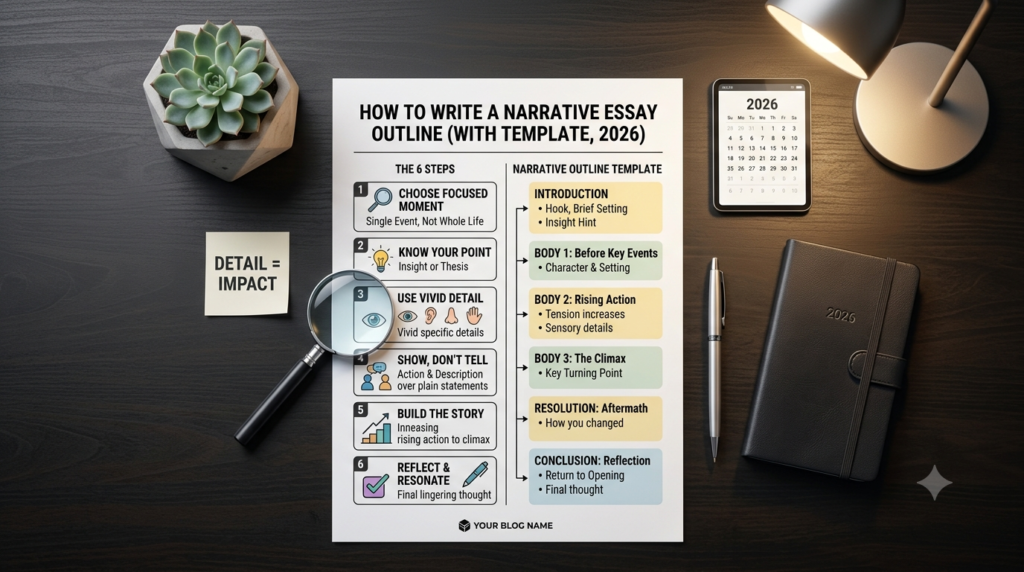
A narrative essay tells a story to make a point, and its outline follows an introduction with a hook and a thesis, a body that builds the events towards a climax, and a conclusion that reflects on the meaning. A clear outline keeps the story focused and makes sure it leads somewhere, rather than wandering. A narrative essay tells a real or imagined story, usually from your own experience, to convey an insight or point. It uses storytelling rather than argument, but it still needs structure, and an outline is what stops it from becoming a rambling account of everything that happened. Planning the shape of the story first lets you decide what to include, where the tension builds, and what the whole thing is for. Even in a personal essay, the underlying discipline of clear organisation is the same one our how to structure an assignment guide covers, and this guide applies it to storytelling. What is a narrative essay? A narrative essay is a piece of writing that tells a story to make a point, drawing on techniques such as setting, character and a clear sequence of events. What separates a strong narrative essay from a diary entry is that the story is chosen and shaped to lead somewhere: every scene, detail and moment serves an insight the writer wants to convey. That insight is the essay’s version of a thesis, and it is why a narrative essay, for all its freedom, still rewards planning. The outline is where you decide which moments earn their place and how they build towards the point. The narrative essay outline, section by section A narrative essay usually follows the shape below. The lengths are a guide; adapt them to your assignment. Introduction The introduction has three jobs. It opens with a hook, a vivid moment, image or question that pulls the reader in, since a flat opening loses them before the story begins. It sets the scene briefly, giving just enough of the who, where and when for the reader to follow. And it ends by signalling the point, the insight the story will reveal, which works like a thesis statement but is often hinted at rather than stated outright, so as not to give the ending away. Keep the introduction short; its job is to draw the reader in and orient them, not to summarise the story. Body: building the story The body is the story itself, and it usually unfolds in chronological order so the reader can follow the events. This is where you use specific, sensory detail to make the story vivid, and where you show rather than tell, letting actions and description carry the meaning rather than stating it plainly. Crucially, the body should build: the events rise in tension towards a turning point, rather than sitting flat. Keep every scene relevant to the point you are making, and cut anything that does not move the story towards it, however true it is. This is the longest part of the essay, usually two or three paragraphs of rising action. Climax and resolution The climax is the key moment the story has been building towards, the turning point where something changes, is realised or is decided. It is the emotional peak of the essay, so give it room. The resolution then shows the aftermath: how the moment changed you or what it revealed, and it ties off the events so the reader is not left hanging. Together, the climax and resolution are what turn a sequence of events into a story with a point. Conclusion The conclusion steps back and reflects on the meaning of the story. It returns to the insight hinted at in the introduction, now earned by everything the reader has been through, and it ends with a final thought that lingers. A good narrative conclusion does not simply summarise what happened; it says why it mattered, which is the moment the essay delivers its point. A narrative essay outline template Here is a ready-to-use skeleton you can fill in for your own story. Introduction: Hook (a vivid moment or image); brief setting (who, where, when); a hint of the point the story will reveal. Body paragraph 1: The situation before the key events; establish character and setting; begin the sequence. Body paragraph 2: Rising action; the events build and tension increases; specific, sensory detail throughout. Body paragraph 3: The climax; the turning point the story has built towards; the emotional peak. Resolution: The immediate aftermath; how the moment changed you or what it revealed. Conclusion: Reflection on the meaning; return to the opening insight; a final lingering thought. Filling this in before you write keeps the story focused and ensures it builds towards a point rather than trailing off. Adjust the number of body paragraphs to the length you have been set, but keep the rising-action-to-climax shape whatever the size. Tips for a strong narrative essay A narrative essay gives you room to be creative, but the discipline of a clear plan is what makes that creativity land. Outline the shape first, keep every scene earning its place, and let the climax and reflection carry the meaning. Whatever the story, the same principle holds throughout: choose a focused moment, build it towards a turning point, and end by showing why it mattered. Common narrative essay mistakes to avoid A few habits weaken an otherwise good story, and knowing them helps you catch them in the outline stage before they cost you. Most of these come down to the same thing: a narrative essay is a shaped story, not a record of events. Planning the shape in your outline is what keeps it focused.
International Business Dissertation Topics: 110+ Ideas with Research Aims (2026)
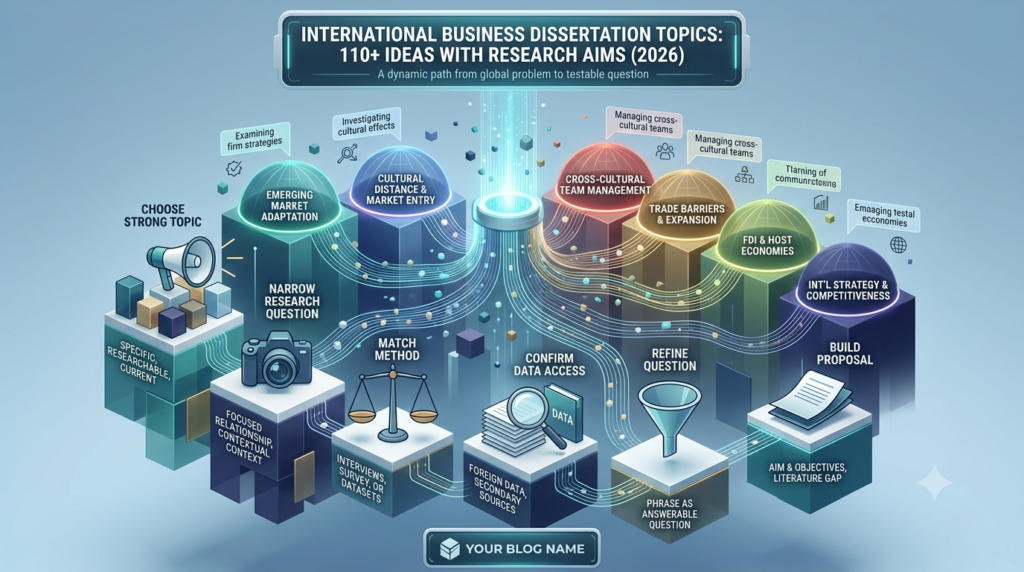
A strong international business dissertation topic is specific, researchable and current, focused on a clear relationship you can test with data you can access. Fruitful areas include market entry and internationalisation, global strategy, cross-cultural management, international trade, emerging markets and foreign direct investment. This guide gives 110+ topics with six developed examples and a method for shaping any idea into a research question. Choosing an international business dissertation topic is the first real decision of your project, and it shapes everything that follows. The field spans market entry, global strategy, culture, trade and finance, so the best topic is not the broadest but the one you can research well: focused on a specific relationship, grounded in a context you can reach, and connected to a current issue. Because international business often means studying firms or markets you cannot access directly, the choice of method matters early, and our qualitative vs quantitative research guide helps you weigh whether your question calls for interviews, survey data or existing datasets. This guide walks through how to choose, develops six topics to full aim-and-objectives level, then lists more than 110 further ideas grouped by area. How do you choose a strong international business dissertation topic? A good topic meets several conditions at once. It should be relevant to your course and current, interesting enough to sustain you for months, and narrow enough to answer within a dissertation. Above all it must be researchable in practice: international business questions often rely on secondary data, such as trade statistics or company reports, because reaching firms across borders is hard, so confirm your data before committing. A strong topic also usually addresses a gap or a live issue, which reading recent studies, much as you would when writing a literature review, helps you find. The most common mistake is choosing something too broad: ‘globalisation’ is a field, while ‘how cultural distance affects the market entry strategy of UK firms in Southeast Asia’ is a question you can investigate. Six developed international business dissertation topics (with aims and objectives) The six topics below are worked to the level your proposal will need, each with a research aim and three objectives, so you can see how a broad idea becomes a defined study. 1. How firms adapt their strategy when entering emerging markets Research aim: To examine how firms adapt their strategy to succeed when entering emerging markets. 2. The impact of cultural distance on international market entry Research aim: To investigate how cultural distance affects the choice and success of market entry strategies. 3. How multinational firms manage cross-cultural teams Research aim: To examine how multinational firms manage cross-cultural teams to improve performance. 4. The effect of trade barriers on international expansion Research aim: To analyse how trade barriers affect firms’ decisions to expand internationally. 5. How foreign direct investment affects host economies Research aim: To investigate how foreign direct investment affects the economies of host countries. 6. The role of international strategy in firm competitiveness Research aim: To examine how international strategy affects the competitiveness of firms in global markets. 110+ international business dissertation topics by area The ideas below are grouped by sub-area. Treat each as a starting point to narrow around a context and sample you can access. For related fields, see our business dissertation topics, management dissertation topics and marketing dissertation topics guides. Market entry and internationalisation Global and international strategy Cross-cultural management International trade and policy Emerging markets Multinational corporations International human resource management Global supply chains and operations International marketing Foreign direct investment and finance Global sustainability and ethics What makes a strong international business dissertation topic? Beyond meeting the practical conditions above, the strongest topics share a clear angle. They focus on a specific relationship, such as how one international factor affects a firm outcome, rather than describing a broad area, which gives you something to test rather than summarise. They are grounded in a definable context, a country, a region, an industry or a type of firm, which keeps the scope manageable and the data reachable. And they connect to a current issue in the global economy or a gap in the literature, which gives the work relevance. A topic that combines a focused relationship, a clear context and a genuine gap will nearly always make a stronger dissertation than a broad or descriptive one. How do you turn a topic into a research question? A topic is a starting area; a research question is what your dissertation answers, so the next step is to sharpen one into the other. Take your chosen area, add a specific context and a relationship to investigate, and phrase it as a question evidence can answer, so ‘market entry’ becomes ‘how does cultural distance affect the entry mode choice of UK firms in Southeast Asia?’. From there you decide what data you need, and because international business often depends on it, whether existing datasets will serve better than gathering your own, a choice our primary vs secondary research guide helps you make, then set the plan out in a research proposal. Grounding the question in international business theory is what turns it into research rather than commentary. Tips for refining your topic Once you have a topic and question, the next steps are designing the study and organising the write-up. Our how to write a dissertation methodology guide covers the research design, and our how to structure an assignment guide helps you organise the whole piece. Before you submit, it is worth checking your own finished draft for originality, which you can do with our plagiarism check. Whichever area you choose above, the same principle holds throughout: narrow the topic, match the method to it, and let a clear, evidenced argument carry the work.