Qualitative vs Quantitative Research: What’s the Difference? (2026)

Qualitative research explores meaning and experience using non-numerical data such as interviews and observations, and answers ‘how’ and ‘why’ questions. Quantitative research measures and tests using numerical data such as surveys and statistics, and answers ‘how many’ and ‘what relationship’ questions. Which you choose depends on your research question. Choosing between qualitative and quantitative research is one of the first big decisions in a dissertation or research project, and getting it right shapes everything that follows. The two approaches collect different kinds of data, answer different kinds of questions, and are analysed in completely different ways, so the choice is not a matter of preference but of fit with what you are actually trying to find out. This guide explains what each approach is, sets out the key differences side by side, and shows how to decide which suits your own research question, so your methodology rests on a clear, justified choice rather than a guess. What is qualitative research? Qualitative research explores meaning, experience and context using non-numerical data, usually words. It asks open questions about how and why something happens, and gathers rich, detailed data through methods such as interviews, focus groups, observations and the analysis of documents or texts. Because it aims for depth rather than breadth, it typically uses smaller, purposively chosen samples, and the data is analysed by identifying themes and patterns rather than by counting. Qualitative research is well suited to understanding people’s perspectives, motivations and experiences, and to exploring topics where the important questions are not yet well defined. Its findings are detailed and contextual, though usually less generalisable to a wider population than numerical results. What is quantitative research? Quantitative research measures and tests using numerical data. It asks questions about how much, how many, or what the relationship is between things, and gathers data through methods such as surveys with closed questions, experiments and structured measurements. Because it aims for breadth and generalisability, it typically uses larger samples chosen to represent a wider population, and the data is analysed statistically. Quantitative research is well suited to measuring the scale of something, comparing groups, and testing hypotheses about relationships between variables. Its findings can often be generalised beyond the sample, though they tend to offer less depth and context than qualitative data, telling you what is happening more clearly than why. Qualitative vs quantitative: the key differences The two approaches differ across every stage of a project, from the question to the analysis. The table sets the main contrasts side by side. Aspect Qualitative Quantitative Data Non-numerical: words, meaning Numerical: numbers, measurements Question How and why How many, how much, what relationship Methods Interviews, focus groups, observation Surveys, experiments, measurements Sample Smaller, purposively chosen Larger, representative Analysis Themes and patterns Statistics Aim Depth and understanding Breadth and generalisability Findings Rich and contextual Generalisable, less detailed Neither approach is better in the abstract; they are simply suited to different questions. A project that wants to understand how patients experience a treatment calls for qualitative depth, while one that wants to measure whether the treatment reduces symptoms across a population calls for quantitative measurement. The skill is matching the approach to the question, which is exactly what a marker looks for when assessing your methodology. When should you use each approach? The deciding factor is always your research question. Use qualitative research when you want to explore, understand or interpret, when the topic is not yet well understood, or when meaning and experience are central. Use quantitative research when you want to measure, compare or test, when you need results that generalise to a wider group, or when the key questions concern amounts, frequencies or relationships between variables. A useful test is to look at the verb in your research question: words like explore, understand and describe point towards qualitative work, while words like measure, compare and test point towards quantitative work. If your question contains both kinds of aim, that is often a sign you should consider combining the two. What is mixed-methods research? Mixed-methods research combines qualitative and quantitative approaches in a single study, using each for what it does best. A researcher might, for example, run a survey to measure how widespread an attitude is, then conduct interviews to understand why people hold it, so the numbers show the scale and the words explain the reasons. Mixed methods can give a fuller picture than either approach alone, but it also asks more of you, since you have to design, carry out and analyse two kinds of data and then integrate the findings. For that reason it is powerful when the research question genuinely needs both, but it is not a way to avoid choosing; a mixed-methods study still has to justify why each approach is there. How do you choose for your dissertation? For a dissertation, the choice of approach belongs in your methodology, where you justify it against your research question rather than simply stating it. Start from what you are trying to find out, decide whether that calls for depth, breadth or both, and then choose the approach and methods that fit, explaining why they suit the question and why the alternatives do not. Practical factors matter too: the time you have, your access to participants or data, and the skills the analysis will require. Our how to write a dissertation methodology guide covers how to write this section and justify your choices, and framing that choice well begins at the proposal stage, which our research proposal example guide walks through. Common mistakes to avoid A clear, justified choice of approach is the foundation of a strong research project, and it makes every later stage easier. For fitting your methodology into the wider structure of your work, see our how to structure an assignment guide. Frequently asked questions What is the difference between qualitative and quantitative research? Qualitative research explores meaning and experience using non-numerical data such as interviews, while quantitative research measures and tests using numerical data
Personal Statement Examples and How to Write Your Own (2026)

A personal statement is a short essay for a university application that explains why you want to study a subject and why you are suited to it. A strong statement opens with genuine motivation, gives evidence of your interest and skills, and connects them to the course. Write your own, since admissions systems check for similarity. A personal statement is one of the few parts of a university application you fully control, and it can make the difference between offers when grades are similar. It is also one of the hardest things to write, because you have to sound genuine, specific and mature in a few hundred words, without slipping into cliche. This guide explains what admissions tutors actually look for, walks through a workable structure, and shows illustrative examples of strong and weak approaches. One thing to be clear about from the start: use examples for inspiration only and write your own statement, because admissions systems run similarity checks and a copied statement can cost you a place. What is a personal statement? A personal statement is a short piece of writing submitted as part of a university application, most often through UCAS in the UK, in which you explain why you want to study your chosen subject and why you would be a good student of it. Its purpose is to let admissions tutors see the person behind the grades: your motivation, your understanding of the subject, and the experiences and skills that have prepared you for it. Because many applicants have similar predicted grades, the statement is often where a tutor decides between candidates, which is why it repays real thought. It is not a list of achievements; it is an argument that you belong on the course, built from evidence. Admissions processes evolve, and the exact format can change, so always check the current UCAS guidance for how statements are submitted and what is asked for in the year you apply. Whatever the format, the underlying question a tutor is asking stays the same: why this subject, and why you. What do admissions tutors look for? Tutors are reading for a handful of things, and knowing them tells you what to put in and what to cut. The table sets out what they value and what weakens a statement. Tutors want to see What weakens a statement Genuine motivation for the subject Generic reasons that could apply to anyone Evidence of interest beyond the syllabus Vague claims with no examples to back them Relevant skills and experiences A list of achievements with no reflection Reflection on what you learned Cliches and empty opening lines A clear link to the course Copied phrasing that fails similarity checks The single most important quality is evidence. Saying you are passionate about a subject means nothing on its own; showing what you read, did or noticed, and what you took from it, proves the passion is real. Every claim in a strong statement is backed by a specific example, which is what separates a memorable statement from the many that blur together. How do you structure a personal statement? There is no single required structure, but a reliable shape helps you cover what matters in a logical order. Throughout, the writing should be clear, specific and reflective. The reflective habit, always saying what an experience taught you or why it mattered, is the same analytical skill that earns marks in academic work, which our how to write critically guide develops. A statement that reflects reads as mature; one that only lists reads as thin. Personal statement examples These short illustrative snippets show the difference between a weak, generic opening and a stronger, specific one. They are for guidance only, to be studied rather than copied. Weak (generic) Stronger (specific and reflective) ‘I have always been passionate about science and want to help people, so medicine is the perfect career for me.’ ‘Volunteering on a hospital ward, I saw how much of a diagnosis depends on listening carefully to a patient, which turned my interest in biology into a specific ambition to study medicine.’ ‘I love reading and have read many books, which is why I want to study English.’ ‘Reading two very different accounts of the same historical event made me want to understand how narrative shapes truth, a question I want to pursue in an English degree.’ In each pair, the stronger version replaces a claim with a concrete experience and a reflection on what it meant. That is the move to aim for in your own statement: for every quality you want to convey, find the specific thing you did and the specific thing you learned. Study examples like these for how they work, then write your own from your own experiences, because a genuine statement in your own voice is both more convincing and safe from similarity checks. How do you make your statement stand out? Beyond structure, a few habits lift a statement above the average. Be specific rather than general at every opportunity, since detail is what tutors remember. Reflect on your experiences rather than listing them, because reflection shows maturity and self-awareness. Keep the focus on the subject and your suitability for it, rather than drifting into unrelated personal history. Write in your own natural voice rather than an inflated one, as forced formality reads as insincere. And redraft: strong statements are rewritten many times, tightened and sharpened until every sentence earns its place. Above all, keep it honest, since anything you write may be discussed at interview, and a statement you cannot stand behind is a liability rather than an asset. Reading your statement aloud is a simple way to catch sentences that sound forced or insincere before you submit. Common personal statement mistakes A statement that is specific, reflective and genuinely yours is the one that works. For related writing skills, see our how to write a first-class essay guide. Check the current UCAS guidance for the exact requirements in your
Management Dissertation Topics: 110+ Ideas with Research Aims (2026)

A strong management dissertation topic is specific, researchable and current, focused on a clear relationship you can test with data you can access. Fruitful areas include strategic management, leadership, organisational behaviour, change, operations, project and innovation management. This guide gives 110+ topics with six developed examples and a method for shaping any idea into a research question. Choosing a management dissertation topic is the first real decision of your project, and it shapes everything that follows. Management is a broad field, so the best topic is not the most ambitious one but the one you can research well: focused on a specific relationship, grounded in a context you can reach, and connected to a current issue. That focus depends partly on an early decision about method, since management questions can call for measurement, for depth, or for both, a choice our qualitative vs quantitative research guide helps you weigh. This guide walks through how to choose, develops six topics to full aim-and-objectives level, then lists more than 110 further ideas grouped by area. How do you choose a strong management dissertation topic? A good topic meets several conditions at once. It should be relevant to your course and current, interesting enough to sustain you for months, and narrow enough to answer within a dissertation rather than a whole field. Above all it must be researchable in practice: you need to reach the organisation, managers or data the question requires, so it helps to confirm that access before committing. A strong topic also usually addresses a gap or a live management challenge, which gives the work a clear reason to exist, and reading recent studies in your area, much as you would when writing a literature review, is how you find that gap. The most common mistake is choosing something too broad: ‘leadership’ is a field, while ‘how transformational leadership affects employee performance in UK SMEs’ is a question you can investigate. Six developed management dissertation topics (with aims and objectives) The six topics below are worked to the level your proposal will need, each with a research aim and three objectives, so you can see how a broad idea becomes a defined study. 1. The impact of transformational leadership on organisational performance Research aim: To examine how a transformational leadership style affects organisational performance and employee motivation. 2. How change management strategies affect employee resistance Research aim: To investigate how different change management strategies influence employee resistance during organisational change. 3. The role of strategic planning in SME growth Research aim: To analyse how strategic planning practices affect the growth and survival of small and medium-sized enterprises. 4. How organisational culture influences innovation Research aim: To examine how organisational culture affects an organisation’s capacity to innovate. 5. The effect of project management practices on delivery success Research aim: To evaluate how project management practices affect the successful delivery of projects on time and to budget. 6. How knowledge management affects organisational learning Research aim: To investigate how knowledge management practices affect organisational learning and performance. 110+ management dissertation topics by area The ideas below are grouped by sub-area. Treat each as a starting point to narrow around a context and sample you can access. For related fields, see our business dissertation topics guide. Strategic management Leadership Organisational behaviour and culture Change management Operations and supply chain management Project management Innovation and technology management Risk and crisis management Performance and quality management Knowledge, information and SME management What makes a strong management dissertation topic? Beyond meeting the practical conditions above, the strongest topics share a clear angle. They focus on a specific relationship, such as how one management practice affects an organisational outcome, rather than describing a broad area, which gives you something to test rather than summarise. They are grounded in a definable context, a sector, a country, a type of organisation, which keeps the scope manageable and the data reachable. And they connect to a current management challenge or a gap in the literature, which gives the work relevance. A topic that combines a focused relationship, a clear context and a genuine gap will nearly always make a stronger dissertation than a broad or descriptive one. How do you turn a topic into a research question? A topic is a starting area; a research question is what your dissertation answers, so the next step is to sharpen one into the other. Take your chosen area, add a specific context and a relationship to investigate, and phrase it as a question evidence can answer, so ’employee motivation’ becomes ‘how do flexible working policies affect employee motivation in UK technology firms?’. From there you decide what data you need and whether it is best gathered fresh or drawn from existing sources, a choice our primary vs secondary research guide helps you make, then you set the whole plan out in a research proposal. Grounding the question in management theory is what turns it into research rather than commentary. Tips for refining your topic Once you have a topic and question, the next steps are designing the study and organising the write-up. Our how to write a dissertation methodology guide covers the research design, and our how to structure an assignment guide helps you organise the whole piece. Before you submit, it is worth checking your own finished draft for originality, which you can do with our plagiarism check. Whichever area you choose above, the same principle holds throughout: narrow the topic, match the method to it, and let a clear, evidenced argument carry the work. Ready to take your dissertation further? Get specialist support. From refining your research question and literature review to methodology, analysis and final structure, dissertation work requires careful planning at every stage. Explore our dissertation writing support for your research project. Explore dissertation writing support
140 Marketing Research Topics for Papers (2026)
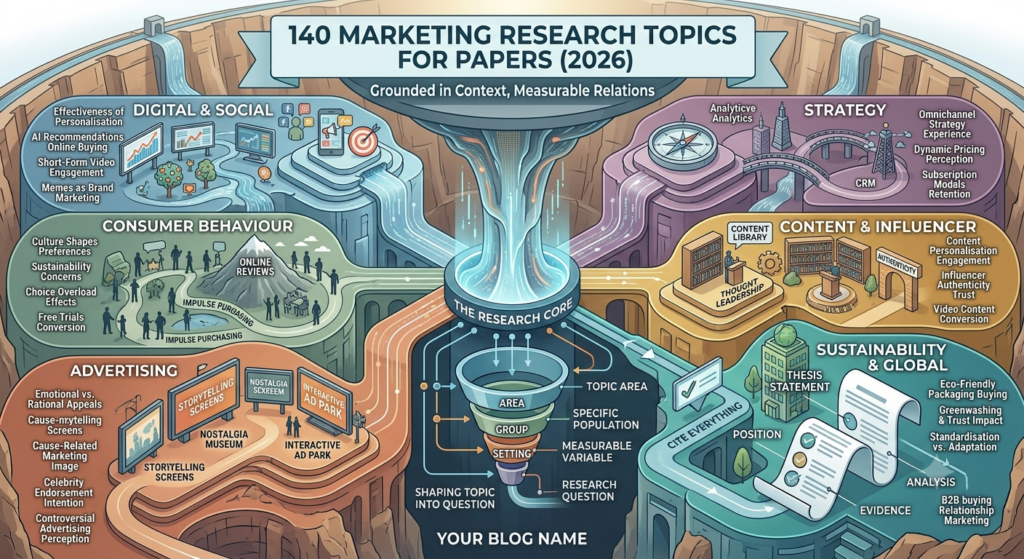
A strong marketing research topic focuses on a specific relationship you can test with data, such as how one marketing factor affects a consumer outcome. Fruitful areas include digital and social media marketing, consumer behaviour, branding, advertising, strategy, content and influencer marketing, and analytics. Narrow a broad trend to a researchable question. Marketing changes quickly, which makes it a rich source of research topics but an easy field in which to pick something too broad. The best topics focus on a specific relationship, grounded in a context you can gather data on, and the method matters early, since surveying consumers, analysing campaign data and interviewing marketers answer very different questions, a choice our qualitative vs quantitative research guide helps you make. This guide gives 140 topics grouped by area, then shows how to turn one into a research question. For a dissertation-length project, our marketing dissertation topics guide develops these further with research aims and objectives. What makes a good marketing research topic? A strong marketing topic focuses on a specific relationship between a marketing factor and a consumer or business outcome, rather than a broad trend. It is grounded in a definable context, a sector, a platform, a country or a consumer group, which keeps the scope manageable and the data reachable. And it connects to a current development, which gives the work relevance and makes the literature easier to review. The most common mistake is choosing something too broad: ‘social media marketing’ is an area, but ‘how influencer authenticity affects purchase intention among UK Gen Z consumers’ is a question you can actually study. Narrow every promising idea to that level before you commit. 140 marketing research topics by area The topics below are grouped by area. Narrow any of them to a sector, platform or consumer group you can gather data on. Digital marketing Social media marketing Consumer behaviour Branding Advertising and communication Marketing strategy Content and influencer marketing Sustainability and ethical marketing International and B2B marketing Retail, e-commerce and analytics How do you turn a topic into a research question? A topic is a starting area; a research question is what your study answers, so the next step is to sharpen one into the other. Focus your area onto a specific relationship and context, and phrase it as a question evidence can answer, so ‘influencer marketing’ becomes ‘how does influencer authenticity affect purchase intention among UK Gen Z fashion consumers?’. From there you decide what data you need, whether that means a survey, existing campaign data or analytics, and whether you rely on primary or secondary sources, then set the plan out in a research proposal. Connecting the question to marketing theory and recent studies is what makes it research rather than opinion. Choosing the right topic for your assignment With 140 options above, data and fit decide it. Favour a topic where you can realistically gather the consumer or campaign data it needs, since a question with no reachable evidence is not workable. Check it suits your course and the length you have been set, and narrow it to a specific sector, platform or group. Once your question is set, the paper still needs a clear structure and an argument that analyses the evidence rather than describing it, which our critical writing guide helps you build. Whichever area you choose above, the rule is the same: narrow it, match the method to it, and let the analysis carry the work.
MLA Referencing and Format: A Full Guide with Examples (2026)
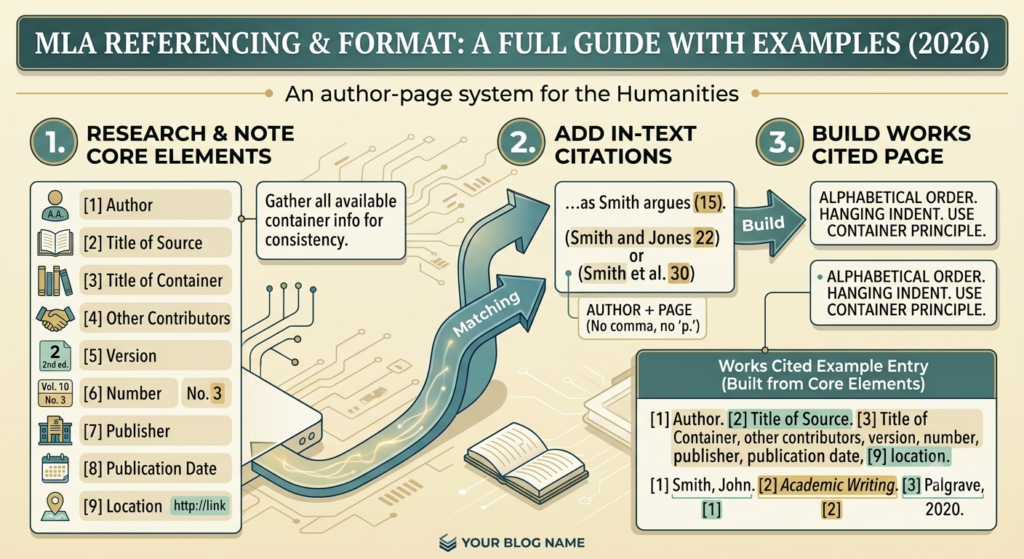
MLA is an author-page referencing style used mainly in the humanities. You cite the author’s surname and a page number in the text, such as (Smith 15), and list full details in a Works Cited page at the end. This guide covers MLA format: in-text citations, the Works Cited entry for common sources, and the core-elements template. MLA style, from the Modern Language Association, is the standard in English, languages and many humanities subjects. It is an author-page system: a brief citation in the text points to a full entry on a Works Cited page. This guide explains MLA format in its current 9th edition, with in-text rules and Works Cited examples for the sources you use most, so you can reference cleanly and keep the presentation marks. Confirm any details against the official MLA Handbook or your department’s guidance. What is MLA format? MLA format is the referencing and document style of the Modern Language Association. It has two linked parts: an in-text citation giving the author surname and a page number, and a Works Cited list at the end giving full details of every source, ordered alphabetically. MLA also sets document conventions, such as double spacing, a readable font, and a header with your surname and page number, though the exact requirements can vary, so check your brief. How do MLA in-text citations work? An MLA in-text citation gives the author surname and the page number, with no comma between them and no ‘p.’, for example (Smith 15). If you name the author in your sentence, put only the page number in brackets, for example Smith argues this point clearly (15). For a source with no page numbers, such as many websites, use just the author surname. How do you format an MLA Works Cited entry? MLA 9th edition builds each entry from a template of core elements: Author. Title of Source. Title of Container, other contributors, version, number, publisher, publication date, and location. The table shows the format and an example for common sources. Source MLA format and example Book Author. Title of Book. Publisher, Year. -> Smith, John. Academic Writing. Palgrave, 2020. Journal article Author. “Title of Article.” Journal Name, vol. X, no. Y, Year, pp. 10-25. Chapter in an edited book Author. “Title of Chapter.” Title of Book, edited by Editor, Publisher, Year, pp. 10-25. Website Author. “Title of Page.” Website Name, Publisher, Date, URL. What are MLA core elements? Rather than a different template for every source type, MLA 9th uses one list of nine core elements that you fill in as far as they apply, in order, each followed by the punctuation shown in the handbook. The key idea is the container: the larger work a source sits in, such as the journal that holds an article or the website that holds a page. Getting the container right is what makes MLA entries consistent across source types. How do you reference in MLA step by step? MLA is one style among several. For the general principles, see our how to cite sources guide; for other styles, our APA referencing guide and Harvard referencing guide. If you are compiling sources with commentary, our annotated bibliography guide uses the same entry formats. Common MLA mistakes to avoid Accurate referencing protects easy presentation marks. For help checking your work, our assignment writing help and essay writing help services can review it. Frequently asked questions What is MLA format? MLA is an author-page referencing style used mainly in the humanities. You cite the author surname and page number in the text, such as (Smith 15), and list full details on a Works Cited page. How do you write an MLA in-text citation? Give the author surname and page number with no comma and no ‘p.’, for example (Smith 15). If you name the author in the sentence, put only the page number in brackets. What is the difference between MLA and APA? MLA uses author-page citations, such as (Smith 15), and a Works Cited page, and is common in the humanities. APA uses author-date citations, such as (Smith, 2020), and a reference list, and is common in the sciences. What is a Works Cited page? It is the MLA list of all the sources you cited, at the end of your work, ordered alphabetically by author surname with a hanging indent, built from MLA’s core elements.
Psychology Dissertation Topics: 110+ Ideas with Research Aims (2026)
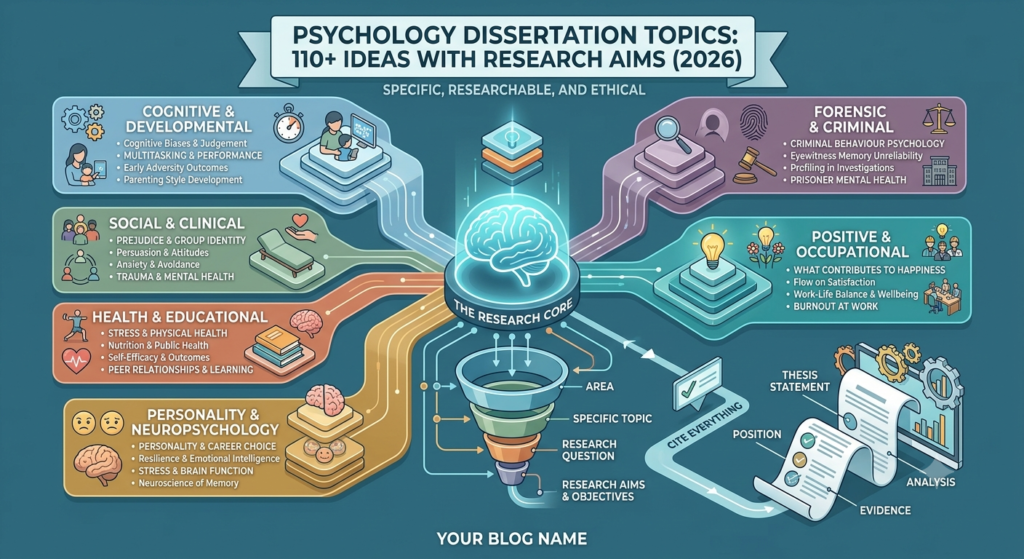
A strong psychology dissertation topic is specific, researchable and ethical, focused on a clear relationship you can test with data you can gather. Fruitful areas include cognitive, developmental, social, clinical, health, educational and forensic psychology. This guide gives 110+ topics with six developed examples and a method for shaping any idea into a research question. Choosing a psychology dissertation topic is the first real decision of your project, and it shapes everything that follows. Psychology is broad and empirical, so the best topic is not the most ambitious but the one you can research well: focused on a specific relationship, testable with data you can gather ethically, and connected to a current issue. Because psychology usually involves people, the choice between measuring behaviour and understanding experience shapes the whole design, which our qualitative vs quantitative research guide helps you weigh, and ethics is central throughout. This guide walks through how to choose, develops six topics to full aim-and-objectives level, then lists more than 110 further ideas grouped by area. How do you choose a strong psychology dissertation topic? A good topic meets several conditions at once. It should be relevant to your course and current, interesting enough to sustain you for months, and narrow enough to answer within a dissertation. Above all it must be researchable and ethical: a topic is only workable if you can recruit participants and gather data within ethical guidelines, and sensitive topics or vulnerable groups raise requirements you must plan for. A strong topic also addresses a live debate or a gap, which reading recent studies, much as you would when writing a literature review, helps you find. The most common mistake is choosing something too broad: ‘social media and mental health’ is a field, while ‘how time spent on Instagram relates to body image in young women’ is a question you can investigate. Six developed psychology dissertation topics (with aims and objectives) The six topics below are worked to the level your proposal will need, each with a research aim and three objectives, so you can see how a broad idea becomes a defined study. 1. The impact of social media use on adolescent mental health Research aim: To examine how social media use affects the mental health and wellbeing of adolescents. 2. How sleep affects memory and cognitive performance Research aim: To investigate how sleep quality affects memory and cognitive performance. 3. The effect of childhood attachment on adult relationships Research aim: To examine how childhood attachment style affects adult relationships. 4. How stress affects decision-making Research aim: To investigate how stress affects the quality of decision-making. 5. The relationship between exercise and depression Research aim: To analyse the relationship between regular exercise and symptoms of depression. 6. How cognitive biases affect judgement Research aim: To examine how cognitive biases affect everyday judgement and decisions. 110+ psychology dissertation topics by area The ideas below are grouped by sub-area. Treat each as a starting point to narrow around a group and setting you can access ethically. The universal skills of designing and writing up research apply across all of them, and our how to structure an assignment guide helps with the write-up. Cognitive psychology Developmental psychology Social psychology Clinical and abnormal psychology Health psychology Educational psychology Forensic and criminal psychology Personality and individual differences Biological and neuropsychology Positive psychology and wellbeing Occupational and applied psychology What makes a strong psychology dissertation topic? Beyond meeting the practical conditions above, the strongest topics share a clear angle. They focus on a specific relationship, such as how one variable affects another, rather than describing a broad area, which gives you something to test rather than summarise. They are grounded in a definable population, an age group, a clinical group or a setting, which keeps the scope manageable and recruitment realistic. And they connect to a current issue or a gap in the literature, which gives the work relevance. A topic that combines a focused relationship, a clear population and an ethical, feasible design will nearly always make a stronger dissertation than a broad or descriptive one. How do you turn a topic into a research question? A topic is a starting area; a research question is what your dissertation answers, so the next step is to sharpen one into the other. Take your chosen area, add a specific population and a relationship to investigate, and phrase it as a question evidence can answer, so ‘social media and mental health’ becomes ‘how does daily Instagram use relate to body image among young women aged 18 to 25?’. From there you decide what data you need and whether you will gather it yourself or draw on existing datasets, a choice our primary vs secondary research guide helps you make, and you build ethics into the plan before setting it out in a research proposal. Grounding the question in psychological theory is what turns it into research rather than opinion. Tips for refining your topic Once you have a topic and question, the next steps are designing the study and organising the write-up. Our how to write a dissertation methodology guide covers the research design and its ethics. Before you submit, it is worth checking your own finished draft for originality, which you can do with our plagiarism check. Whichever area you choose above, the same principle holds throughout: narrow the topic, design it ethically, and let a clear, evidenced study carry the work. Ready to take your dissertation further? Get specialist support. From refining your research question and literature review to methodology, analysis and final structure, dissertation work requires careful planning at every stage. Explore our dissertation writing support for your research project. Explore dissertation writing support
IEEE Referencing: A Full Guide with Examples (2026)
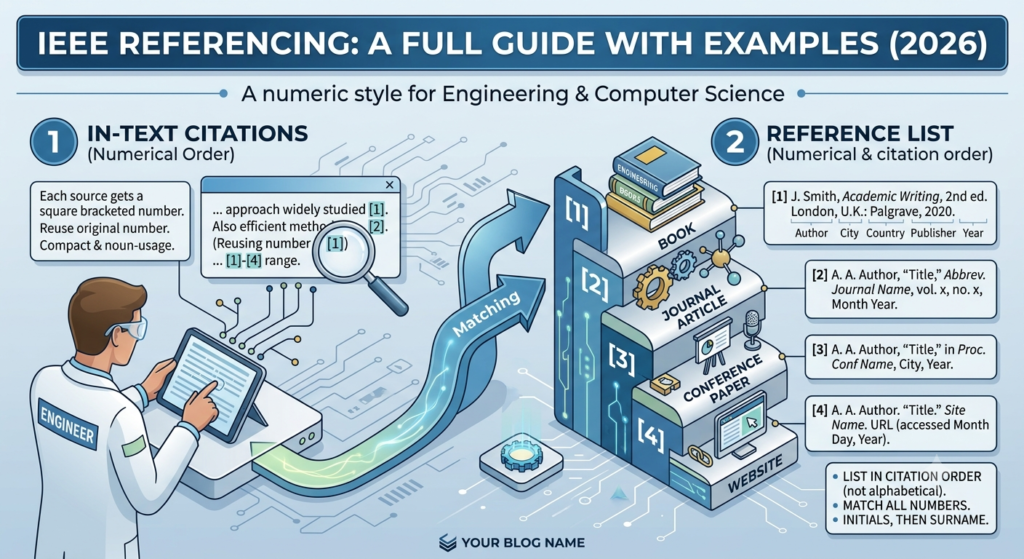
IEEE referencing is a numeric style used in engineering and computer science. You number sources in the order they appear and cite them with a number in square brackets on the line, such as [1], then list them in that numerical order in the reference list. The same source keeps the same number throughout. IEEE is the standard referencing style in engineering, computer science and related technical subjects. Like Vancouver, it is numeric rather than author-date: each source is given a bracketed number that stands in for it in the text. This guide explains how IEEE in-text citations and the numbered reference list work, with examples for the sources you use most, so you can reference cleanly in a technical assignment. Confirm details against the current IEEE reference guide, which sets the exact formats. What is IEEE referencing? IEEE referencing is the citation style of the Institute of Electrical and Electronics Engineers, used across technical and computing disciplines. It uses a number in square brackets in the text, matched to a numbered entry in the reference list. Sources are numbered in the order they first appear, so the reference list is in citation order rather than alphabetical. Its compact bracketed numbers keep technical writing readable, which is why engineering and computer science favour it. How do IEEE in-text citations work? Each source is given a number the first time it is cited, shown in square brackets on the line, not as a superscript, for example: this approach has been widely studied [1]. Unlike some numeric styles, the bracketed number can also be used as a noun in the sentence, for example: as shown in [1], the method is efficient. The same source always keeps its original number. How do you format an IEEE reference list? Entries are numbered in citation order and start with the bracketed number. Authors are given as initials followed by surnames. The table shows the format and an example for common sources. Source IEEE format and example Book [n] A. A. Author, Title of Book, xth ed. City, Country: Publisher, Year. -> [1] J. Smith, Academic Writing, 2nd ed. London, U.K.: Palgrave, 2020. Journal article [n] A. A. Author, “Title of article,” Abbrev. Journal Name, vol. x, no. x, pp. 10-25, Month Year. Conference paper [n] A. A. Author, “Title of paper,” in Proc. Conference Name, City, Year, pp. 10-25. Website [n] A. A. Author. “Title of page.” Site Name. URL (accessed Month Day, Year). How do you reference IEEE step by step? IEEE is one style among several. For the general principles of citing, see our how to cite sources guide; for another numeric style, our Vancouver referencing guide; and for an author-date style, our APA referencing guide. For structuring the wider assignment, see how to structure an assignment. Common IEEE mistakes to avoid Accurate referencing protects easy marks. For help checking your work, our assignment writing help and essay writing help services can review it. Frequently asked questions What is IEEE referencing? IEEE is a numeric referencing style used in engineering and computer science. You number sources in the order they appear, cite them with a bracketed number such as [1], and list them in numerical order. How do you write an IEEE in-text citation? Give the source number in square brackets on the line, for example [1]. The number can also be used as a noun in the sentence, and the same source keeps its number throughout. Is the IEEE reference list alphabetical? No. IEEE lists references in the order they were first cited in the text, so the list is numbered in citation order rather than alphabetical order. What is the difference between IEEE and APA? IEEE is numeric, citing sources with bracketed numbers in citation order, and is used in engineering. APA is author-date, citing the author and year, with an alphabetical reference list, and is used in the social sciences.
150 Social Issues Topics for Essays and Papers (2026)
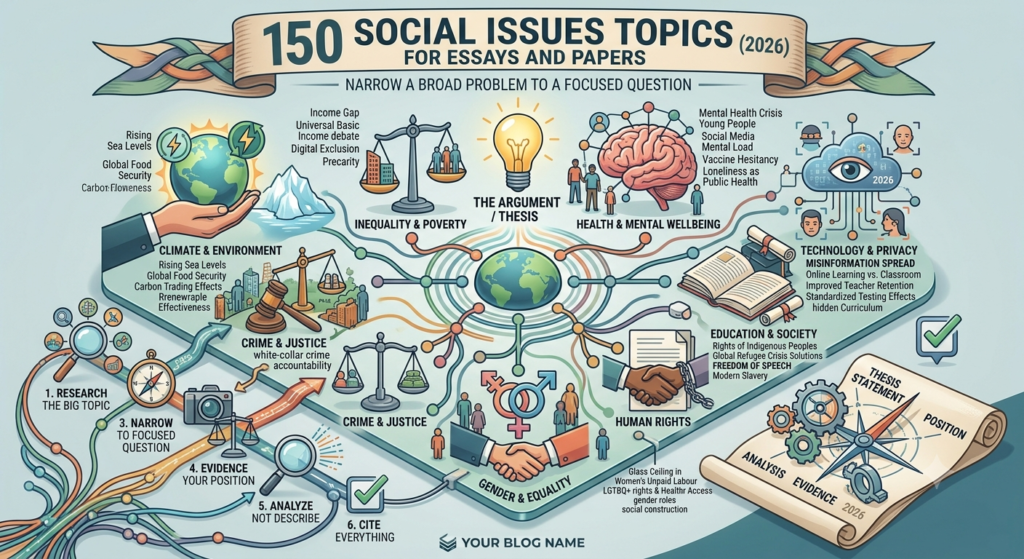
A strong social issues topic is current, arguable and backed by credible evidence. The most fruitful themes right now include climate and the environment, inequality and poverty, health and mental wellbeing, technology and privacy, education, human rights, and gender equality. Narrow a broad problem to a specific, researchable question rather than trying to cover the whole issue. Social issues make some of the best essay and research paper subjects because they are current, contested and rich in evidence. That same richness is the trap, though: it is easy to pick a problem so broad that you can only describe it, when what earns marks is a focused, arguable question you can defend. A social issues essay is ultimately an argument, so the same habits that lift any essay, a clear position and genuine analysis rather than description, decide the grade here too, which is why it helps to keep the principles of critical writing in mind from the start. This guide sets out the major issues of the moment, gives 150 topics grouped by theme, and shows how to turn one into a strong essay. The biggest social issues today Before the full list, it helps to see the major issues shaping public debate right now, since a topic drawn from a live, evidence-rich issue is far easier to research and argue. The most prominent include: 150 social issues topics by theme The topics below are grouped by theme. Narrow any of them to a specific group, place or period you can find evidence on, since focus is what turns a broad concern into a remarkable essay. Climate and the environment Inequality and poverty Health and mental wellbeing Technology, media and privacy Education and society Human rights and social justice Gender and equality Crime, justice and community Global and future issues How to write a strong social issues essay A social issues essay lives or dies on argument, not coverage. Start by narrowing your chosen issue to a specific, arguable question and stating your position as a clear thesis statement, so the reader knows from the outset what you will prove. Build the essay on credible, academic sources rather than the media alone, and treat every point as something to evidence and analyse rather than merely assert, which is exactly the descriptive-to-analytical shift covered in our critical writing guide. Give the opposing view a fair hearing before explaining why your position holds, since a one-sided essay reads as a rant rather than an argument. Organise it all within a clear structure, and because these essays draw heavily on other people’s research and data, cite everything carefully so you avoid plagiarism. Do those things and a good topic becomes a strong essay. Choosing the right topic for your assignment With 150 options above, the deciding factors are evidence and fit. Favour an issue with a genuine debate and plenty of credible sources, since a topic no one disagrees with gives you nothing to argue, and one with thin evidence leaves you stranded. Check that the issue suits your course and the length you have been set, and narrow it to a specific angle, group or country you can actually research. A focused question on a well-evidenced issue will always beat a broad take on a fashionable one. Whichever theme you choose from the lists above, the same rule holds: narrow it, evidence it, and let your argument, not your description, carry the essay.
How to Write a Cover Letter: A Step-by-Step Guide (2026)
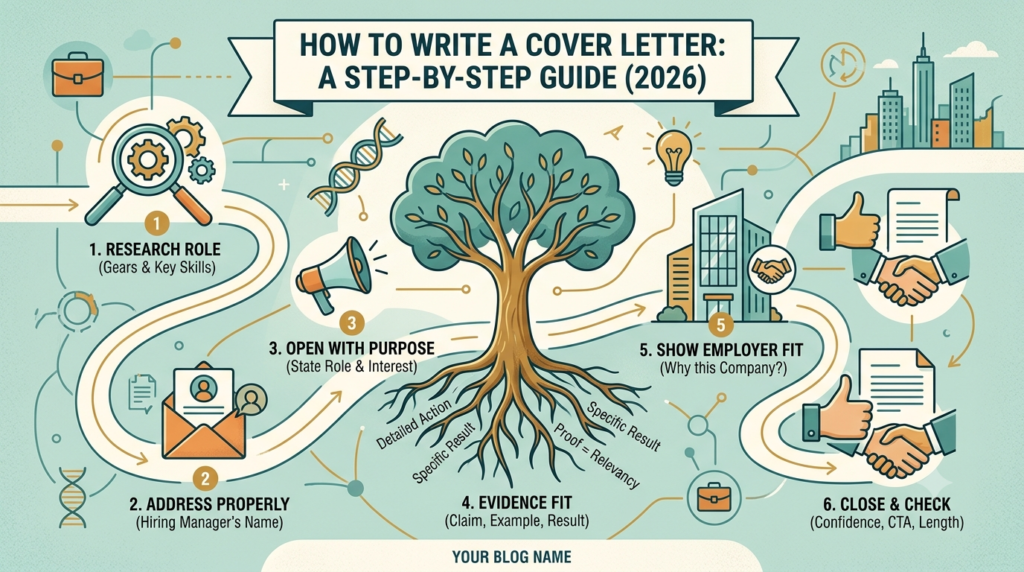
To write a cover letter, address it to a named person, open with the role and a clear reason for applying, use one or two paragraphs to evidence your most relevant skills with examples, explain why you fit this employer, and close confidently with a call to action. Keep it to one page, and tailor it to every job. A good cover letter turns your CV from a list into a case for why you should be interviewed. The secret is not clever writing but tailoring: matching your experience to the specific job and evidencing it. This guide walks through how to write a cover letter step by step, what goes in each paragraph, and how to tailor it fast, so you can write one that actually gets read. What is the purpose of a cover letter? A cover letter introduces you and makes the case that your skills and experience fit a specific role. It sits alongside your CV and does what a CV cannot: it explains why your background matters for this job and this employer, and it shows how well you communicate in writing. A strong cover letter can be the difference between an application that is read and one that is skimmed and set aside. How do you write a cover letter step by step? Follow these steps in order. Each maps to a part of the finished letter. Step What to do 1. Research the role Read the advert and note the key skills and requirements it lists. 2. Address it properly Find and use the hiring manager’s name where you can. 3. Open with purpose State the role and a specific, genuine reason for applying. 4. Evidence your fit Match your experience to the requirements, with brief examples and results. 5. Show employer fit Refer to something specific about the employer or role. 6. Close and check End with a call to action, then proofread and check the length. What goes in each paragraph? For finished examples of these paragraphs in context, see our cover letter examples guide, which shows weak and strong versions side by side. How do you tailor a cover letter quickly? Tailoring is what makes a cover letter work, and it does not have to be slow. Keep a strong base letter, then for each application change three things: the opening reason for applying, the examples you choose to match this advert’s key requirements, and the employer-fit paragraph. Mirror the language of the advert where it fits your genuine experience, since many employers scan for the skills they listed. That focused tailoring beats a longer, generic letter every time. How long should a cover letter be? One page, no more. Aim for three or four short paragraphs and around 250 to 400 words. Employers read many applications quickly, so a concise, specific letter that gets to the point is far stronger than a long one. If it runs over a page, cut the least relevant example rather than shrinking the font. Common cover letter mistakes Clear, well-structured writing carries a cover letter, the same clarity our how to write a first-class essay guide covers for academic work. Frequently asked questions How do you start a cover letter? Address it to a named person where possible, then open by stating the role you are applying for and a specific, genuine reason you are interested, rather than a generic line. How long should a cover letter be? One page, usually three or four short paragraphs and around 250 to 400 words. Keep it concise and specific, since employers read applications quickly. What should you not put in a cover letter? Avoid generic templates, a word-for-word repeat of your CV, unevidenced claims, famous quotes, and any leftover company or role name from a previous application. Do I need a cover letter if one is not requested? If the application allows it, a tailored cover letter usually helps, since it lets you make the case for your fit. If the employer explicitly says not to include one, follow their instruction.
120 Sports Essay Topics for Students (2026)
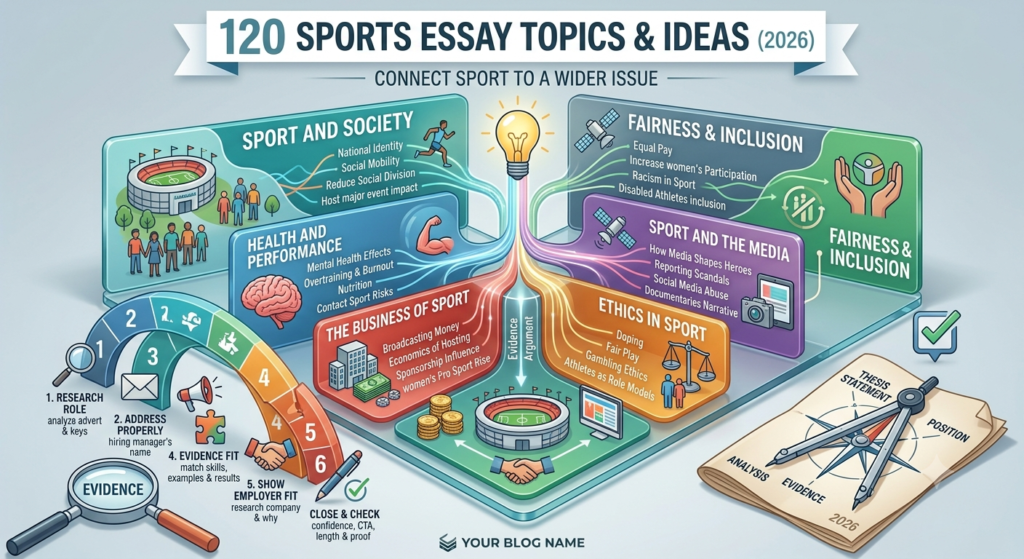
A strong sports essay topic connects sport to a wider issue, such as society, health, business, ethics, media or technology, rather than simply describing a game or player. Choose a focused, arguable angle you can support with evidence, and use sport as a lens on a broader question. Sport is a great essay subject because it connects to so much else: identity, health, money, ethics, politics and culture. The strongest sports essays use sport as a lens on a wider issue rather than recounting a match, and because they are arguments, the same habits that lift any essay, a clear position and analysis rather than description, decide the grade, which is why it helps to keep the principles of critical writing in mind from the outset. This guide gives 120 topics grouped by theme, then shows how to write a strong one. What makes a good sports essay topic? A good sports essay topic does two things. It connects the sport to a wider issue, so the essay has something to argue beyond the events of a game, and it is narrow and arguable enough to defend with evidence in the length you have. ‘Football’ is not a topic; ‘whether the commercialisation of football has harmed the game for ordinary fans’ is one you can argue. The best topics also draw on evidence you can find, whether statistics, examples or research, so it is worth checking that a debate exists and that sources are available before you commit. Sport is rich in strong feelings, so the skill is turning a passion into a reasoned, evidenced argument. 120 sports essay topics by theme The topics below are grouped by theme. Narrow any of them to a specific sport, league or country you can find evidence on. Sport and society Health and performance The business of sport Ethics in sport Sport and the media Fairness, inclusion and gender Technology and the future of sport Youth, school and grassroots sport Sport, politics and global issues How to write a strong sports essay A sports essay is still an argument, so treat it like one. Connect the sport to a wider issue and state your position as a clear thesis statement, so the reader knows what you will argue. Support each point with evidence, statistics, examples or research, rather than opinion alone, and analyse what that evidence shows instead of just describing events, which is the analytical habit our critical writing guide builds. Give the opposing view a fair hearing before explaining why your position holds, organise it all within a clear structure, and cite your sources so you avoid plagiarism. Do that, and a topic you care about becomes a strong, reasoned essay. Choosing the right topic for your assignment With 120 options above, evidence and interest decide it. Favour a topic where a genuine debate exists and where you can find statistics or examples, since a one-sided or under-evidenced topic gives you little to argue. Check it suits your course and the length you have been set, and narrow it to a specific sport, league or country. A focused, arguable topic on a well-documented issue will always beat a broad take on a fashionable one. Whichever theme you choose above, the same rule holds: use sport as a lens on a wider issue, narrow it, evidence it, and let your argument carry the essay.