How Do You Write a Dissertation Methodology Chapter?
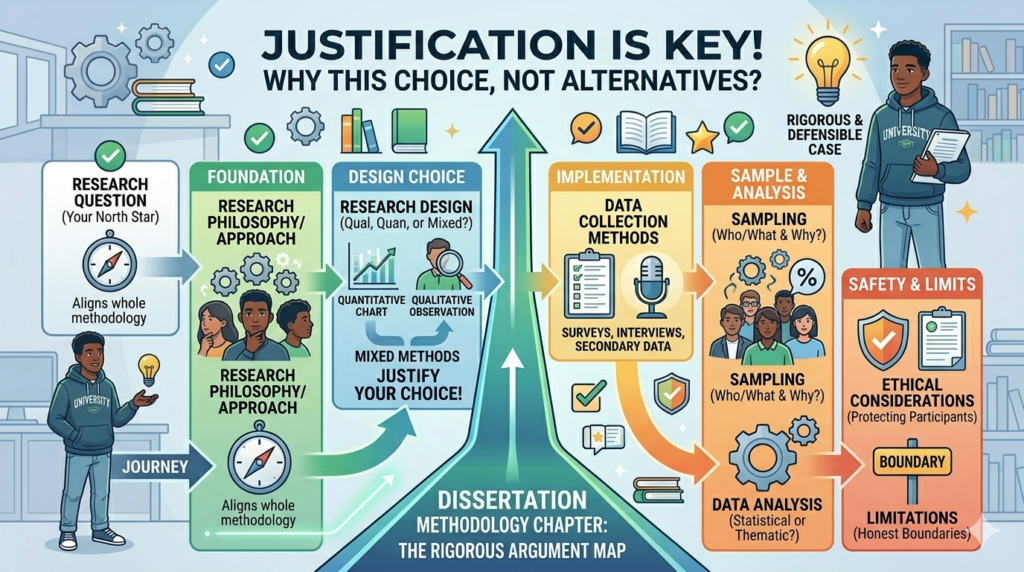
A dissertation methodology chapter explains how you carried out your research, then justifies why those choices were the right ones for your question. It is not a description of what you did. It is an argument that your approach was rigorous, defensible, then capable of answering your research question. The methodology is often the chapter examiners scrutinise hardest, because it shows whether your findings can be trusted. A weak methodology undermines even strong results. This guide covers the sections to include, how to justify your choices, then the mistakes that cost marks. If you have not yet locked your research question, start with our guide to writing a dissertation proposal, since the methodology flows directly from it. What should a methodology chapter include? A complete methodology moves through a predictable set of sections, each answering a question the examiner will ask. You do not need heavy jargon for every section, but you do need each one present, then justified. The chapter reads as a chain: each choice follows from the one before, all of it serving your research question. How do you choose between qualitative and quantitative methods? The choice follows your question, never the other way round. Quantitative methods suit questions about how much, how many, or whether a relationship holds across a large group. They produce numerical data you analyse statistically. Qualitative methods suit questions about why or how something is experienced, producing rich textual data from interviews or observation. A question such as “Does flexible working raise productivity in UK SMEs?” points quantitative. A question such as “How do SME employees experience flexible working?” points qualitative. Many dissertations use a mixed approach, combining both to balance breadth with depth. Our explainer on primary and secondary research helps you decide what data you actually need before you commit. → Stuck framing your approach? A model methodology chapter built around your question shows you exactly how to justify each choice, structured to your university’s expectations. How do you justify your methodology? Justification is what separates a first class methodology from a descriptive one. For every choice, answer “why this, rather than the alternatives?” If you ran interviews, say why interviews suited your question better than a survey. If you sampled twelve participants, explain why that number was appropriate for your design. Support your reasoning with methodological sources. Citing established texts on research methods shows the examiner your choices rest on accepted practice rather than convenience. This is the analytical move that earns marks: not what you did, but the reasoned case for why it was sound. How should you write about ethics and limitations? Ethics Set out how you protected participants: informed consent, the right to withdraw, anonymity, then secure data storage. Note any ethical approval your department requires. Even a study using only secondary data needs an ethics paragraph, since data use itself carries responsibilities. Limitations Stating limitations strengthens your work rather than weakening it. A small sample, a single site, or a short timeframe are normal constraints. Naming them shows you understand the boundaries of your claims, which examiners read as research maturity. The error is pretending limitations do not exist, then hoping nobody notices. What tense and voice should a methodology use? Write the methodology in the past tense, since you are reporting research already carried out: “interviews were conducted”, not “interviews will be conducted”. The passive voice is common here, though many institutions now accept the first person for reflective points. Check your department’s guidance, then stay consistent throughout. Once your methodology is set, it should align cleanly with the rest of your chapters, which our guide to dissertation structure maps out. How do you write a mixed methods methodology? A mixed methods study combines quantitative then qualitative data, so the methodology has to explain not just each method, but why you brought them together. State whether the two strands run at the same time or in sequence, then how they inform each other. A common design surveys a large group for breadth, then interviews a smaller subset for depth, with the interviews explaining patterns the survey reveals. The justification is the part examiners look for. Explain what the combination achieves that a single method could not. If your numbers show that flexible working raises productivity, your interviews can show why, which neither method delivers alone. Make that complementarity explicit rather than leaving the reader to assume it. What are the most common methodology mistakes? A handful of errors recur across undergraduate then masters work, then each is avoidable once you know to watch for it. The fix for all of them is the same discipline: for every sentence in the chapter, ask whether it explains why, not just what. A methodology that keeps answering “why this choice” is one that holds up under questioning, which is exactly what your viva will test. Our guide to preparing for a dissertation viva shows how examiners probe these choices. It helps to write the methodology as though a sceptical reader is sitting beside you, asking “says who?” after every claim. That reader is your examiner. When each choice is backed by a methodological source then a clear reason, the chapter stops being a description of your weekend of data collection, then becomes the rigorous case that lets a reader trust your findings. That shift in mindset, from reporting to justifying, is what lifts the chapter into the upper bands. Ready to take your dissertation further? Get specialist support. From refining your research question and literature review to methodology, analysis and final structure, dissertation work requires careful planning at every stage. Explore our dissertation writing support for your research project. Explore dissertation writing support Frequently asked questions How long should a dissertation methodology chapter be? Typically 15 to 20 per cent of your total word count. For a 10,000 word dissertation that is roughly 1,500 to 2,000 words, enough to cover design, methods, sampling, analysis, ethics, then limitations with proper justification. What goes in a methodology chapter?
What Is a Capstone Project? Types and Examples
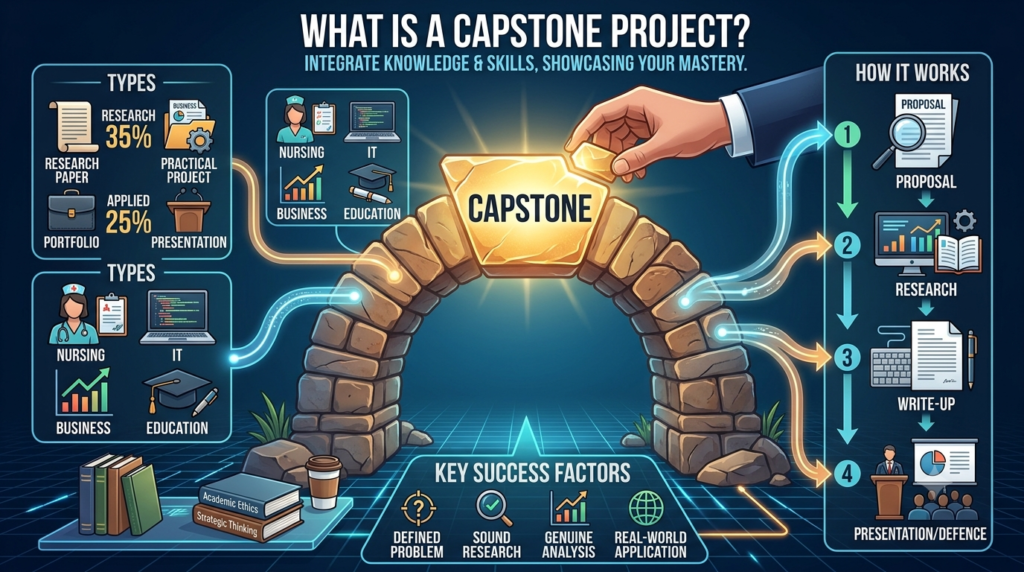
A capstone project is a final piece of work that pulls together everything you learned on your course to solve a real problem. It is common in US programmes and in applied subjects. Unlike a dissertation, it is usually applied and practical rather than purely research based, and you choose the problem yourself. The word capstone confuses a lot of students, especially those moving between the UK and US systems, because it means slightly different things in different places. At its core, though, a capstone is the same idea everywhere: a final project that proves you can put your whole course to work on something real. What makes a capstone different from other assignments? Three things set a capstone apart. That independence is the point. The capstone is your chance to show you can work like a professional in your field, making the decisions yourself rather than following a brief. Why do programmes use capstone projects? Capstones exist to bridge the gap between studying a subject and doing the job. A traditional exam or essay tests whether you understood the material. A capstone tests whether you can use it, which is what employers actually care about. That is why they are so common in applied and professional fields. A nursing capstone shows you can improve real patient care. A computer science capstone shows you can build something that works. A business capstone shows you can solve a real commercial problem. In each case, the finished project becomes something you can point to and say, I did this, which is far more useful in an interview than a grade on a transcript. How is a capstone different from a dissertation? Capstone Dissertation Main aim Solve a real, applied problem Answer a research question Style Practical and professional Academic and research led Output A solution, plan, or product A written research study Common in US programmes, applied subjects UK and most research degrees Length Often shorter Usually longer The two overlap, and some programmes use the words loosely, so always check what your own course means by capstone before you start. Where does the word capstone come from? The name is a useful clue to what the project is. A capstone is the final stone placed at the top of a building, the one that locks all the others in place and finishes the structure. A capstone project does the same thing for your degree. It sits at the end and pulls everything together. That image explains why capstones are integrative by design. They are not meant to test one new thing you learned last term. They are meant to test whether you can bring your whole course to bear on a single real problem, which is exactly what you will have to do once you are working. Keeping that picture in mind helps when you choose a topic, because the best capstones genuinely draw on the breadth of what you studied. What subjects use capstone projects? Capstones appear across applied disciplines, where showing you can do the job matters as much as knowing the theory. What are the types of capstone projects? Capstones take different forms depending on the field, but most fall into a few types. How do you approach a capstone? Most capstones come with a supervisor or advisor who signs off your proposal and gives feedback at set points. The structure below fits most applied capstones. What are examples of capstone projects? Real examples make the idea concrete. Each of these solves a real problem and draws on a whole course rather than one module. In every case, the point is the same. You identify a problem, apply what you learned, and produce something that could actually be used. How is a capstone graded? Capstones are usually graded on how well you solved the problem, not just on what you wrote. Assessors tend to look at a few things. That last point surprises students. A capstone that honestly reflects on what went wrong often scores better than one that pretends everything went perfectly, because reflection shows real professional judgement. How do you choose a capstone topic? A good capstone topic sits where your interest, your course, and a real problem meet. Choose something you can genuinely study or solve in your time frame, with access to whatever people, data, or setting it needs. As with a dissertation, a narrow, specific problem beats a broad one every time. How long does a capstone take to complete? A capstone usually runs across a full term or semester, with set milestones along the way rather than one final deadline. The exact timeline depends on your programme, but most follow a similar shape. You typically spend the early weeks choosing your problem and writing a proposal, the middle stretch doing the actual work with check-ins from your advisor, and the final weeks producing your report and, in many cases, a presentation. Because the work is spread out, the students who struggle are usually the ones who treat the early milestones as unimportant and leave everything to the end. The steady approach wins, because a capstone rewards consistent work far more than a last minute sprint, and your advisor’s feedback at each stage is most useful when you actually have time to act on it. Ready to develop your capstone project? Let our experts help. Once you’ve chosen your topic, the next step is turning your idea into a structured project with clear research, analysis and presentation. Explore our capstone project writing support for guidance throughout your project. Explore capstone project writing support Frequently asked questions What is a capstone project in simple terms? A final project that pulls together everything from your course to solve a real problem. It is usually applied and practical, and you choose the problem yourself. Is a capstone the same as a dissertation? No, though they overlap. A capstone is usually applied and practical, aimed at solving a real problem. A dissertation is research led, aimed
How Long Does It Take to Write a 2000 Word Assignment?
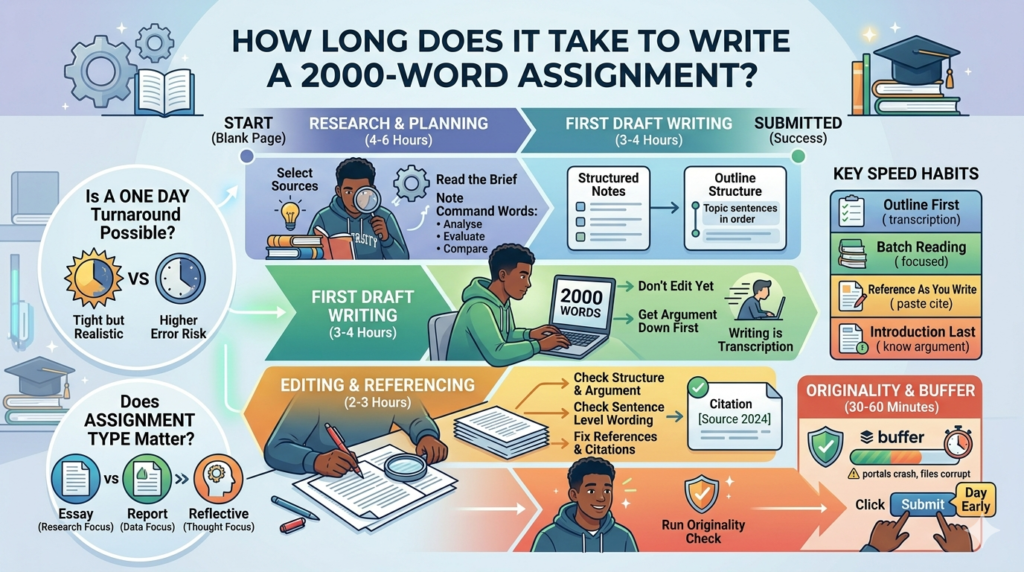
A 2,000 word assignment takes most students 8 to 14 hours from blank page to final submission, spread across research, planning, writing, then editing. The writing itself is the smallest part. Reading, thinking, then redrafting take the bulk of the time, which is why starting early matters more than writing fast. The honest answer depends on three things: how familiar you are with the topic, how much reading the brief demands, then how polished the final piece needs to be. A reflective journal you know well might take six hours. A researched essay in an unfamiliar area can stretch past fifteen. Breaking the task into stages gives you a realistic timeline rather than a panicked all nighter. How long does each stage actually take? Splitting a 2,000 word assignment into stages shows where the hours really go. Understanding the brief: 30 to 60 minutes Read the question, the marking criteria, then any rubric twice. Note the command words such as “analyse”, “evaluate”, or “compare”, because they decide what the marker expects. Skipping this stage is the most expensive mistake students make, since a misread brief can sink an otherwise strong piece. Research and reading: 3 to 5 hours This is usually the longest stage. Gather sources, read selectively, then take structured notes tied to the points you plan to make. Reading everything is a trap. Read with your argument in mind, capturing only what supports or challenges it. If you are unsure which sources count, our explainer on primary and secondary research clarifies what to prioritise. Planning and outlining: 30 to 45 minutes Map your structure before writing a single paragraph. List your topic sentences in order. A clear outline turns the writing stage from a struggle into transcription, because you already know what each paragraph must do. Writing the first draft: 3 to 4 hours With a plan in place, most students write 2,000 words of the first draft in three to four hours. Do not edit as you go. Get the argument down, then fix it later. Trying to perfect each sentence on the first pass is what makes writing feel slow. Editing and referencing: 2 to 3 hours Editing is where good work becomes strong work. Check structure first, then argument, then sentences, then references last. Formatting citations correctly takes longer than students expect, so leave real time for it. → Short on time this week? A model assignment built to your brief gives you a structured reference answer to learn from, so your own writing stage moves faster. How can you write a 2000 word assignment faster? Speed comes from preparation, not from typing quickly. A few habits cut hours off the total. The students who finish fastest are rarely the fastest typists. They are the ones who decided their structure early, which removes the staring at a blank page that eats so many hours. Our guide to structuring a university assignment shows how to build that plan in under an hour. How long does a 2000 word assignment take to write by hand? If your assessment requires handwriting, add time. The average person writes 20 to 30 words a minute by hand, so 2,000 words is roughly 70 to 100 minutes of pure writing, before any thinking. Most handwritten exam answers are shorter for this reason. For coursework, type your draft, then copy it out if required, rather than composing by hand from scratch. Can you write a 2000 word assignment in one day? Yes, though it is tight rather than ideal. A focused day of around eight hours can produce a solid 2,000 word piece if you already understand the topic. The risk is editing. Work written in a single sitting carries errors the writer no longer sees, so a one day turnaround usually costs you marks on polish. If a deadline has crept up, our breakdown of how UK universities mark essays shows which quick fixes protect the most marks when time is short. Does the assignment type change how long it takes? The format shifts the total significantly, even at the same word count. Researched essays These sit at the longer end, since reading then synthesising sources is the slow part. Expect the full 12 to 14 hours for an unfamiliar topic, most of it spent before any writing begins. Reports Reports often move faster once the data is in hand, because the labelled structure removes decisions about flow. The time moves into presenting findings clearly in tables then figures, which has its own learning curve. Reflective writing Reflective pieces can be quicker, since the source material is your own experience rather than a literature base. The challenge is depth of reflection rather than research time, so budget thinking time over reading time. What should your timeline look like the week before a deadline? Spreading a 2,000 word assignment across a week beats a single marathon every time, since the gaps let your editing eye reset. A workable plan looks like this. The buffer on the final day matters more than students expect. Portals crash, files corrupt, then deadlines do not move. Submitting a day early removes a whole category of avoidable stress. One last point on speed. The time a 2,000 word assignment takes falls sharply the second time you write in a format, because the structure stops being a decision. The first report you write is slow; the third is routine. Treat each piece as practice that lowers the hours on the next, then the early investment in learning the shape pays back across your whole degree. → Beat the deadline without cutting corners. Check originality with a fast Turnitin and AI report, or see pricing for a model answer turned around in as little as a few hours. Frequently asked questions How many hours does a 2000 word assignment take? Most students need 8 to 14 hours in total: around 4 hours of research, 1 hour planning, 3 to 4 hours drafting, then 2 to 3 hours editing
How to Structure a University Assignment: Formats That Win Marks
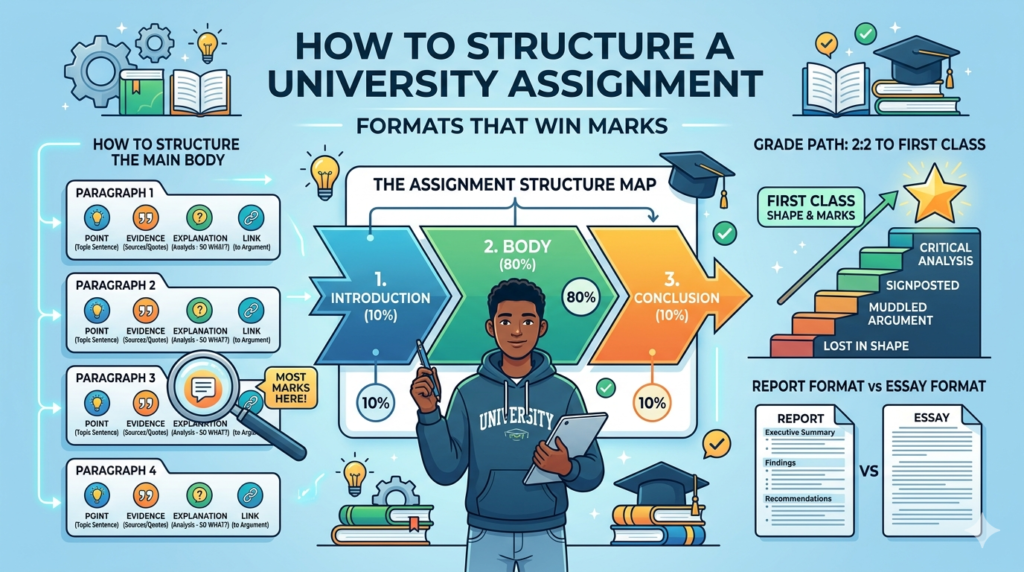
A university assignment follows a clear three part shape: an introduction that states your argument, a body that develops it in focused paragraphs, then a conclusion that ties it back to the question. Get that structure right and you make the marker’s job easy, which is what moves a piece from a 2:2 into 2:1 or first class territory. Most marks lost in undergraduate work are not lost on ideas. They are lost in shape. A student can know the material well, yet bury the argument so deeply that the marker never sees it. This guide walks through the structure that works for almost every brief, then shows where the shape shifts for reports, reflective pieces, then case studies. What is the basic structure of a university assignment? Every standard assignment has three parts that carry roughly fixed proportions. The introduction takes about 10 per cent of your word count. The main body takes around 80 per cent. The conclusion takes the final 10 per cent. For a 2,000 word assignment that means a 200 word introduction, 1,600 words of body, then a 200 word conclusion. Those proportions matter because markers read for signposting. They want to know your position early, see it built with evidence in the middle, then watch you land it at the end. When a body section swells to fill the introduction’s job, or a conclusion smuggles in new arguments, the reader loses the thread. Holding the proportions keeps your argument visible from the first line to the last. How do you write an introduction that sets up the marks? A strong introduction does three jobs in a short space. It frames the topic, states your central argument or thesis, then signposts the order of what follows. Think of it as a map handed to the reader before the journey starts. First, frame the topic. Open with the specific question or problem, not a broad historical sweep. A line such as “This assignment examines whether flexible working improves productivity in small firms” tells the marker exactly what is coming. Then state your position. Even a balanced piece needs a thesis, a sentence that says where you will land. Finish the introduction by signposting the sections in order. This is the single fastest way to lift a muddled draft, because it forces you to decide your structure before you write the body. If you want to see how markers translate this into a grade, our guide to what UK university markers actually want breaks down the criteria line by line. How should you structure the main body? The body is where most of your marks live, so each paragraph needs to earn its place. The reliable pattern is one idea per paragraph, built with the PEEL shape: Point, Evidence, Explanation, then Link. What does a PEEL paragraph look like? Start with a topic sentence that states the point. Bring in evidence, a source, a statistic, or an example. Explain what that evidence means for your argument, which is the analysis markers reward most. Close with a link sentence that connects back to the question or forward to the next paragraph. The explanation step is where weaker work falls down. Describing a source is not the same as analysing it, so always push past “what” into “so what”. How long should a paragraph be? Aim for 150 to 200 words, roughly four to six sentences. A paragraph shorter than three sentences usually means the idea is underdeveloped. One that runs past 250 words often hides two separate points that should be split. Reading your body aloud is a quick test: if you run out of breath before the point lands, the paragraph is doing too much. → Need a model assignment to study from? Our assignment writing support builds reference answers structured to your exact brief, so you can see how a first class shape works before you write your own. What makes a strong conclusion? A conclusion synthesises, it does not summarise. Weak conclusions repeat the introduction in different words. Strong ones pull the threads together to show what the argument adds up to, then answer the question directly. Never introduce new evidence here. If a point matters enough to include, it belongs in the body. A useful closing move is to state the limitation or the wider implication. A line such as “While the evidence supports flexible working in small firms, the picture may differ in regulated sectors” shows the marker you understand the boundaries of your own argument. That awareness reads as maturity, which sits at the top of most marking rubrics. You can see how this plays out across grade bands in our breakdown of how UK universities mark essays. How does structure differ by assignment type? The intro, body, then conclusion spine holds for most work, yet several common formats reshape it. Reports A report swaps flowing sections for labelled ones: executive summary, introduction, methodology, findings, discussion, recommendations, then references. Headings are expected, not optional. If your brief uses the word “report”, structure for scannability rather than continuous prose. Our guide to writing coursework that scores a first covers report formatting in more depth. Reflective writing Reflective assignments follow a model such as Gibbs, moving through description, feelings, evaluation, analysis, then an action plan. The argument is about your own learning rather than an external debate, so the first person is allowed here when it is rarely allowed elsewhere. Dissertations and longer projects A dissertation scales the same logic across chapters rather than paragraphs. Each chapter carries its own mini introduction then conclusion. If you are working toward one, our chapter by chapter walkthrough of dissertation structure shows how the shape expands. How does good structure affect your grade? Markers work on time. A clearly structured piece lets them find your argument, your evidence, then your analysis quickly, so they can award the marks you have earned. A disorganised piece forces them to hunt, and marks that are hard to find often
Does Turnitin Detect AI and ChatGPT Writing?

Yes. Turnitin has an AI writing indicator that estimates how much of your text reads as AI generated. It is separate from the similarity score and it is not perfect. It can flag human writing as AI and miss edited AI text, so the result is a prompt for review, not a verdict. Since AI writing tools became part of everyday student life, the first thing people want to know is whether Turnitin can tell. The short answer is that it tries, through a feature built specifically for the job, and that the feature is useful but far from infallible. Understanding what it can and cannot do is the difference between sensible caution and needless panic. Does Turnitin have an AI detector? Yes. In addition to the familiar similarity report, Turnitin provides an AI writing indicator. Where the feature is switched on by your institution, it produces an estimate of how much of your document appears to have been generated by an AI tool, shown as a percentage. It runs on a completely separate model from the similarity check and answers a different question, so a single submission can return both a similarity score and an AI score that have nothing to do with each other. Check your Turnitin score for UK universities, Australian universities, European universities, and Canadian universities. How does the AI indicator actually work? The model looks at patterns in how the text is written rather than whether it matches another source, and it does this in a fairly specific, mechanical way. Turnitin breaks your document into small segments, roughly a paragraph or a few sentences at a time, rather than judging the whole thing at once. Each segment is scored on its own for how likely it is to be machine generated, and the individual segment scores are then averaged into the overall percentage you see. Two properties of the writing matter most to this kind of model. The first is predictability, sometimes called perplexity in the underlying research: AI text tends to choose the statistically most likely next word again and again, which produces smooth, expected phrasing. Human writing is less predictable, with more unusual word choices and small imperfections. The second is rhythm, sometimes called burstiness: humans naturally mix long, complex sentences with short, blunt ones, while AI output tends to settle into a more even, consistent sentence length. Turnitin’s model was trained on a large set of confirmed human writing and confirmed AI writing from tools including GPT-3.5 and GPT-4, and it learned the statistical fingerprint that separates the two. This is an indirect signal, not a fingerprint in the forensic sense. There is no hidden watermark in most AI text that the tool reads. It is making an educated guess based on style, which is why it can be confidently wrong in both directions, and why a heavily edited AI paragraph can slip through while an unusually smooth human paragraph gets flagged. A worked example makes the averaging concrete. Say a 1,500-word essay is broken into ten roughly equal segments. If the model scores eight of those segments as essentially human, say 0.05 to 0.15 on its internal 0-to-1 scale, but two consecutive segments in the middle of the essay score 0.9, the overall document percentage comes out far lower than the risk actually sitting in that one section, because the average smooths across the whole paper. This is precisely why the segment-level highlights matter more than the headline number. A 22% overall AI score sitting in one concentrated, unedited block tells a very different story than the same 22% spread thinly and inconsistently across the entire document, and only opening the highlighted view shows you which one you are looking at. Why does Turnitin hide scores under 20%? This is a detail most guides skip, and it matters if you are trying to make sense of a low number. Turnitin’s testing found that AI scores in the 1% to 19% range carry a meaningfully higher risk of being false positives than scores at 20% and above. Rather than show a precise but unreliable number in that range, the system displays an asterisk instead of a percentage, so your tutor sees something like *% rather than, say, 12%. No sentence-level highlights are shown for scores in that band either. Once a submission crosses 20%, Turnitin shows the exact percentage and starts highlighting the specific segments it believes are AI generated. In 2026, this breakdown is further split into two categories: text that appears to be AI generated with no further changes, and text that appears to be AI generated and then run through a paraphrasing or humanising tool afterwards. That second category exists precisely because running ChatGPT output through a paraphraser used to be a common workaround, and Turnitin’s detector now specifically looks for the statistical residue that paraphrasing leaves behind, even when the words themselves have been substantially changed. Is the AI score the same as the similarity score? No, and confusing the two causes a lot of needless worry. The similarity score measures matching text, the overlap between your words and other sources. The AI score measures how a machine like your writing reads. They are entirely independent, produced by different models looking at different things. You can write something entirely yourself, cite nothing identical to any source, score a clean zero on similarity, and still pick up a high AI score because your style happens to look even and predictable. The reverse is also true: a paper stitched together from quotes and paraphrased sources can score high on similarity while reading as completely human. For the similarity side of the picture, see how Turnitin works. Can Turnitin’s AI detection be wrong? Yes, and this is the most important thing to understand. No AI detector on the market is fully reliable, and Turnitin is open that its indicator should be read as guidance rather than proof. Turnitin’s own published testing puts the false positive rate at under 1% for
Is Using ChatGPT for Essays Plagiarism?
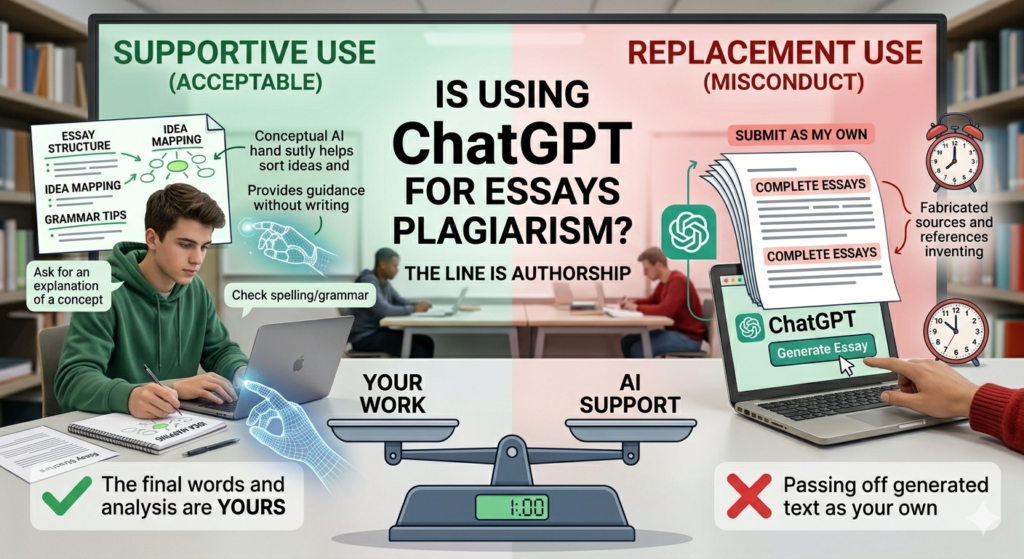
Using ChatGPT is not automatically plagiarism, but submitting AI written work as your own usually breaks academic integrity rules. Most universities now treat undisclosed AI use as misconduct. Using it to brainstorm or check grammar is generally fine. Passing off generated text as your own writing is the line most institutions draw. The rules around AI moved fast, and they are not the same at every university, which leaves a lot of students genuinely unsure where the line sits. This is the practical version, without the scare tactics and without pretending the answer is simpler than it is. The short version is that the problem is rarely the tool itself. It is what you do with what it produces. Is using ChatGPT plagiarism? Plagiarism, in the traditional sense, is presenting someone else’s words or ideas as your own without credit. AI muddies this because the text does not come from a person you could cite. So most universities have stopped trying to squeeze AI into the old definition and instead treat undisclosed AI writing as its own category of academic misconduct. The practical effect is the same. If you hand in AI generated text as if you wrote it, you are likely breaking the rules, whether your institution calls it plagiarism or something else. The useful distinction is between using AI to support your own work and using it to do the work for you. Support is generally acceptable. Replacement generally is not. For the wider context on what counts as misconduct, see what counts as plagiarism. When is AI use acceptable? Many universities are comfortable with AI as a study aid, as long as the final work is yours and you follow any disclosure rules. Common acceptable uses include: The common thread is that you remain the author. The AI helps you think, but the words and the analysis are yours. Always check your own course rules, because some allow more than others and a growing number ask you to declare any AI use, however minor. When does AI use break the rules? The line is usually crossed when AI stops supporting your work and starts producing it. That includes: That last point catches people out. AI tools can fabricate convincing references that do not exist, and submitting those is a serious problem on top of the AI question, because it looks like you cited work you never read. Can teachers tell you used AI? Often, yes, through a combination of detection tools and simple familiarity with your writing. Many institutions run AI detection, and while it is imperfect, it flags work for a closer look. Just as importantly, tutors notice when a student’s style changes suddenly, when the writing is fluent but oddly empty of real argument, or when references do not check out. See does Turnitin detect AI for how the detection side works and where it falls short. How do I check my work for AI flags? If you used AI anywhere, or even if you did not and just want to be safe, run your work through our AI content detector before you submit. Look at the flagged sections and rework anything that reads as generated, adding your own examples and analysis so the writing is clearly yours. This matters even for fully human work, because AI detectors produce false positives and honest writing sometimes gets flagged, so it is worth catching before it reaches your tutor. What should I do if I already used AI? If you leaned on AI more than you should have, the fix is to make the work genuinely yours. Rewrite the generated parts in your own voice, add your own analysis, examples and reading, and check that every reference is real and that you have actually read it. Then check the result for AI flags, and follow your university disclosure rules if it asks you to declare AI use. The goal is to end up with work you understand and can stand behind, because that is what an assessment is for in the first place. What counts as disclosing AI use? As more universities ask students to declare how they used AI, it helps to know what a good disclosure looks like, because a vague line at the end of an essay is not really disclosure. The point is to be specific about what the tool did and what you did, so your tutor can see that the thinking and the writing are yours. A useful disclosure names the tool, describes the task you used it for, and makes clear that the final work is your own. For example, stating that you used an AI tool to suggest an essay structure, or to explain a concept you then wrote about yourself, or to check grammar on text you had written, is clear and honest. What does not count is implying you wrote everything when a tool generated parts of it, or burying heavy AI use under a token mention. If your course provides a disclosure format, use it exactly. If it does not, a short, specific statement is far safer than silence, and silence about significant AI use is what most often turns an allowed activity into misconduct. A simple rule of thumb for staying safe If you want one principle to keep you clear of trouble, it is this. You must be the author of your work, in both the words and the thinking. AI can help you understand, plan and polish, but the moment it is producing the substance that you then submit as your own, you have crossed the line, whether or not a detector ever catches it. A practical test is to ask whether you could sit down with your tutor and talk through your work in detail, explaining why you made each choice and where each idea came from. If you could, the work is genuinely yours and you are almost certainly fine. If you could not, because parts of it were generated and you never really engaged
Capstone Project Help: The Complete Guide to Writing a Capstone Project
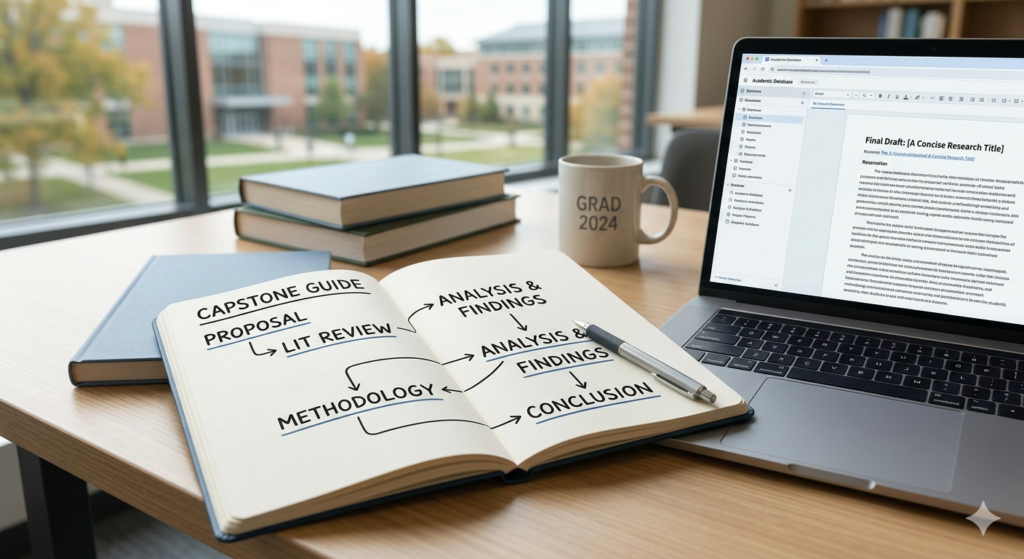
A capstone project asks you to apply everything from your degree to one real problem. Writing it well comes down to four things: a focused question, a clear structure, evidence-led analysis, then disciplined time management. This guide covers all four, plus how to use capstone projects help the right way. A capstone sits at the end of your programme for a reason. It is the piece that proves you can take what you have learned then put it to work on a problem that matters in your field. That makes it rewarding, but also high stakes, since it often carries a heavy share of your final mark. The good news is that a capstone rewards process over brilliance. Get the steps right, in order, then the project largely builds itself. What is a capstone project, and why does it matter? A capstone project is a culminating assignment that integrates the knowledge, skills, then methods from your whole course into a single substantial piece of work. Unlike a normal essay, it usually solves or investigates a practical problem, then often includes a presentation or portfolio alongside the written report. We cover the full definition, types, then examples in our guide to what a capstone project is. It matters because it is the closest thing in your degree to professional work. Employers, then admissions panels for further study, read a capstone as evidence that you can scope a problem, gather evidence, then deliver a reasoned recommendation. That is why the grading rewards application, not just knowledge. What does a capstone project structure look like? Most capstone projects follow a structure close to a short dissertation. The sections, in order, are: introduction, literature review, methodology, findings, discussion, conclusion, then references, with appendices where needed. Before you write a word, map this into an outline. Our step by step guide to writing a capstone project outline shows how, with a worked example. If your project is research-heavy, the same logic that drives a dissertation structure applies at a slightly smaller scale. How long does a capstone project take to write? A capstone is a project of weeks, not days. A typical undergraduate capstone runs 25 pages or more, then expects real research behind it, so plan for several weeks across topic selection, research, writing, then revision. A realistic split puts the largest block on research, a focused block on drafting, then a final stretch on editing, referencing, then preparing any presentation. The single biggest predictor of a strong capstone is an early start. Projects written in a panic at the end read as rushed, because they are. Beginning the moment the brief lands gives you time to refine the question, which is where most of the quality is won or lost. What are the most common capstone mistakes? Four errors recur, then each is avoidable. → Want to see how a strong capstone is built? A model capstone project structured to your brief gives you a worked reference for every section, so you can see the standard before you write your own. How do you choose a capstone topic? Choose a problem that is specific, researchable, then genuinely interesting to you, since you will live with it for weeks. The best topics sit where your field has a real gap then you can actually gather evidence. For a long list grouped by subject, see our 50+ capstone project ideas, then narrow one into a sharp project question. How do you get capstone help without risking academic integrity? This is the question behind every “do my capstone project” search, then it deserves a straight answer. Legitimate capstone help means using support as a learning aid while the work you submit stays your own. A model capstone shows you how a strong project is structured, argued, then referenced, in the same way a worked example in a textbook teaches a method. The misuse is copying it wholesale then submitting it, which breaches academic integrity rules at every institution. Used well, support speeds your learning: a model project to benchmark against, feedback on your draft, then an originality check before you submit. Run your finished draft through a Turnitin similarity and AI report so you can see exactly what your supervisor’s system will see, then fix any issues while they are still fixable. Our guide to reducing plagiarism in long projects covers the technique. How is a capstone presentation or defence assessed? Many capstones end with a presentation or viva where you talk through your work then field questions. Assessors look for three things: whether you can explain your problem then findings clearly, whether you can defend your method when challenged, then whether you understand the limits of your own work. Prepare by rehearsing a five minute summary, then listing the three hardest questions you could be asked. Being able to say “this is what I would do differently next time” reads as maturity, not weakness. Treat the presentation as part of the project, not an afterthought. A strong written report undersold in a nervous, unstructured talk loses marks that were already earned. A clear, confident walkthrough protects them, so build in time to rehearse before the day. How should you manage your time across a capstone? Work backward from the deadline, then block the project into phases: a week or two to settle the question, then proposal, the largest block for research, a focused block for drafting section by section, then a final stretch for editing, referencing, then rehearsing any presentation. Build a buffer at the end, since data collection slips then portals fail. Students who protect that buffer submit calmly, while those who do not lose marks to avoidable last-minute errors. Ready to develop your capstone project? Let our experts help. Once you’ve chosen your topic, the next step is turning your idea into a structured project with clear research, analysis and presentation. Explore our capstone project writing support for guidance throughout your project. Explore capstone project writing support Frequently asked questions What is
Cookery Assignment Help: A Complete Guide for Commercial Cookery and Hospitality Students

Cookery assignments are not really about cooking. They test whether you can document, cost, then reflect on professional kitchen practice, through logbooks, menu plans, reflective journals, then food safety records. Strong marks come from precise records then honest reflection, not from being the best cook in the room. Many culinary students are surprised by how much writing their course demands. You enrolled to cook, then found yourself filling logbooks, costing menus, then reflecting on your service. That paperwork is where assessment lives, since it is the only way an assessor can verify what you did in a kitchen they did not see. This guide breaks down each type of cookery assignment, then shows how to approach it for top marks. What does a cookery assignment actually involve? Cookery assessment is built from several recurring tasks, then most courses use a mix of them. Knowing what each one tests stops you treating them all the same way. Each rewards precision over flair. An assessor cannot taste your dish, so the marks go to how clearly you evidence then explain your practice on paper. Which qualifications set cookery assignments? The format depends heavily on where you study. In Australia, commercial cookery sits within vocational training, most commonly the Certificate III in Commercial Cookery (SIT30821) then the Certificate IV, built from units of competency such as SITHCCC043 Work effectively as a cook then SITHKOP005 Coordinate cooking operations. These units demand logbooks, service-period records, then mapped evidence. In the United Kingdom, culinary study runs through City and Guilds diplomas, NVQs, then hospitality management courses, which lean more on reflective writing, menu projects, then theory essays. Wherever you study, read your unit or module guide closely, since the evidence it requires is exactly what your assignment must produce. Why do students find cookery assignments hard? The difficulty is rarely the cooking. It is the volume of documentation stacked on top of long practical hours, then split between kitchen shifts and written deadlines. Many culinary students also study in a second language, which makes the writing slower, then the technical terminology, mise en place, emulsification, brunoise, adds a vocabulary layer on top. Time is the real pressure. A full practical day leaves little energy for writing up a logbook or costing a menu, so records pile up then get rushed near the deadline. The fix is habit: capture evidence as you go, then write it up the same day while the detail is fresh. Need help turning culinary research into an academic assignment? From food safety and HACCP reports to menu planning, nutrition analysis and hospitality coursework, academic cookery assignments require both subject knowledge and clear academic structure. Explore cookery assignment writing support How do you write a strong cookery logbook? A logbook proves you performed each task to standard, so entries must be dated, detailed, then signed off by your supervisor. Vague entries fail, since they evidence nothing. Each entry should name the dish, the method, the quantity, the equipment, then a short reflection. Our full guide to completing a commercial cookery logbook covers the SITHCCC units, the required frequency, then the common mistakes that cost marks. → Behind on your paperwork? A model cookery logbook or menu project built to your unit shows exactly how a strong submission is evidenced, so you can see the standard before writing your own. How do you cost and plan a menu? Menu assignments test commercial thinking, not just cooking. You design a menu, build standard recipe cards, calculate each dish cost, then set prices using a target food cost percentage. The marks sit in the accuracy of the numbers, then the justification of your choices. Our guide to costing and planning a menu walks through the calculations with a worked example. How do you write reflective entries? Reflection asks you to analyse your performance, not describe it. Using a model such as Gibbs, you move from what happened, through how it went, to what you would change. Honest self-evaluation then a clear action plan score higher than a flattering account where nothing went wrong. Our guide to writing a reflective commentary shows how to structure each stage. How do you reference a cookery assignment? Theory and menu assignments still need referencing, usually in Harvard or Chicago depending on your provider. Cite the sources behind your claims: food safety regulations, nutrition guidelines, then technique references. Even practical assignments benefit from a short reference list showing the standards you worked to. Treat referencing as easy marks you should not give away through carelessness. How do you get a cookery assignment help the right way? Legitimate help means using support to learn, while the work you submit stays your own. A model logbook entry, a sample reflective commentary, or a worked menu costing shows you the standard, in the same way a demonstration dish shows you a technique. The misuse is copying records of practice you did not perform, which is both dishonest then easy for an assessor to spot. Use support as a template, then evidence your own real work. Before you submit any written piece, a quick Turnitin and AI report confirms your originality, which matters since many cookery providers now attach one as standard. How do you balance practical hours with written assignments? The hardest part of a culinary course is rarely a single task; it is fitting the paperwork around long kitchen shifts. The students who cope build small daily habits rather than leaving everything to a deadline weekend. Spend ten minutes after each shift updating your logbook while the detail is fresh. Keep a running note of menu ideas then reflections on your phone. Block one short writing session a week for theory work. None of these is heavy alone, but together they stop the documentation becoming a wall you face all at once near assessment. This matters more in cookery than in most subjects, because the evidence is perishable. A logbook entry written a week late loses the specific detail that makes it
Law Assignment Help: A Practical Guide to Higher Marks

Law assignment help means learning how to research, structure, analyse legal issues, and apply case law correctly to produce higher-scoring university assignments. Whether you’re tackling a problem question or an argumentative essay, success depends on demonstrating legal reasoning rather than simply describing the law. In this guide, you’ll learn how to plan your answer, use the IRAC method effectively, reference sources correctly, avoid common mistakes, and build clear legal arguments that meet university marking criteria. What does a law assignment actually test? Markers reward legal reasoning, not memory. A strong answer states the relevant rule, points to the authority behind it, applies that rule to the facts in front of you, and reaches a clear conclusion. Listing every case you can remember does the opposite. It fills the word count without showing the examiner that you can think like a lawyer. This is why the IRAC method is so widely taught. You set out the Issue, state the Rule, Apply it to the facts, and give a Conclusion. The application step is where the marks sit. Two students can cite the same case and the same statute, but the one who explains why that authority decides the question in front of them will score higher every time. How should you structure a law assignment? Structure depends on the type of question you have been set. The two most common are problem questions and essay questions, and they reward different things. Problem questions A problem question gives you a scenario and asks you to advise a party. Work through it issue by issue. For each issue, name it, state the rule with its authority, apply the rule to the specific facts, and reach a conclusion on that point before moving on. Resist the urge to write everything you know about the area. Advise on what the facts raise, and nothing more. Essay questions An essay question asks you to argue a position, often on whether the law in an area is satisfactory. Here the marks come from a clear line of argument supported by authority and academic commentary. Plan your argument before you write, decide what your answer to the question is, and make every paragraph push that argument forward rather than summarising the topic. How do you reference a law assignment correctly? Most UK law schools use OSCOLA, which places citations in footnotes rather than in the text. Cases, statutes, books and journal articles each have their own format, and small errors add up fast across a long footnote list. If you are studying in the United States, your course is more likely to use Bluebook. Whichever style applies, set up your footnotes as you write rather than at the end, when it is easy to lose track of a source. Accurate referencing is also part of academic integrity. A missed citation can read as someone else’s idea presented as your own, even when that was never your intention. Checking your work before you submit catches these slips while you can still fix them. What are the most common law assignment mistakes? How do you plan a law assignment before you write? Planning saves you from the most common law assignment problem, which is writing a great deal while saying very little. Read the question twice and underline exactly what it asks. For a problem question, list each legal issue the facts raise, in the order they arise. For an essay, decide your answer to the question before you write a single word. A short plan that names your issues, or states your argument in one line, keeps every paragraph earning marks rather than drifting into general description. It also helps to gather your authority while you plan. Note the key cases and statutes for each issue, with a line on what each one decides. When you come to write, you are applying authority you have already chosen rather than hunting for it mid-sentence, which is where structure usually breaks down. Ten minutes of planning often saves an hour of rewriting. What does good application look like in practice? Picture a contract problem where the question is whether a binding agreement was formed. A weak answer explains the rules on offer and acceptance in general terms and hopes the marker connects them. A strong answer names the issue as whether a particular email was an offer or an invitation to treat, states the rule with its authority, then applies it to the exact wording in the scenario and reaches a conclusion on that point. Same law, but the second answer shows the examiner you can reason rather than recite, which is what lifts a script into the higher bands. How do you build a clear argument in a law essay? An essay needs a thread the reader can follow from the first paragraph to the last. Open by stating your position on the question, then use each paragraph to advance one supported point towards it. Bring in academic commentary to show you are engaging with the debate, not just describing the rules, and deal honestly with the strongest argument against your view before you answer it. A measured essay that takes a clear position and defends it will almost always beat one that lists everything known about the topic without committing to an answer. Where can you get help with a law assignment? Start with your module materials and your tutor, who know exactly how your work will be marked. Your university library and academic skills team can help with OSCOLA and with structuring an argument. Beyond that, a study-support service can give you a worked model answer to learn from, so you can see how a strong response applies authority to facts before you write your own. Used this way, as a reference rather than a submission, it is a study aid like any past paper or textbook example. DoMyWork provides this kind of model-answer and guidance support for law students, and holds a Trustpilot rating of 4.2
What Counts as Plagiarism? Types and Examples

Plagiarism is the act of using someone else’s words, ideas, research, or creative work without giving proper credit and presenting it as your own. It can happen intentionally or by mistake, but both forms can lead to serious academic and professional consequences. This guide explains the different types of plagiarism, why it matters, how universities detect it, and the best practices to ensure your work remains original and properly referenced. Most plagiarism at university is not a student copying a whole essay from the internet. It is far quieter than that. A missing citation here, a paraphrase that stayed too close to the original there, a sentence pasted from your notes that you forgot was not your own. These small slips are easy to make and easy to avoid once you know what to look for. What is plagiarism? Plagiarism is using another person’s words, ideas, data or structure as if they were your own, without crediting where they came from. Credit normally means a citation in the text and a full entry in your reference list, and when you keep someone’s exact wording it also means quotation marks. Leave any of those out and you risk presenting borrowed material as original, which is the heart of the offence. It helps to see plagiarism as a question of honesty rather than a question of similarity. The point is not whether your words happen to match a source. The point is whether you have been straight about what is yours and what you took from elsewhere. A heavily quoted essay with perfect citations is honest even though much of it is other people’s words. A lightly reworded passage with no citation is dishonest even though the words look original. The credit is what separates the two. What are the main types of plagiarism? Plagiarism comes in several recognised forms, and most students only worry about the most obvious one. Knowing the full set makes them far easier to spot in your own writing. Type What it is Example Direct copying Lifting text word for word with no quotation marks or citation Pasting a paragraph from a journal article straight into your essay Mosaic or patchwork Mixing copied phrases with your own words around them Keeping a source sentence and swapping only a few words Inadequate paraphrasing Rewording a source but keeping its structure and ideas, with no credit Same argument in the same order, just synonyms changed Self plagiarism Reusing your own earlier work without disclosing it Submitting part of a previous assignment as new work Accidental Forgetting a citation or losing track of which notes were copied A quote you saved that ended up unmarked in the final draft Source based Citing a source you did not read, or inventing one Listing a reference you found in another author’s bibliography but never opened The two that trip students up most often are inadequate paraphrasing and accidental plagiarism, because both can happen even when you are trying to do the right thing. We look at each in detail in paraphrasing versus plagiarism and accidental plagiarism and how to avoid it. Is paraphrasing plagiarism? Not when you do it properly. Real paraphrasing means taking an idea and expressing it fully in your own words and your own sentence structure, then crediting the source it came from. It shows you understood the material well enough to rebuild it, which is exactly what your tutor wants to see. It becomes plagiarism in two situations. The first is when the wording stays too close to the original, so you have really just performed a thesaurus swap while keeping the author’s structure and phrasing. The second is when you reword perfectly but leave out the citation, so the idea reads as your own. Good paraphrasing needs both halves, genuinely new wording and a clear credit. To see the line drawn with side by side examples, read paraphrasing versus plagiarism. What about reusing your own work? Submitting work you have handed in before, even partly, counts as self plagiarism at many institutions, and it surprises a lot of students who assume their own writing is theirs to reuse freely. The reasoning is that each assessment is meant to be original work produced for that task, so recycling an old essay claims credit twice for the same effort. It also shows up clearly in similarity tools, since your earlier submission may sit in the database. This matters most for postgraduate and research students, who often build on their own earlier papers and can recycle text without realising. If that is you, read self plagiarism, and how to avoid it, which explains how to reuse your own ideas legitimately by citing yourself and being open about it. Can you plagiarise by accident? Yes, and accidental plagiarism is probably the most common kind at university. It rarely comes from bad intent. It comes from messy note taking, copying a passage into a draft to come back to later and then forgetting, losing track of which ideas came from which source, or running out of time and skipping the careful citation work at the end. The penalty for accidental plagiarism is often lighter than for deliberate copying, but it can still cost you marks, so it is worth preventing. The fixes are mostly about process. Keep your own writing and your copied notes in clearly separate places. Record the source the moment you note something down. Leave enough time at the end to check your citations properly rather than rushing. We cover the causes and the prevention in accidental plagiarism and how to avoid it. How do you avoid plagiarism? Avoiding plagiarism is mostly a set of small habits that become automatic with practice. None of them is difficult on its own. For the referencing side, read how to cite sources correctly, and when your draft is ready, run it through our plagiarism checker to see where you stand before it counts. Worked examples: how plagiarism happens and how to fix it The types make more sense with