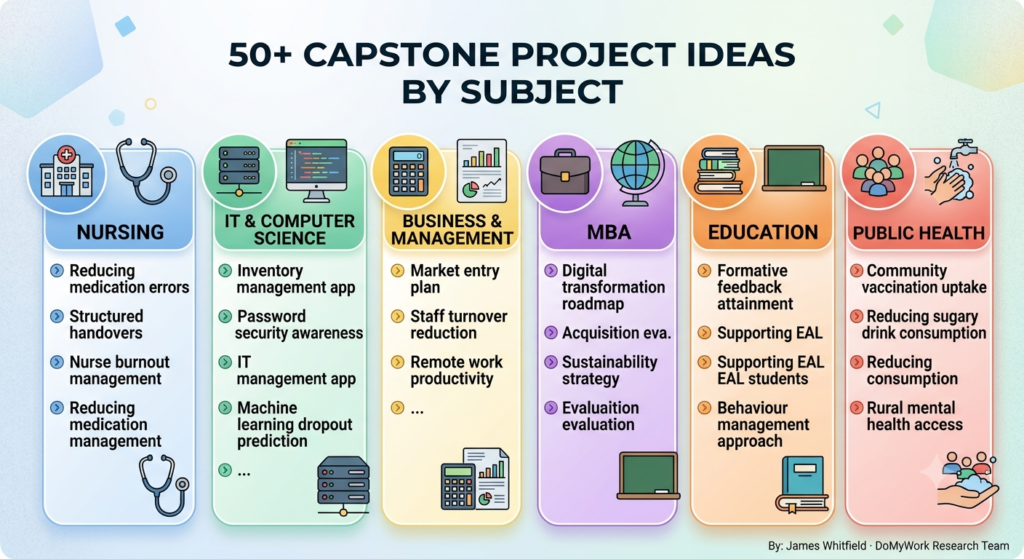
The best capstone ideas solve a specific, researchable problem in your field rather than covering a broad topic. Below are over fifty ideas grouped by subject, nursing, IT, business, MBA, education, then public health, each framed so you can turn it into a workable project question.
A weak capstone usually starts with a weak topic. “Social media marketing” is a subject, not a project. “How does Instagram influencer marketing affect purchase intent among UK students?” is a project. The lists below are deliberately specific, so you can adopt one directly or use it as a template for your own.
How do you choose a strong capstone topic?
A strong topic meets four tests. It is specific enough to research in the time you have. The data or evidence is actually available to you. It addresses a real gap or problem. It interests you enough to sustain weeks of work. Run any idea through those four before committing. For more on framing, see our capstone project ideas approach in the main guide.
Nursing capstone project ideas
- Reducing medication errors on a busy hospital ward.
- The effect of structured handovers on patient safety.
- Improving hand hygiene compliance among staff.
- Managing burnout among newly qualified nurses.
- A falls prevention protocol for elderly inpatients.
- Patient education to improve diabetes self-management.
- Pain assessment in non-verbal patients.
- Reducing readmission rates after discharge.
Nursing capstones translate evidence into practice, so pair your idea with our nursing paper support for the clinical writing conventions.
IT and computer science capstone ideas
- Building a small inventory management app for a local business.
- Evaluating password security awareness among students.
- A machine learning model to predict student dropout.
- Comparing cloud storage providers for a small firm.
- A usability study of a university booking system.
- Detecting phishing emails with a simple classifier.
- A chatbot prototype for a customer support desk.
- Assessing accessibility on local council websites.
Business and management capstone ideas
- A market entry plan for a product entering a new region.
- Reducing staff turnover in a retail chain.
- The impact of remote working on team productivity.
- A pricing strategy review for a small service business.
- Customer loyalty drivers in a coffee shop chain.
- Supply chain risk in a post-pandemic context.
→ Found your idea? A model capstone in your subject shows how a strong project takes a question like these from proposal to conclusion.
MBA capstone project ideas
- A digital transformation roadmap for a mid-size firm.
- Evaluating an acquisition opportunity for a named company.
- A sustainability strategy with measurable targets.
- Assessing the ROI of a marketing automation rollout.
- A change management plan for a restructuring.
MBA capstones lean on business frameworks then financial analysis, so our MBA assignment guide is a useful companion. For broader business angles, browse our business dissertation topics.
Education and public health capstone ideas
- The effect of formative feedback on student attainment.
- Supporting students with English as an additional language.
- A behaviour management approach for a primary classroom.
- A community vaccination uptake campaign.
- Reducing sugary drink consumption among teenagers.
- Mental health support access in rural areas.
How do you turn an idea into a project question?
Take any idea above, then sharpen it into a question with a clear variable, a defined population, then a measurable outcome. “Staff turnover in retail” becomes “Which retention measures most reduce turnover among part-time retail staff?” That sharper question gives your whole project a spine. For a wider pool of researchable angles, our 150 topic ideas guide helps you generate variations.
Here is the move in practice. “Remote working” becomes “How does fully remote working affect collaboration in small software teams?” Or “customer loyalty” becomes “Which loyalty scheme features the most increase in repeat purchases in an independent coffee shop?” In each case you have added a population, a variable, then a measurable outcome. That is the difference between a topic you could talk about forever then a question you can actually answer in a capstone.
How many sources does a capstone need?
There is no fixed number, but a focused capstone usually draws on fifteen to thirty quality sources, weighted toward recent, peer-reviewed work in your field. Quality beats quantity: ten sources you engage with critically beat forty you only list. Build your source list as you research, then note in one line what each source adds to your specific question. If you cannot say what it contributes, it probably does not belong.
What makes a capstone idea fail?
Ideas fail for predictable reasons. The topic is too broad to research in the time available. The data you need is not actually accessible to you. The question has no measurable outcome, so the findings have nowhere to land. Or the idea is purely descriptive, with no problem to solve. Test any idea against those four traps before you commit, since changing topics in week six is far more costly than spending an extra day choosing well at the start.
How do you avoid choosing the same topic as everyone else?
Popular subjects attract crowds, then a crowded topic is harder to make original. The fix is to localise or specify. “Employee motivation” is crowded; “what motivates part-time staff in independent UK gyms” is yours. Add a specific population, setting, or angle that reflects something only you can access, a workplace you know, a local organisation, or a dataset you can reach. That specificity is what makes a familiar subject feel fresh to a marker.
It also makes the research easier. A tightly defined question points you straight at the few sources then the exact data you need, rather than drowning you in a vast general literature. Narrow early, then the whole project moves faster.
One last filter: imagine presenting the finished project in a single sentence. If you can say “I found that X affects Y, so the organisation should do Z”, the idea has a clear shape. If that one sentence comes out vague, the idea needs sharpening before you start.
Ready to develop your capstone project? Let our experts help.
Once you’ve chosen your topic, the next step is turning your idea into a structured project with clear research, analysis and presentation. Explore our capstone project writing support for guidance throughout your project.
Frequently asked questions
What is a good capstone project idea?
A good capstone idea solves a specific, researchable problem in your field, uses evidence you can actually gather, then interests you enough to sustain weeks of work. Narrow any broad topic into a clear project question.
What are easy capstone project topics?
Topics where data is easy to gather tend to be most manageable, such as a usability study, a small survey-based project, or an analysis of existing organisational data. Easy to research matters more than easy to write.
How do I choose a capstone topic for nursing?
Pick a practice problem you have seen, such as medication errors, falls prevention, or patient education, then frame it as a question about improving a measurable outcome. Nursing capstones reward translating evidence into practice.
Can I use the same idea as my dissertation?
You can build on a related area, but submitting the same work for two assessments is self-plagiarism. A capstone applies knowledge to a practical problem, while a dissertation generates new research, so frame the question differently.