Dissertation Structure Explained Chapter by Chapter
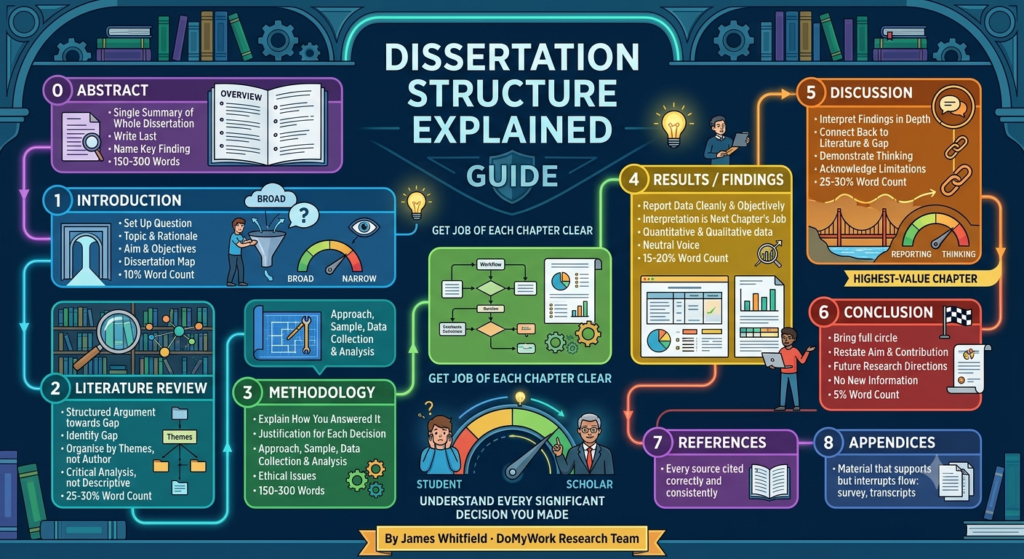
A standard UK dissertation has five core chapters: introduction, literature review, methodology, results, and discussion, wrapped by an abstract at the front and references plus appendices at the back. The introduction sets up the question, the literature review shows the gap, the methodology explains how you answered it, the results present what you found, and the discussion explains what it means. Get the job of each chapter clear and the writing gets far easier. Most students lose marks not because their research is weak, but because they put the right material in the wrong chapter. Findings drift into the discussion, method creeps into the results, and the introduction tries to do the literature review’s job. This guide walks through every section in order, explains exactly what belongs there, tells you roughly how many words to spend on it, and points out the specific mistake that costs marks in each one. What is the standard dissertation structure? The five-chapter model is the default across most UK undergraduate and master’s programmes in the social sciences, business, and health subjects. In order, the document runs as title page, abstract, acknowledgements, contents page, introduction, literature review, methodology, results, discussion, conclusion, references, and appendices. That said, this is a convention, not a law. Some subjects merge results and discussion into one chapter. Some sciences use the IMRaD format, which is introduction, methods, results, and discussion, with a shorter standalone literature section. A few programmes want six or seven chapters, splitting the discussion from the conclusion or giving the theoretical framework its own chapter. Always check your own handbook first, because your marking criteria describe the structure your examiner actually expects. The model below is the most common one and the safest default when your handbook is vague. How should you split your word count across chapters? A rough split helps you plan before you write, so you do not spend 4,000 words on the introduction and run out of room for the discussion. For a typical dissertation the introduction takes about 10 percent, the literature review about 25 to 30 percent, the methodology about 15 percent, the results about 15 to 20 percent, and the discussion about 25 to 30 percent, with the conclusion taking the last 5 percent or so. To make that concrete, here is how a 10,000 word and a 15,000 word dissertation would split under those proportions. Chapter Share 10,000 words 15,000 words Introduction 10% 1,000 1,500 Literature review 27% 2,700 4,000 Methodology 15% 1,500 2,250 Results 18% 1,800 2,700 Discussion 25% 2,500 3,750 Conclusion 5% 500 750 These are guides, not targets to hit exactly. The two chapters that carry the most marks in most schemes are the literature review and the discussion, which is why they get the largest share. If you are unsure how long your whole dissertation should be for your level, the word count section in our 2026 dissertation topics guide sets out the usual ranges for undergraduate, master’s, and PhD work. The abstract The abstract is a single summary of the whole dissertation, usually 150 to 300 words, written last even though it sits first. Its job is to let a reader understand your entire project without reading further, so it needs one or two sentences on each of the following: the problem and why it matters, your aim, your method, your key finding, and your main conclusion. Write it after everything else is finished, because you cannot summarise findings you have not yet written. The most common mistake here is treating the abstract like an introduction and describing what you set out to do without stating what you actually found. An abstract that never mentions a result is not doing its job. Name at least one concrete finding, even briefly. Chapter 1: Introduction The introduction sets up the whole dissertation. It answers four questions for the reader in order: what is the topic, why does it matter, what specifically are you investigating, and how is the dissertation structured. By the end of it, a reader should know your research question, understand why it is worth asking, and have a map of what is coming. A strong introduction moves from broad to narrow. It opens with the wider context, funnels down to the specific problem, states the aim and objectives or research questions clearly, and closes with a short outline of the chapters. Keep the literature light here. You are motivating the question, not reviewing the field yet. The mistake that costs marks is starting too wide, spending three paragraphs on the general importance of the topic before ever naming what this particular dissertation is about. Get to your specific question quickly. If your aim and objectives still feel loose, our guide on how to write a dissertation proposal covers how to sharpen them, since the proposal aim usually becomes the introduction aim. Chapter 2: Literature review The literature review is not a summary of everything written on your topic. It is a structured argument that builds towards the gap your research fills. Its job is to show you know the field, to organise what is already known into themes, and to identify the specific space where your question sits. Organise it by theme or debate, not by author. A review that goes “Smith said this, then Jones said that, then Brown said the other” reads as a list. A review organised around two or three themes, showing how different researchers agree and disagree within each, reads as analysis. End the chapter by naming the gap explicitly, because that gap is the bridge into your own study. The most common mistake is being descriptive rather than critical, reporting what each source said without ever evaluating it or connecting it to the others. Every paragraph should be doing comparative work, not just reporting. It also helps to be clear on whether your study rests on existing sources or new data, a distinction our guide on primary versus secondary research explains in full. Chapter 3: Methodology
Best AI Content Detectors in 2026
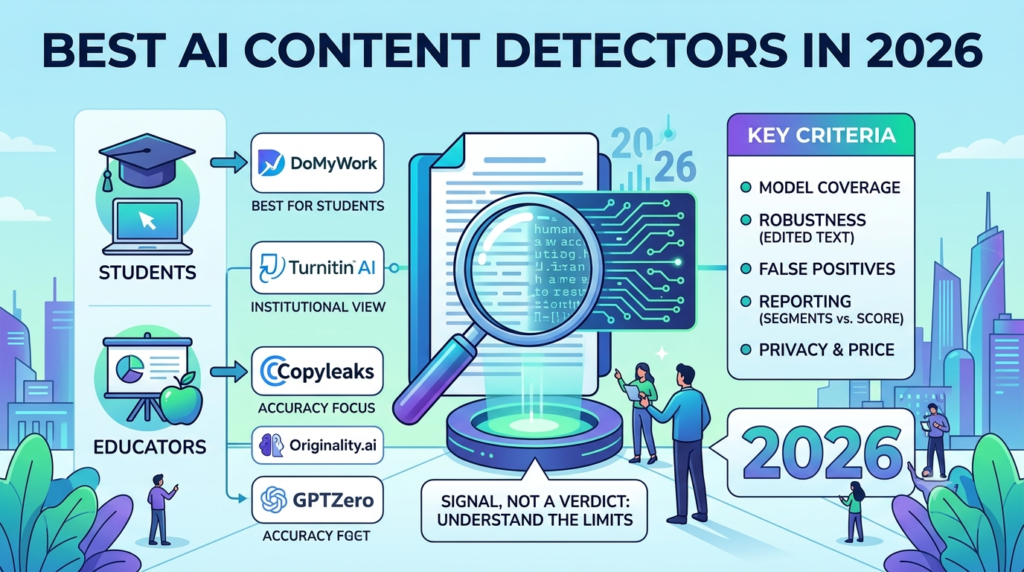
The best AI content detector depends on your need. For students checking their own work before submission, you want a tool that covers the major models and explains its result. For educators you want consistency and clear reporting. No detector is fully reliable, so the best ones are honest about false positives and treat the score as a signal, not a verdict. AI writing tools are everywhere, and so are the detectors that claim to spot them. The market is noisy, the claims are bold, and the reality is messier than the marketing suggests. No detector is perfect, and the gap between the best and the worst is mostly about honesty, coverage and how clearly they present a result you still have to interpret. This guide ranks the main options by use case and is straight about their limits. What is the best AI content detector? For a student who wants to check their own work before submitting, the best detector is one that covers the major models like ChatGPT, Gemini and Claude, shows you which sections look AI generated, and is clear that the result is an estimate. That last point matters more than raw confidence, because a tool that hands you a single number with false certainty is more dangerous than one that flags sections for review. Our own AI content detector is built around reviewing flagged passages rather than delivering a verdict. How accurate are AI detectors? Honestly, less than their marketing implies. Detectors work by spotting patterns associated with machine writing, mainly how predictable and even the text is, and that is an indirect signal rather than a fingerprint. They get a lot right, but they also produce false positives, flagging genuine human writing, and false negatives, missing AI text that has been edited. The accuracy varies by tool, by the model that produced the text, and by the writing style of the human involved. We go deeper in how accurate AI detectors are. How we tested them A fair comparison has to look past the headline accuracy claim. We weighed how many models a detector recognises, how it handles edited and mixed text, how clearly it reports its findings, and crucially its false positive behaviour on genuine human writing, since flagging honest work is the most damaging failure a detector can have. We also considered privacy and price, because a detector that stores your unpublished work is a poor choice regardless of accuracy. The main AI detectors at a glance Tool Best for Model coverage Notes DoMyWork Students checking before submission Major models Flags sections to review, plus a Turnitin option Turnitin AI The institutional view Major models What many universities use, via your login Copyleaks Strong detection focus Broad Subscription, aimed at organisations Originality.ai Publishers and web teams Broad Built for content teams, subscription GPTZero Quick individual checks Major models Popular, free tier available Best for students Students need to see what might get flagged before a tutor does, and then fix it, so the best student tool shows flagged sections clearly and lets you recheck after editing. The point is not to obtain a clean number to brag about, it is to identify passages that read as machine written, even in honest work, and rework them in your own voice. The official Turnitin report also includes AI detection, so you can see close to the institutional result before you submit. Best for educators For educators, consistency and clear reporting matter more than a high confidence score, because the result will feed into conversations and sometimes decisions about students. The most useful tools for teaching contexts are honesty about uncertainty, flag sections rather than condemning whole documents, and pair the score with guidance on interpreting it. A responsible educator uses a detector as one input alongside knowing how a student usually writes, never as sole proof. Why false positives matter This is the part the marketing skips. A false positive, where a detector flags genuine human writing as AI, can seriously harm an honest student, and it happens more often to certain writers, including those writing in a second language and those with a very even, structured style. A detector that boasts high accuracy while quietly producing false positives is doing real damage. The best tools are upfront about this and frame their output as a signal to review, which is the only safe way to use any detector. How to use a detector well Use a detector to guide a review, not to deliver a verdict. Run your work, look at the flagged sections, and ask whether each one reads in your own voice. Rework the parts that feel generic or uniform, add your own examples and analysis, and recheck. If you are an educator, treat a flag as the start of a conversation, not the end of one. Either way, the result is information, and the judgment stays human. For how the Turnitin indicator fits in, see Does Turnitin detect AI. How do AI detectors actually work? Understanding the mechanism explains both their usefulness and their limits. Detectors do not read a hidden watermark in most cases. Instead they measure how predictable your writing is, on the theory that AI tools tend to choose the most likely next word again and again, producing smooth, even text, while humans write with more variation and surprise. The detector turns that predictability into a likelihood that a machine wrote the text. Because it is reading style rather than a fingerprint, it can be confidently wrong in both directions, which is the root of every limitation that follows. Free vs paid AI detectors Free detectors are fine for a quick personal check, to get a rough sense of how your writing reads before you submit. Paid tools tend to offer broader model coverage, clearer reporting, and features aimed at organisations, but a higher price does not buy certainty, because the underlying problem of false positives affects all of them. So treat the free or paid
Finance Assignment Help: How to Solve and Write Finance Assignments
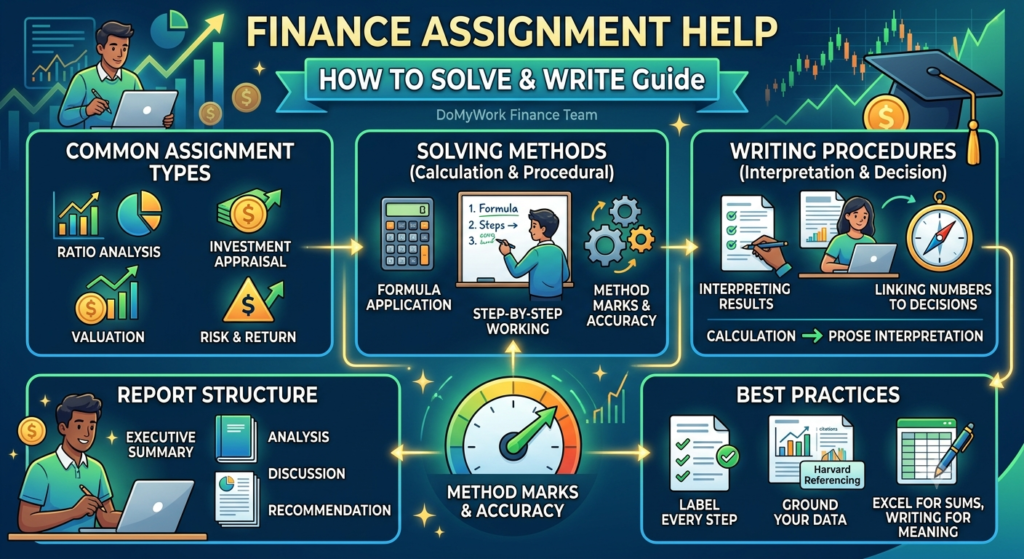
Finance assignments reward methods, not memory. Whether you are calculating ratios, appraising an investment, or valuing a company, the marks come from showing your working clearly, interpreting the numbers, then linking them to a decision. This guide covers the main finance assignment types, the formulas behind them, then how to present your answers for top marks. Many students who fear finance are surprised to learn that most marks are procedural. You are not expected to invent theory. You are expected to apply the right formula, lay out the steps, then explain what the result means. Once you see finance as a set of repeatable methods rather than a wall of numbers, it becomes far more manageable. This guide breaks down each common assignment type, then shows how to approach it. What types of finance assignments will you face? Finance modules recycle a handful of task types, so knowing them in advance removes most of the surprise. Most assignments mix calculation with written interpretation, then it is the interpretation where higher marks are won or lost. Why do students find finance assignments hard? The difficulty is rarely any single formula. It is the combination: numerical work, then written interpretation, then underlying theory, all in one task. Students strong at maths sometimes skip the explanation, while students strong at writing sometimes fumble the calculation. Finance needs both. Presentation adds another layer. A correct answer buried in messy working still loses method marks, since the examiner cannot follow it. Spreadsheets help, but only if the logic behind them is shown. The students who do best treat every finance answer as a small argument: here is the calculation, here is what it means, here is the decision it supports. How do you approach a finance calculation question? Work through a reliable sequence rather than diving at the numbers. Read the question fully, then identify what it is really asking. Pick the correct formula or model. Set out your working in clear, labelled steps, showing each input. Calculate carefully, keeping your units consistent. Then, crucially, interpret the result: state what the number means for the decision at hand. That final interpretation step is the one weaker answers skip. A net present value of forty thousand pounds means nothing on its own; saying the project should be accepted because it adds value is what earns the mark. How do you interpret financial ratios? Ratios only mean something in comparison, against prior years, against competitors, or against an industry benchmark. A current ratio of 1.5 is neither good nor bad until you compare it. Always pair a calculated ratio with a short interpretation, then a comparison. Our full guide to ratio analysis with worked examples covers each ratio category in detail. → Stuck on a finance problem set? A model finance assignment with full working shows you exactly how to lay out each calculation then interpret the result, as a reference for your own answers. How do you appraise an investment? Investment appraisal uses three main tools: payback period, net present value, then internal rate of return. NPV is the one examiners weigh most, since it accounts for the time value of money then gives a clear accept-or-reject rule. Our guide to NPV, IRR and payback works through each with a full example. How do you write a finance report? Some assignments ask for a report rather than a problem set: analysing a company then recommending a course of action. These follow a structured format, executive summary, analysis, discussion, then recommendation. Our guide to writing a financial analysis report sets out the structure with an example. How do you show your working for full marks? Finance marking usually awards method marks, so a wrong final answer with correct working still scores. Label each step. Show the formula before you plug in numbers. Keep units consistent, then round only at the end. Present calculations in a clear table where possible. This discipline protects marks even when a small arithmetic slip creeps in, since the examiner can see you understood the method. How do you reference a finance assignment? Even calculation-heavy assignments need referencing when you use data or theory. Cite the source of your figures, an annual report, a database, or a set of financial statements, then reference any models or texts you draw on, usually in Harvard. Accurate data sourcing shows your numbers are grounded, which markers value. Structure the written parts the way you would any assignment, following our guide to structuring a university assignment. How do you get finance assignments the right way? Legitimate help means using worked model solutions to learn the method, while the work you submit is your own. A model answer that shows how a valuation is built, or how a report reaches its recommendation, teaches you the approach in the same way a worked textbook example does. The misuse is copying it wholesale. Since finance work is increasingly checked for both plagiarism and AI generation, run your finished draft through a Turnitin and AI report so you can confirm it reads as your own before you submit. Should you use Excel for finance assignments? For anything with repeated calculations, ratios across years, or a discounted cash flow, a spreadsheet saves time then reduces arithmetic errors. Build your formulas cleanly, then label every row so the logic is visible. If your assignment allows it, submitting the spreadsheet alongside your write-up shows your working in full. The caution is that a spreadsheet answer still needs interpretation in prose; a grid of numbers with no explanation earns few marks. Use Excel to do the sums, then use your writing to say what they mean. One habit worth building early: keep your inputs, such as the discount rate or tax rate, in separate labelled cells, then reference them in your formulas. A single change then updates the whole model, which is how finance is done in practice, then it makes checking your work far easier. → Get financial support the right way. See
110+ Hospitality and Cookery Assignment Topics for 2026
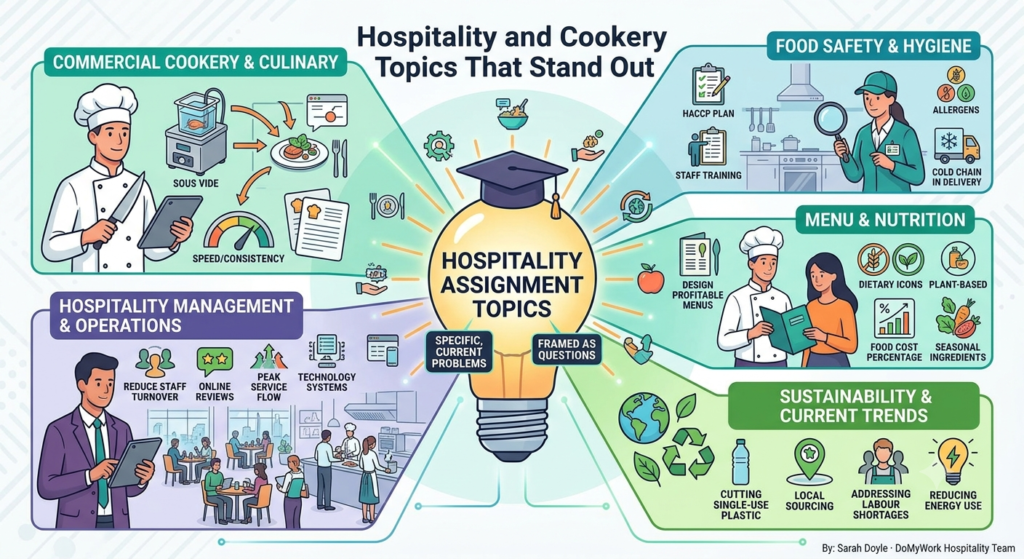
A good hospitality or cookery topic is practical, tied to real kitchen or venue operations, and narrow enough to research with the evidence you can gather. Below are more than 110 hospitality and professional cookery topics for 2026, grouped by area, from kitchen operations and menu costing to food safety, nutrition, sustainability and guest experience, each ready to shape into a clear question. How do you choose a good cookery or hospitality topic? Begin with the part of the industry you know best, kitchen production, food and beverage service, events or management, because you will write with more authority on what you have seen in practice. Then check you can gather evidence, whether that is costing data, a small guest survey, or published industry reports. Our cookery assignment help guide explains how these assessments are marked and what evidence they expect. Keep the scope tight. A whole theme like sustainability is too big; reducing food waste in a single kitchen section is answerable. Several of your assessments have set formats, so match the topic to the task: our guides to menu planning and costing, the commercial cookery logbook and reflective culinary commentary show what each one needs. Professional cookery and kitchen operations topics Menu planning, development and costing topics Food safety, hygiene and HACCP topics Need help turning culinary research into an academic assignment? From food safety and HACCP reports to menu planning, nutrition analysis and hospitality coursework, academic cookery assignments require both subject knowledge and clear academic structure. Explore cookery assignment writing support Nutrition, health and special diets topics Sustainability and food waste topics Food and beverage service topics Hospitality management and guest experience topics Events, banqueting and industry topics Workforce and professional practice Need academic support with your cookery coursework? Practical cookery work often comes with written reflections, reports and supporting academic work. Explore our cookery assignment support for help with the written side of your coursework. Explore cookery assignment support Bakery, pastry and beverage topics Culinary trends and innovation topics Cost control, operations and workforce topics Kitchen safety, wellbeing and workforce topics Marketing, service technology and careers topics Careers, training and industry trends topics How do you turn a topic into a research question? A topic names a subject; a research question is something you can answer with evidence. Take one idea above, fix the setting and the outcome you will measure, and decide whether you are describing, comparing or evaluating. Much hospitality research works well as a small case study or a short survey, supported by industry sources. When you reach the write-up, our assignment structure guide keeps it clear, and if a reflective element is required, our reflective culinary commentary guide shows the model to follow. Frequently asked questions How do I choose a cookery or hospitality topic? Start with the area you know best in practice, then check you can gather evidence such as costing data, a short survey or industry reports. Narrow the theme to a single question set in one kitchen, venue or service so it is realistic to research. What kind of evidence do hospitality assignments need? Most use a mix of practical data and published sources, for example dish costings, a small guest survey, observation of a service, or industry and food-standards reports. Match the evidence to the task and keep the scope small enough to gather it properly. Can a cookery topic be a case study? Yes. A single kitchen, restaurant or event makes a strong case study, letting you go into real depth on one setting rather than spreading a survey too thin. Just be clear about what your single case can and cannot show. Can I get help with my cookery or hospitality assignment? Yes. If you would like a subject expert to help you shape a topic, gather the evidence and structure the work, our cookery assignment writing help service is designed around that kind of guided support.
Plagiarism and Similarity Checks for Journal Submission
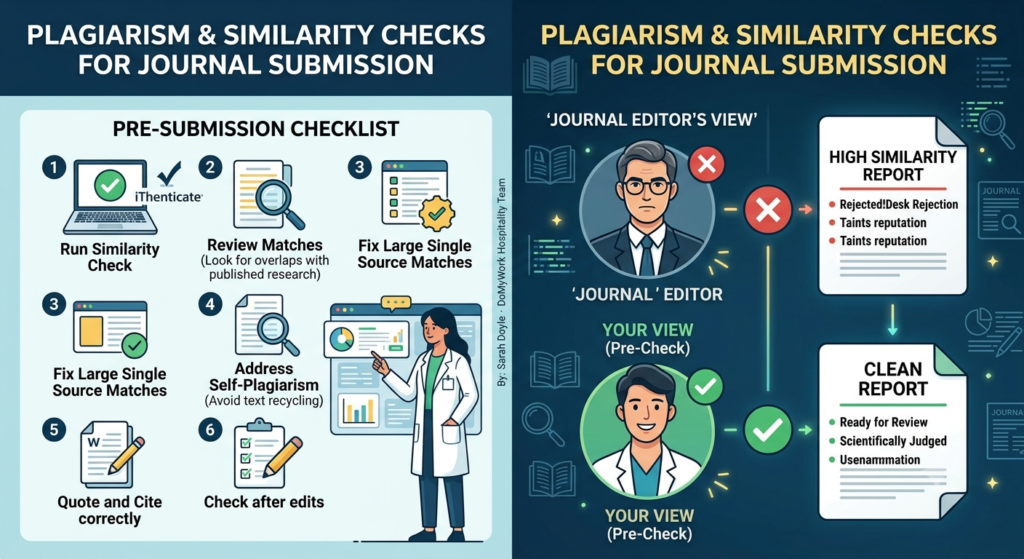
Before you submit to a journal, run a similarity check so you can fix overlaps the editor would otherwise flag. Many publishers use iThenticate, which checks against published research and journal archives. Aim for a clean report with low single source matches, and pay close attention to text reused from your own earlier papers. Submitting to a journal raises the stakes well above a normal assignment. Editors screen for similarity before they even send a paper out for review, and a high or careless similarity report can get your manuscript rejected or sent back before anyone reads the science. Checking your own work first lets you fix the avoidable problems and present a clean submission. Here is what to check, against what, and how to read the result. How do I check my paper before journal submission? Run your full manuscript, with references in place, through a similarity tool that checks against published research, then review the report match by match. Treat it the way an editor will, by looking past the headline percentage to the individual sources. Fix any passage that sits too close to a source, tidy your quoting and citations, and pay special attention to text you may have carried over from your own earlier work. Then run a final check before you submit. What is iThenticate and how does it differ from Turnitin? iThenticate is the similarity service built for researchers and publishers, and it is the one many journals use behind the scenes. It comes from the same company as Turnitin and uses similar matching, but it is aimed at published and professional research rather than student assignments, and it checks heavily against journal archives and scholarly databases. The practical difference for you is the audience. Turnitin is tuned to student work, iThenticate to research manuscripts. For a direct comparison, see iThenticate vs Turnitin. What similarity score do journals accept? There is no single accepted figure, and it varies by publisher, but the same principle applies as everywhere else, namely that the spread matters more than the total. Editors are less worried by a modest percentage spread across many sources than by a single source contributing a large block, which suggests text was lifted. Many publishers look for low single source matches and treat a high overlap with any one paper as a red flag. Check the specific journal guidance where it exists, and aim for a clean report rather than a particular number. How do I handle self plagiarism and text recycling? This is the issue that catches researchers most often. Reusing text from your own earlier papers, sometimes called text recycling, is treated seriously by journals, because each publication is expected to be a distinct contribution. Methods sections are a common trap, since you may run the same procedure across studies and describe it the same way. The fix is to rewrite reused passages for the new paper and cite your earlier work where appropriate. For the full explanation, see self plagiarism, and how to avoid it. What about reusing your thesis as papers? Turning thesis chapters into journal articles is normal and expected, but it has to be handled carefully. If your thesis is publicly available in a repository, a similarity check may match your paper against it, which can look alarming even though it is your own work. Be open about the relationship between the thesis and the paper, follow the journal policy on prior dissemination, and rewrite rather than copy where you can. Many publishers accept work derived from a thesis as long as you disclose it, so the key is transparency, not secrecy. Can I check before I submit? Yes, and you should. You do not have to wait for the editor’s check to find out there is a problem. Run your own similarity check first, ideally against academic sources, so you see what the editor will see and can fix it in advance. Our plagiarism checker for researchers covers what to look for, and our thesis plagiarism checker handles long documents privately, which matters for unpublished manuscripts. A pre-submission checklist Why editors check similarity before review Journals screen for similarity at submission because their reputation depends on publishing original work, and a high overlap is a fast signal that something needs a closer look. A paper that arrives with obvious copying, or a large block matching a single source, can be desk rejected before it ever reaches a reviewer, which wastes the months you waited. Editors are not looking to catch you out so much as to protect the journal, but the effect on you is the same. Submitting a clean report removes a reason for early rejection and lets the science be judged on its merits. What a good pre-submission report looks like A clean submission report is not necessarily a zero, because methods, references and standard terminology will always match. What editors want to see is a low overlap with any single source, and matches that are clearly accounted for by legitimate reuse such as your reference list or a standard protocol. A report where one paper contributes a large share is the warning sign, since it suggests lifted text. So when you check, focus on the largest single source matches and make sure each is either properly quoted, properly cited, or rewritten. Methods sections and the recycling trap Methods are the most common place researchers run into trouble, because you may use the same procedure across several studies and describe it the same way each time. Reusing your own methods text across papers is text recycling, and journals increasingly flag it. The fix is to describe the method afresh for each paper, or to cite your earlier paper for the full protocol and summarise briefly. It feels unnecessary, since the method genuinely is the same, but the expectation is that each paper stands as its own distinct piece of writing. See self plagiarism for the principle behind this. Choosing the right tool for a
40 Dissertation Viva Questions and How to Answer Them
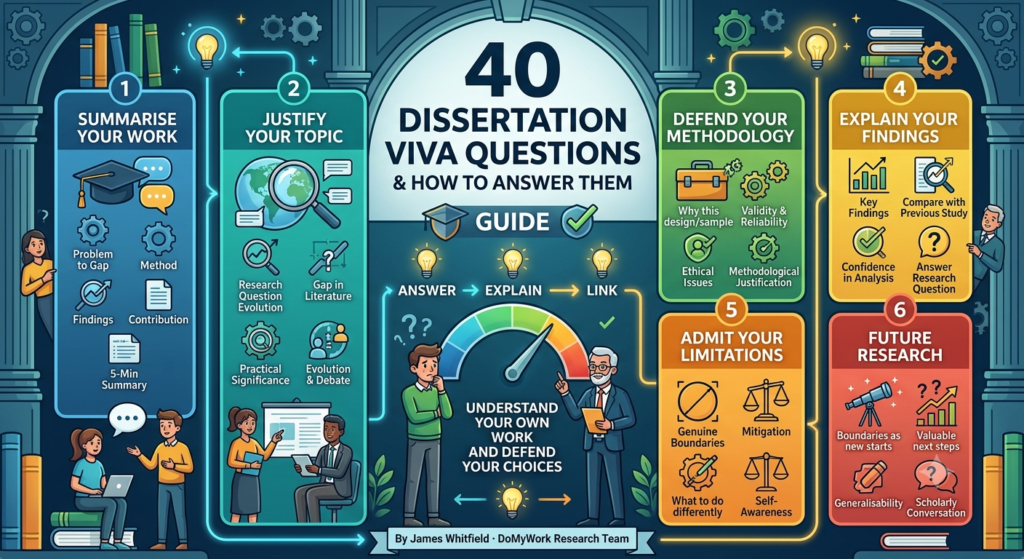
Most viva questions fall into six predictable groups: summarising your work, justifying your topic, defending your methodology, explaining your findings, admitting your limitations, and pointing to future research. Examiners are not trying to catch you out. They are checking that you understand your own work and can defend the choices you made. If you can answer the forty questions below, you can handle almost any viva. The viva, or viva voce, is an oral examination where you defend your dissertation to examiners. It frightens people because it feels unpredictable, but the truth is that the same questions come up again and again, in slightly different words. This guide gives you the questions grouped by type, a simple structure for answering any of them, worked examples for the hardest ones, and honest advice on what to do when you genuinely do not know the answer. What is a viva and what are examiners looking for? A viva is an oral defence of your dissertation, usually held with one internal examiner from your own university and one external examiner from another institution. In the UK it is standard for doctoral work and increasingly used for some master’s programmes. It typically lasts one to three hours, and many universities open with a short summary or presentation from you before the questions begin. What examiners want is not perfection. They want evidence that the work is genuinely yours, that you understand every significant decision you made, and that you can discuss your research like a scholar rather than recite it like a student. They will probe your methodology, your interpretation, and your awareness of what your study does not answer. A calm, honest, reflective candidate who can justify their choices scores far better than one who claims their work has no weaknesses. A simple framework for answering any viva question The single most useful habit in a viva is to answer in three moves: give the direct answer first, add a brief explanation, then link it back to your study. This stops you rambling, keeps you calm, and makes every answer sound structured even when the question surprises you. So if an examiner asks why you chose interviews, you say the direct answer first, that interviews suited your question because you needed depth over breadth. Then the brief explanation, that your research question was about lived experience, which numbers could not capture. Then the link to your study, that this is why you interviewed twelve participants in depth rather than surveying two hundred. Answer, explain, link. Practise this rhythm until it is automatic, because under pressure it gives you a track to run on. It also naturally prevents the most common viva mistake, which is talking too much and burying your actual answer. Opening questions Examiners almost always start gently, to settle you in. These are the most predictable questions in the entire viva, so prepare them most of all. The classic openers are: summarise your thesis in five minutes, tell us about your research in one sentence, what is your main contribution, and what made you choose this topic. The five-minute summary should move cleanly from problem to gap to method to key findings to contribution, and you should be able to deliver it without reading. The one-sentence version is harder and more revealing, because it tests whether you truly command what your work argues. A reliable frame is: this dissertation uses a named method to investigate a named topic and argues a named finding. Write that sentence before the viva and say it aloud until it feels natural. If you cannot compress your dissertation into one sentence, you do not yet fully own it. Topic and rationale questions These questions test whether your research question came from somewhere real rather than appearing from nowhere. Expect: why does this topic matter, why did you frame the question this way, how did your research question evolve, and what is the practical or academic significance of your work. The strongest answers trace a clear line from a gap in the literature or a real-world problem to your specific question. Name the papers or the problem that pointed you there. If your question changed during the project, and it usually does, say so and explain what changed and why, because that shows a researcher responding to evidence rather than clinging to a plan. If your topic sat in a fast-moving area, this is a natural place to show you understand the current debate. For students whose topic sits in a trending area, our guide on 2026 dissertation topics shows the kind of live gaps examiners find compelling. Literature review questions Here examiners check that you engaged with the field properly rather than citing a convenient handful of sources. Expect: how did you select your sources, which theories underpin your work, whose work influenced you most, and how does your study fit into the existing literature. Be ready to name your key theoretical framework and explain why you chose it over alternatives. Be ready to discuss a study that disagrees with yours, because examiners often probe whether you can hold a debate rather than just cite agreement. The strongest answers show you understand your field as a set of live arguments, not a pile of references. If an examiner names a paper you did not cite, stay composed, acknowledge it, and either connect it to your work on the spot or note it as a fair point for your corrections. Nobody has read everything. Methodology questions This is the most heavily probed part of most vivas, because your method is where the credibility of your findings lives. Expect: why did you choose this research design, why this sample and this size, why this analysis method, how did you ensure validity and reliability, and what ethical issues did you consider. Every answer here comes back to justification. It is never enough to say what you did. You have to say why it was the right choice and
Paraphrasing vs Plagiarism: Where the Line Is
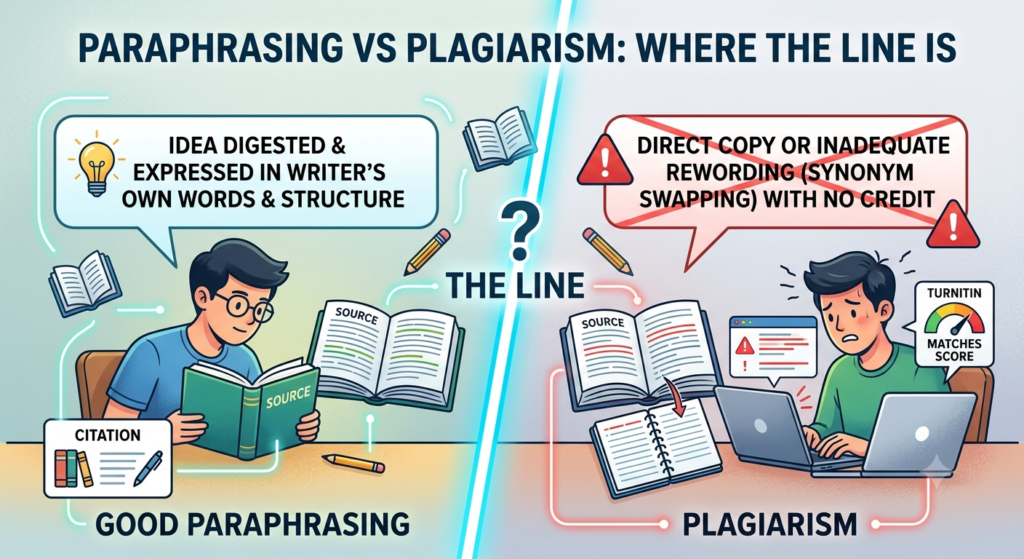
Paraphrasing is fine when you express an idea fully in your own words and your own structure, and credit the source. It becomes plagiarism when the wording stays too close to the original, or when you reword well but leave out the citation. Good paraphrasing needs both genuinely new wording and a clear credit. Paraphrasing is one of the most useful skills in academic writing, and one of the easiest to get wrong. Done well, it shows you understood a source well enough to rebuild it in your own voice. Done badly, it tips into plagiarism even when you meant no harm. The line is clearer than most students think, and once you see it, you can stay on the right side of it without much effort. Is paraphrasing plagiarism? No, not when you do it properly. Proper paraphrasing means taking an idea, understanding it, and expressing it in your own words and your own sentence structure, then crediting the source it came from. That is exactly what tutors want, because it demonstrates comprehension rather than copying. Paraphrasing only becomes plagiarism in two specific situations, which are worth knowing precisely. What does proper paraphrasing look like? Good paraphrasing changes both the words and the structure while keeping the meaning, and it keeps the citation. The test is whether someone could read your version and the original side by side and see two genuinely different pieces of writing that happen to make the same point. If your version just tracks the original sentence by sentence with synonyms swapped in, it is not really a paraphrase, it is a disguised copy. Understanding the idea is what lets you rebuild it freshly, which is why paraphrasing well usually means reading, looking away, and writing from your own understanding. When does paraphrasing cross the line? There are two ways it goes wrong. The first is staying too close to the source, keeping its structure and most of its phrasing while changing a few words, which counts as inadequate paraphrasing even if you cite it. The second is the opposite mistake, rewording perfectly but forgetting the citation, so the idea reads as your own original thought. Both are forms of plagiarism. The first borrows the wording, the second borrows the idea, and proper paraphrasing avoids both at once. A worked example, good and bad Imagine a source that explains that regular feedback improves student performance because it lets learners correct mistakes early. A bad paraphrase keeps the shape and swaps words, producing something like consistent feedback boosts learner results because it allows students to fix errors early, which mirrors the original too closely. A good paraphrase rebuilds it from understanding, for example, students tend to do better when they receive feedback often, since catching and addressing errors as they happen prevents them from becoming habits. Both versions credit the source, but only the second is genuinely the writer’s own expression. How do I paraphrase and still credit the source? For the referencing mechanics behind the credit, see how to cite sources correctly, and if your score is high because of close paraphrasing, how to lower your Turnitin score shows you how to fix it. Does Turnitin catch paraphrasing? Partly. Turnitin matches wording, so a close paraphrase that keeps much of the original phrasing can still be flagged, while a thorough rewrite that genuinely changes the words may not match at all, even if the idea was borrowed. This is the key reason citing ideas matters as much as avoiding copied wording. A clean similarity score does not prove you credited every idea, so good practice is about honesty, not just about beating the checker. For the bigger picture, see what counts as plagiarism. Why paraphrasing matters so much at university Paraphrasing is not just a way to avoid copying, it is a core academic skill that tutors actively look for. When you paraphrase well, you show that you understood a source deeply enough to rebuild its meaning in your own words, which is far more impressive than quoting it. A piece that paraphrases skilfully and cites carefully reads as the work of someone who has digested their reading, while a piece stuffed with quotes reads as someone who has collected it. Learning to paraphrase well improves your marks, not just your similarity score. The two halves of good paraphrasing Every proper paraphrase has two parts that must both be present. The first is a genuinely new expression, your own words and your own sentence structure, not the original with synonyms swapped. The second is the citation, because the idea still belongs to the source even when the wording is yours. Miss the first and you have inadequate paraphrasing, which borrows the wording. Miss the second and you have uncredited paraphrasing, which borrows the idea. Both are forms of plagiarism, and good paraphrasing simply means keeping both halves in place at once. A simple method that works The most reliable way to paraphrase is also the simplest. Read the passage until the point is clear in your head. Then close the source completely and write the idea from memory, in whatever words come naturally to you. Because you are writing from understanding rather than editing the original in front of you, the result comes out in your own voice. Finally, reopen the source to check you kept the meaning accurate, fix anything you got wrong, and add the citation. The act of closing the source is what makes the difference, since it stops you tracking the original sentence by sentence. When to quote instead of paraphrase Paraphrasing is the default, but sometimes a quote is the right choice. Quote when the exact wording matters, such as a precise legal definition, a memorable phrase you want to analyse, or a claim so specific that rewording it would change the meaning. Keep quotes short, mark them clearly with quotation marks, and cite them. The mistake is quoting out of laziness, dropping in long passages because rewording feels
How to Lower Your Turnitin Similarity Score Ethically
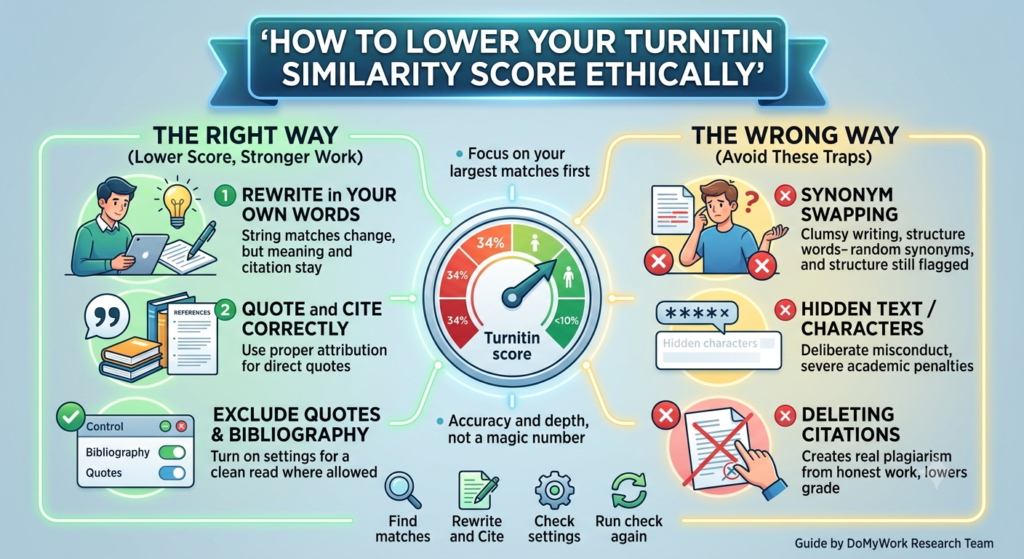
Lower your Turnitin score by finding the largest matches first, then rewriting copied phrasing in your own words, quoting and citing correctly, and excluding the bibliography where allowed. Do not swap random synonyms or hide text. Fix the real overlaps, then run the check again before you submit. A high similarity score sends a lot of students into a panic, and panic leads to the wrong fixes, like deleting citations or scattering synonyms to fool the tool. None of that helps, and some of it makes things worse. The goal is not to trick Turnitin. It is to make sure the work is genuinely yours, which brings the number down honestly and leaves you with a stronger piece. Here is how to do it properly. Why is my similarity score high? Before you change anything, understand the cause, because the fix depends on it. A high score usually comes from one or more of a few sources, namely quotations, a reference list, common phrases in your subject, or a passage you paraphrased too closely. Open the report and sort the matches by size, because one large match matters far more than a long tail of small ones. If the colour confused you, see Turnitin report colours explained. How do I lower it the right way? Work in order of size and you will move the number most with the least effort, because fixing the biggest single source has more impact than tidying a dozen tiny matches. After each significant edit, it is worth rechecking, since edits can introduce new matches as well as remove old ones. What not to do Should I exclude quotes and references? If your institution allows it, yes. Quotations and reference lists are matching text by definition, so they inflate the score without being plagiarism. Excluding them, where the setting is available, gives a cleaner read of your own writing and often brings a worrying number down to a fair level. Whether you can switch this on depends on how your tutor sets up the submission, so it may already be applied or it may be out of your control. How rewriting actually lowers the score Genuine rewriting works because Turnitin matches strings of words, not ideas. When you set the source aside and rebuild a point in your own words and your own sentence structure, the string no longer matches, even though you have kept the meaning and the citation. This is different from synonym swapping, where you keep the author’s structure and only change individual words, which often still matches and reads worse. The skill is to understand the point well enough to express it freshly, which is exactly what good academic writing requires anyway. For the line between fair paraphrasing and plagiarism, see paraphrasing versus plagiarism. How low should the score be? There is no magic number, and the spread matters more than the total, so do not chase a specific figure. A score made of small matches across many sources is healthier than a lower score driven by one heavy source. For the bands and what they mean, read what counts as a good Turnitin score. Once your edits are done, you can confirm the result with an official Turnitin report before you submit. Should I worry about a high score at all? Not automatically, and this is the first thing to settle before you start editing. A high similarity score is not a finding of plagiarism, it is a measure of how much text matched, and a lot of matching is harmless. Before you change a word, open the report and look at where the score comes from. If it is quotes, references and common phrases spread across many sources, you may have little real work to do. If a single source dominates, that is the part that needs attention. Editing blind, without reading the report, is how students accidentally make honest work worse. Why synonym swapping does not work The most common wrong fix is to run through a flagged passage replacing words with synonyms, hoping to dodge the match. It rarely works and often backfires. Turnitin matches strings of words, so if you keep the author’s sentence structure and only change individual words, enough still matches to flag, and the writing reads worse because synonyms chosen for the sake of difference are often clumsy or slightly wrong. Worse, markers recognise synonym swapped text instantly, because it has a stilted quality that genuine writing does not. The real fix is to understand the point and rebuild it, not to disguise the original. How to rewrite a flagged passage properly Take the flagged passage, read it until you understand the point, then close the source and write the idea in your own words from memory. Because you are building the sentence from your own understanding rather than editing the original, the structure and phrasing come out genuinely different, and the match disappears. Then reopen the source to check you kept the meaning accurate, and confirm the citation is in place. This is slower than synonym swapping but it produces better writing and a lower score at the same time, which is the whole point. For the line between fair paraphrasing and plagiarism, see paraphrasing versus plagiarism. Handling quotes and the reference list Quotes and reference lists are matching text by their nature, so they inflate the score without being plagiarism. Two moves help. First, where your institution allows it, exclude quoted material and the bibliography from the calculation, which strips out this harmless matching. Second, check that any long copied stretch is either a properly marked quote or rewritten, since an unquoted copied passage is the worst kind of match. If your high score is mostly quotes and references, excluding them often brings it down to a fair level on its own. For how the colours map to all of this, see Turnitin report colours. A realistic before and after Picture a student who opens their report at 34% and
MBA Assignment Help: How to Write MBA Assignments That Actually Score
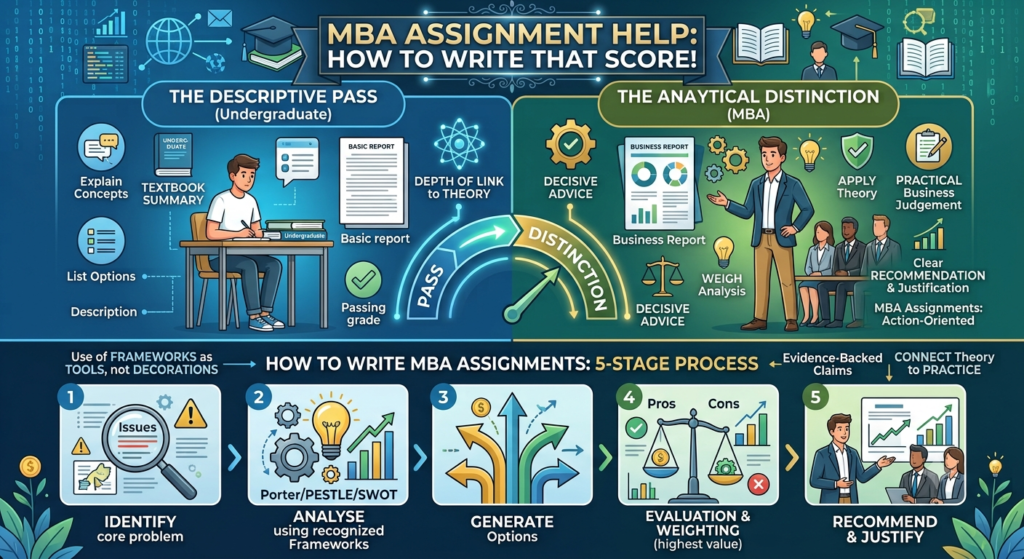
MBA assignments are marked differently from undergraduate work. Examiners want practical business judgement backed by theory, not description. A strong MBA assignment takes a real business problem, applies a recognised framework to analyse it, weighs the options, and makes a clear, justified recommendation. Getting the balance between theory and practical decision-making right is what separates a distinction from a pass. Most MBA students are capable people, often working full time, who lose marks not through lack of ability but through writing that stays descriptive when it should be analytical, or academic when it should be decisive. This guide breaks down the main types of MBA assignment, shows how to structure the most common one, explains the analytical depth examiners are looking for, and points to where sensible help fits in. What makes MBA assignments different? An MBA assignment is judged on business judgement, not just knowledge. Where an undergraduate essay might reward a clear explanation of a concept, an MBA assignment rewards applying that concept to a real situation and reaching a defensible decision. Examiners are training future managers, so they want to see how you think when a business problem has no perfect answer. In practice this means three things run through almost every MBA task. The work has to connect theory to practice, using a framework to illuminate a real business rather than describing the framework for its own sake. It has to be analytical and evaluative, weighing options rather than listing them. And it has to end somewhere, with a clear recommendation you are willing to defend, because managers make decisions. If your assignment reads like a textbook summary, it will pass at best. If it reads like advice a business could act on, it scores. What types of MBA assignments will you face? MBA programmes use a handful of recurring formats, and knowing what each one is really testing helps you pitch it correctly. The case study analysis is the most common and asks you to diagnose a real or fictional company’s problem and recommend a course of action. The business report applies theory to a live organisation, often your own employer, and reads like something you would hand to a leadership team. The reflective assignment asks you to connect your own experience to leadership or management theory, which sounds soft but is marked on the depth of the link, not the anecdote. The strategic analysis asks you to assess a company’s position and future options using structured frameworks. And the research-based assignment, often the dissertation, requires original investigation and is a much larger undertaking, which our guide on dissertation structure covers in full. Each rewards the same core skill, applying theory to a real decision, but the framing differs, so read the brief carefully to see which one you are being asked for. How do you write an MBA case study analysis? Because the case study is the most common MBA format, it is worth having a reliable structure. A strong case analysis moves through five stages in order, and skipping any of them is where marks leak away. The discipline that scores well is spending most of your words on stages four and five. Weaker assignments spend most of their length describing the case and applying frameworks, then rush the recommendation at the end. The recommendation is the point of the whole exercise, so give it room. Which frameworks should you actually use? Frameworks are tools, not decorations, and the mistake that costs marks is applying one for the sake of it. Use a framework only when it genuinely helps you analyse the problem in front of you, and use it to reach an insight rather than to fill in a template. The workhorses across MBA programmes are SWOT for a quick strategic snapshot, PESTLE for the external environment, and Porter’s Five Forces for industry competitiveness. For internal capability, the resource-based view and value chain analysis are common. For strategic choice, Ansoff’s matrix and the BCG matrix appear often. The key is selection and depth over breadth. One framework applied properly, with its output actually feeding your recommendation, beats four frameworks each filled in shallowly and then ignored. When you finish a SWOT, the next paragraph should use what the SWOT revealed. If it does not, the SWOT was decoration, and examiners notice. How do you show analysis instead of description? This is the single biggest divider between MBA grades, so it is worth being precise about what analysis actually looks like. Description tells the reader what is happening. Analysis tells the reader what it means and what follows from it. A simple test is to look at your sentences and ask whether they are doing the word “because” or “therefore” any work. “The company operates in a competitive market” is description. “Because the company operates in a market with low switching costs, its pricing power is limited, which means a differentiation strategy will protect margins better than competing on price” is analysis. The second sentence takes a fact, explains its consequence, and points towards a decision. Every key paragraph in an MBA assignment should be doing that kind of work, moving from fact to implication to consequence. If a paragraph only reports, it is not earning marks, however accurate it is. How do you reference and use evidence properly? MBA assignments still demand academic rigour underneath the practical framing. Claims need support, whether from academic theory, industry data, or the facts of the case itself. A recommendation asserted with no evidence is just an opinion, and examiners mark opinions harshly. Cite recognised management theory to ground your frameworks, and use real data where you can, since specific figures make an argument far stronger than vague assertions. For a business report on a real company, filings and published reports give you citable evidence rather than guesswork, and if you are handling financial analysis, our guide on finance and accounting dissertation topics points to the data sources that also work for MBA finance assignments.
How to Cost and Plan a Menu for a Cookery Assignment
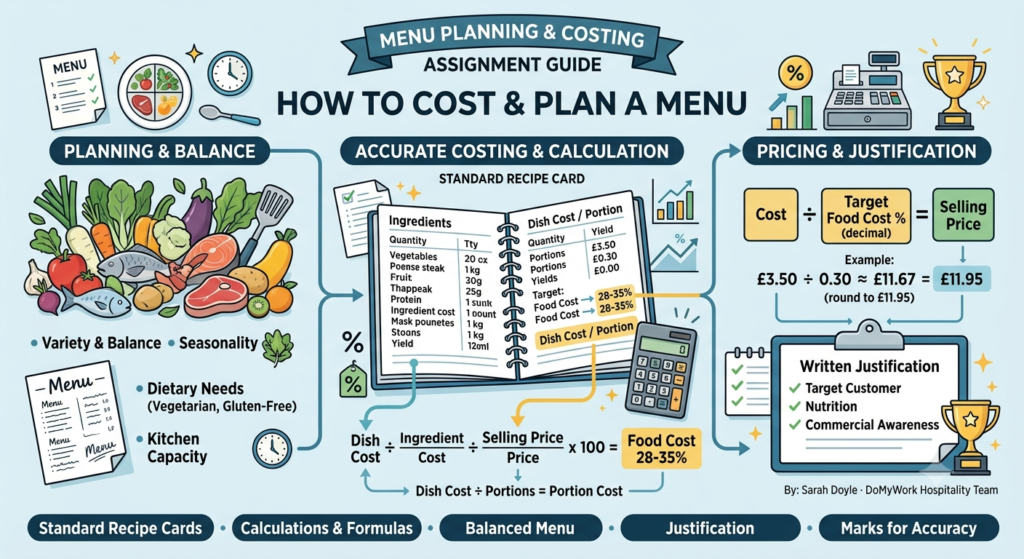
A menu planning and costing assignment asks you to design a menu, then prove it works commercially. You calculate the cost of each dish, set a selling price using a target food cost percentage, then justify your choices against nutrition, balance, then your customer. Accuracy in the numbers is where the marks sit. This is the assignment where culinary skill meets business sense. A beautiful menu that loses money fails the brief, since real kitchens run on margins. The good news is that the maths is simple once you know the formulas, then the justification follows naturally from your costing. This guide covers the recipe cards, the calculations, then the mistakes that quietly drain marks. What does a menu planning assignment involve? A typical menu assignment has four parts: a designed menu, standard recipe cards for each dish, a full costing with selling prices, then a written justification of your choices. The menu shows creativity, the recipe cards show precision, the costing shows commercial awareness, then the justification ties it together. Marks are spread across all four, so none can be skipped. How do you build a standard recipe card? A standard recipe card is the backbone of costing. It lists every ingredient, the exact quantity, the yield, then the number of portions. From this you calculate a cost per portion. Include everything, down to garnish then oil, since small omissions compound across a menu. A precise recipe card also guarantees consistency, which is the point of standardising in the first place. How do you calculate dish cost and food cost percentage? Dish cost is the total ingredient cost divided by the number of portions. Food cost percentage then tells you what proportion of the selling price the ingredients consume, calculated as ingredient cost divided by selling price, multiplied by one hundred. Most kitchens target a food cost percentage between roughly 28 then 35 per cent, though this varies by sector. A lower percentage means more margin, but pricing too high risks losing customers, so the target is a balance. How do you set a selling price? Work backward from your target food cost percentage. If a dish costs three pounds fifty to produce, then your target food cost is thirty per cent, divide the cost by 0.30, which gives a selling price of around eleven pounds sixty seven. You would then round to a sensible menu price, such as eleven pounds ninety five. Showing this calculation clearly, cost, target percentage, then resulting price, is exactly the working markers want to see. Need help turning culinary research into an academic assignment? From food safety and HACCP reports to menu planning, nutrition analysis and hospitality coursework, academic cookery assignments require both subject knowledge and clear academic structure. Explore cookery assignment writing support How do you plan a balanced menu? Beyond cost, a strong menu balances variety, dietary needs, seasonality, then kitchen capacity. Offer a spread of proteins, cooking methods, then price points. Include options for common dietary requirements, since a menu that excludes vegetarian or allergen-aware diners loses both marks then customers. Match the menu to what your kitchen can actually produce at volume, rather than designing dishes that would collapse under a busy service. How do you justify your menu choices? The justification is where you turn decisions into reasoning. For each major choice, explain it against your target customer, nutrition, cost, then practicality. Why this dish at this price for this diner? Why this protein in this season? A menu without justification reads as a list, while a justified menu reads as a commercial decision, which is what the assignment is really testing. What are common menu costing mistakes? Three recur. Forgetting wastage, so the real cost of an ingredient is higher than the purchase price once trimmings are gone. Confusing gross then net quantities, costing the whole item when only part is used. Then leaving small items uncosted, garnish, oil, seasoning, which add up across a full menu. Building wastage then yields into your recipe cards from the start avoids all three. How do you account for wastage in your costing? Wastage is the cost that catches students out. When you buy a whole fish, a side of beef, or a box of vegetables, part of it becomes trim, bone, or peel that never reaches the plate. Your costing must use the usable yield, not the purchase weight. If a vegetable yields seventy per cent usable after peeling, then the real cost per usable kilo is higher than the shelf price. Calculate a yield percentage for each main ingredient, then cost on the usable portion, or your numbers will understate the true food cost. How does gross profit relate to food cost? Food cost percentage then gross profit are two sides of the same coin. If your food cost is thirty per cent of the selling price, your gross profit is the remaining seventy per cent, before labour then overheads. Showing both in your assignment demonstrates commercial understanding: the food cost shows what the dish consumes, then the gross profit shows what it contributes. Markers reward students who can move between the two, since that is how a real kitchen reads its menu. How do you present a menu costing assignment? Presentation carries marks of its own. Lay out each dish with its standard recipe card, then a clear costing table showing ingredient cost, portion cost, food cost percentage, then selling price. Use consistent units then round prices sensibly. A clean, labelled table lets the assessor follow your numbers at a glance, while a messy one hides good work behind confusion. Treat the costing like a document a head chef would actually use, since that professional standard is part of what the assignment tests. How does portion control affect cost? Portion control is where costing meets the real kitchen. If your recipe card assumes a 150 gram portion but the kitchen serves 180 grams, your food cost percentage climbs then your margin shrinks on every plate. Strong