How to Write a Nursing Essay: A Step-by-Step Guide for UK Students

A nursing essay is not just an essay about healthcare. It asks you to do something most other essays do not: connect academic theory to real clinical practice, back every claim with current evidence, and show that you can think like a practitioner as well as a student. Get that link right and the marks follow. Miss it, and even well-written work stalls in the 2:2 band. This guide walks through what a nursing essay is actually testing, how to structure one, when to use a reflective model, and the mistakes that quietly cost marks at UK universities. What is a nursing essay actually testing? Markers are looking for four things at once. First, accurate knowledge of the topic and its terminology. Second, evidence-based practice — the ability to support what you say with research, guidelines and policy rather than opinion. Third, critical analysis, which means weighing the strength of that evidence rather than just reporting it. Fourth, application to practice: showing how the theory changes what a nurse would actually do at the bedside. A First-Class nursing essay does all four. A weaker one describes without evaluating and quotes without applying. How should you structure a nursing essay? Most nursing essays use the same three-part shape as any academic essay, and the proportions matter. Your introduction should be around ten per cent of the word count: set out the topic, why it matters to practice, and the line your essay will take. The main body is where the marks live — one point per paragraph, each built on the PEEL pattern of point, evidence, explanation and link back to the question. The conclusion draws the threads together and states what it all means for practice, without introducing anything new. If you want a fuller framework for building each paragraph and pushing into the top band, our guide on how to write a First-Class essay lays out the writing structure step by step. Working on a nursing paper or assignment? Get subject-specific support. Nursing coursework often requires clinical reasoning, evidence-based research and accurate academic referencing. Explore our nursing paper writing support for university-level nursing work. Explore nursing paper writing help Should you use a reflective model? Many nursing assignments are reflective — they ask you to analyse a placement experience rather than argue a case. When that is the brief, a recognised model keeps your reflection structured instead of drifting into a diary entry. Gibbs’ Reflective Cycle is the one most UK nursing courses teach, moving through description, feelings, evaluation, analysis, conclusion and action plan. For shorter pieces, Driscoll’s What? So What? Now What? is a simpler alternative. The model is scaffolding, not the point: the marks come from the analysis stage, where you explain why something happened and what the evidence says about it, not from simply narrating events. How do you use evidence and sources? Healthcare evidence dates fast, so currency counts. Lean on peer-reviewed journal articles, systematic reviews, NICE and Cochrane guidance, and the NMC Code, and treat textbooks as background rather than your main authority. A common trap is stacking references to pad the list — markers can tell. Each source should earn its place by supporting a specific claim, and where sources disagree, saying so and taking a reasoned position is exactly the critical analysis that lifts a grade. Referencing itself is easy marks that too many students throw away. UK nursing departments usually expect Harvard, so if you are unsure how in-text citations and the reference list fit together, our Harvard referencing guide covers it in plain English. How is a nursing essay marked? Understanding the rubric before you write is one of the biggest advantages you can give yourself. The band you land in is decided less by how much you write and more by how much you analyse and evidence. Our breakdown of what UK university markers actually look for shows how the grade boundaries map onto knowledge, critical analysis, structure and use of sources — read it alongside your own module rubric. Common mistakes that cost marks Mistake Fix Describing more than analysing After each point, ask “so what does this mean for practice?” and answer it Claims with no evidence behind them Support every assertion with a current, cited source Naming a real patient or ward Anonymise everything — the NMC Code requires confidentiality, even in coursework Relying on old or non-academic sources Prioritise recent peer-reviewed research and current guidelines Check your work before you submit Referencing-heavy subjects like nursing naturally pick up similarity matches from quotes, guideline wording and reference lists, so it is worth seeing your report before a marker does. You can run your draft through the $5 Turnitin Plag Check and get your similarity and AI score back in minutes, with no university login, so you walk into submission knowing exactly where you stand. Stuck on a nursing brief, or want an expert model answer to learn from before you write your own? DoMyWork’s nursing assignment help is written by postgraduate subject specialists and delivered as original reference and study material you can check against your own work. Frequently asked questions Can I write a nursing essay in the first person? For a reflective essay, yes — reflection is personal, so first person is expected. For an academic or evidence-based essay, most UK departments still prefer the third person. Always follow your module handbook, because the convention varies by assignment type. How many sources should a nursing essay use? As a rough guide, aim for one to two quality sources per hundred words, weighted towards recent peer-reviewed research, NICE guidelines and the NMC Code. Range and currency matter more than raw numbers. Which reflective model should I use? Gibbs’ Reflective Cycle is the most widely taught in UK nursing and suits structured reflection. Driscoll’s model is a simpler option for shorter pieces. Use whichever your course specifies.
What Is Self-Plagiarism? Definition, Examples and How to Avoid It
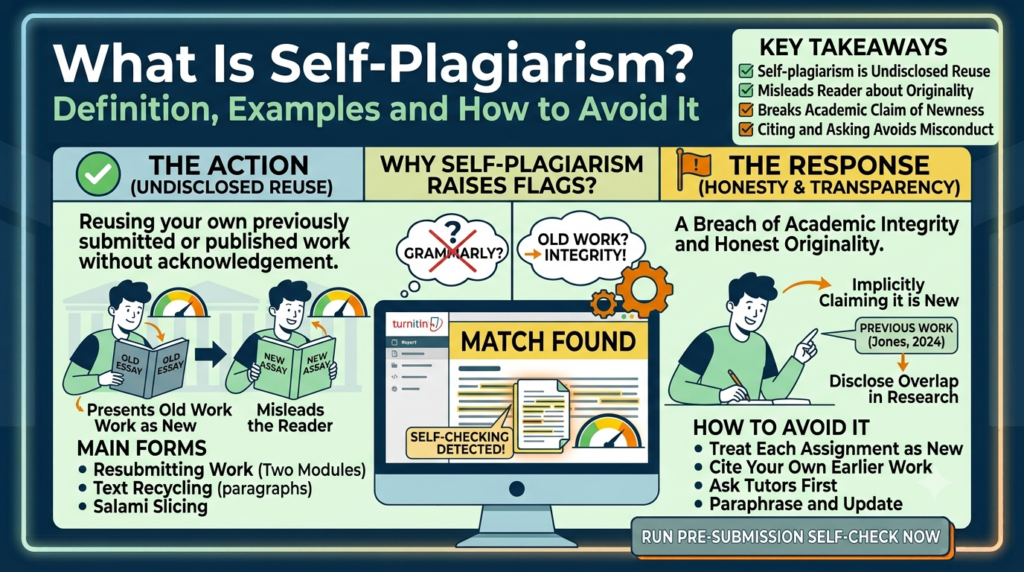
Self-plagiarism is reusing your own previously submitted or published work without acknowledging it. Publication ethics bodies call it text recycling. It counts as an academic integrity breach because it presents old work as new, and text matching software will often flag it against your own earlier submissions. How can you plagiarise yourself? It sounds contradictory, because you cannot steal from yourself. The issue is not theft, it is honesty about originality. When you submit a piece of work, you are implicitly claiming it is new and produced for that purpose. Reusing an old essay, or large chunks of one, breaks that claim and misleads the reader about what is original. The Committee on Publication Ethics (COPE) defines text recycling, also known as self-plagiarism, as reusing one’s own previous writing without being transparent about it or referencing the original appropriately, according to COPE’s published guidance on handling text recycling. The US Office of Research Integrity and major publishers such as Wiley apply the same principle to research writing. What are the main forms of self-plagiarism? Is self-plagiarism always misconduct? Not always, and this is where students and early researchers get caught out. Opinions vary, and context matters. Reusing a standard method description in a research paper is widely seen as more acceptable than recycling parts of an introduction or discussion, because a method that has not changed can only be described in so many ways. COPE’s position is that limited reuse can be legitimate when it is disclosed and referenced, while undisclosed reuse of substantial text misleads the reader about originality. For students, the rule is usually stricter and simpler. Most universities prohibit submitting the same work twice for credit, even though you wrote it, because each submission is meant to be earned separately. Always check your own institution’s academic integrity policy, which is the standard you will be judged against. Why does self-plagiarism get detected? Two reasons. First, universities store submitted work in a repository, so a new submission is checked against your own earlier ones as well as everyone else’s. Turnitin’s similarity check compares against a database that includes previously submitted student papers, which is exactly how recycled text surfaces. Second, markers who taught you before may simply recognise the work. One caveat worth knowing: similarity software only catches recycled text if the earlier work is in the database it searches. Research tools built for publication, such as iThenticate, deliberately do not archive submissions, so pre-submission self-checks do not create a match against your own draft. Our comparison of iThenticate and Turnitin explains how their databases differ. How do you avoid self-plagiarism? Frequently asked questions Can I reuse my own essay for a different class? Usually not. Most universities treat resubmitting the same work for credit in two modules as an academic offence, even though you wrote it. Check your institution’s policy and ask your tutor if you are unsure. Is self-plagiarism as serious as copying someone else? It is generally viewed as less serious than copying another person’s work, but it is still an integrity breach and can carry real penalties, from a capped mark to a formal misconduct finding. Can Turnitin detect self-plagiarism? Yes, where your earlier work sits in a repository it searches. Turnitin compares new submissions against previously submitted student papers, so recycled text from a past assignment can match. Is reusing my methods section self-plagiarism? In research writing, limited reuse of a method’s description is often accepted, provided you disclose it and cite the original. Recycling parts of the introduction, results or discussion is treated more strictly. When in doubt, disclose and reference.
Quoting, Paraphrasing and Summarising: How to Use Sources Well
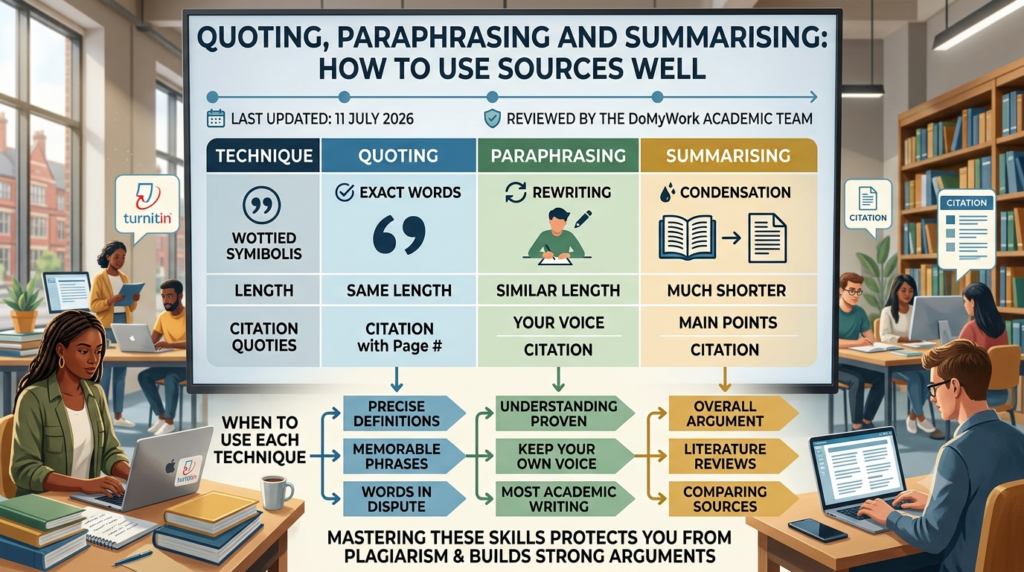
Quoting reproduces a source’s exact words inside quotation marks. Paraphrasing restates one passage in your own words at a similar length. Summarising condenses a longer passage or whole work into its main points. All three require a citation, and most strong academic writing leans on paraphrasing, with quotation kept for when the exact wording matters. What is the difference between the three? There are three ways of bringing a source into your writing, and choosing the right one is a marked skill in its own right. Technique What it does Length vs original Quotation marks Citation needed Quoting Reproduces exact words Same Yes Yes, with page number Paraphrasing Restates one point in your words Similar No Yes Summarising Condenses the main ideas Much shorter No Yes When should you quote? Quote sparingly, and only when the exact words carry weight that a restatement would lose. Good reasons to quote include a precise legal or technical definition, a memorable phrase you intend to analyse, or wording under dispute where the exact language is the point. A piece stuffed with quotations reads as though the writer is hiding behind sources rather than making an argument. Keep quotations short, integrate them into your own sentence, and always add a page number. A long quotation, usually more than about forty words, is set as an indented block without quotation marks, following your style guide’s rule. Example, original: “Assessment shapes how students learn far more than teaching does.” Quoted: As Brown (2020, p. 15) puts it, “assessment shapes how students learn far more than teaching does.” When should you paraphrase? Paraphrasing is the workhorse of academic writing. Use it when you want the idea rather than the wording, which is most of the time. A good paraphrase proves you have understood the source, and it lets you keep your own voice and flow across a paragraph. The test of a real paraphrase is that you have changed both the vocabulary and the sentence structure, not just swapped a few words for synonyms. Read the passage, look away, write the idea from memory, then check you have not drifted back into the original phrasing. Weak paraphrase (too close): Assessment shapes the way students learn much more than teaching does (Brown, 2020). Strong paraphrase: Brown (2020) argues that the design of assessment influences student learning behaviour more powerfully than classroom teaching. The weak version keeps the source’s structure and most of its words, so it would likely be flagged even with a citation. The strong version rebuilds the sentence around the writer’s own understanding. When should you summarise? Summarise when you need the overall argument of a long passage, a chapter or a whole study, rather than one specific point. Summaries are essential in a literature review, where you compare what several sources say without quoting each one at length. Example: Brown’s (2020) study of first year modules concluded that changing assessment format shifted how students prioritised their study time, with continuous assessment encouraging steadier engagement than a single final exam. Why do paraphrasing and summarising still need a citation? Because the idea is still someone else’s, even when the words are yours. A common and costly misunderstanding is that dropping the quotation marks removes the need to cite. It does not. Presenting another person’s idea as if it were your own, whether word for word or reworded, is plagiarism. For a fuller picture of how to reference the sources you draw on, see our guide to how to cite sources. The same principle applies to your own earlier work. Reusing a paragraph from a past assignment without acknowledging it is self-plagiarism, and text matching software will often catch it. How does this affect your similarity score? Quotations legitimately match sources, so a report full of properly cited quotations can show a higher percentage without any wrongdoing. Weak paraphrasing, on the other hand, produces matches that look like copying. The aim is never to trick the software into a lower number, but to make the work genuinely your own, which brings the figure down honestly. Our guide to a good Turnitin similarity score explains how markers read the report behind the percentage. Frequently asked questions Is paraphrasing better than quoting? In most cases, yes. Paraphrasing shows you have understood and processed the source, which markers reward. Reserve quotation for when the exact words genuinely matter. How much do I need to change for a paraphrase? Change both the words and the sentence structure so the passage reads as your own writing. Swapping a few words for synonyms while keeping the original shape is not a paraphrase and can be flagged as plagiarism. Do I need a page number when I paraphrase? Author and year are required in every style. A page number is compulsory for quotations and recommended for paraphrases of a specific passage, since it helps the reader locate the point. Can a paraphrasing tool do this for me? Automated rewriting tools tend to produce awkward, near-identical text that still matches the source and can trigger AI flags. They also skip the understanding that paraphrasing is meant to demonstrate. Write the paraphrase yourself, then edit for clarity.
How to Cite Sources: A UK Student’s Guide to Referencing
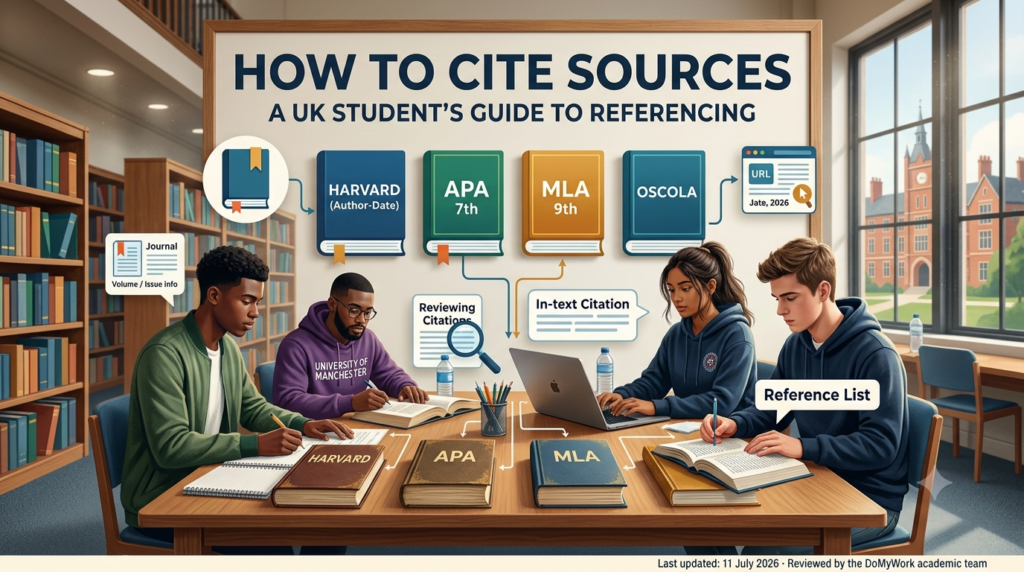
Citing a source means telling the reader exactly where an idea, fact or quotation came from. You do it twice: a short in-text citation at the point you use the source, and a full entry in your reference list at the end. The format depends on the style your department requires, usually Harvard, APA, MLA or OSCOLA. Why does citing sources matter? Citation does three jobs at once. It credits the people whose work you have built on, it lets your marker trace and verify your claims, and it protects you from an allegation of plagiarism. A well referenced piece signals that you have read widely and engaged with the evidence, which is one of the clearest markers of a strong academic argument. It also protects your similarity score. Correctly quoted and cited material is expected to match sources, and markers read the report rather than the headline percentage. If you want to understand how that number is judged, see our guide to what counts as a good Turnitin similarity score. What is the difference between an in-text citation and a reference? Every source you use appears in two places, and both are required. A citation with no matching reference, or a reference with no in-text citation, is a common reason to lose marks. Check that every one pairs up before you submit. Which referencing style should you use? Never choose a style by preference. Your module handbook or assignment brief states the required style, and different departments in the same university often use different ones. The four you will meet most often in the UK are set out below. Style Common subjects In-text format Governing guide Harvard (author-date) Business, social sciences, education, nursing (Author, Year, page) Cite Them Right (Pears and Shields) APA 7th edition Psychology, health sciences, some social sciences (Author, Year, p. x) APA Publication Manual, 7th ed. (2020) MLA 9th edition English, humanities, arts (Author page) MLA Handbook, 9th ed. (2021) OSCOLA Law Numbered footnotes OSCOLA, 4th ed. (University of Oxford) Harvard is not a single fixed standard. Many UK universities publish their own Harvard variant, so follow your institution’s version where one exists, and use Cite Them Right as the default reference for it. How do you write an in-text citation? The pattern is consistent within a style, and the worked examples below use a single source, a 2021 book by Smith, so you can see how the same reference behaves. Use a signal phrase when the author is the focus of your sentence, for example: Smith (2021) argues that widening participation improves retention. Use the bracketed form when the point matters more than who made it. How do you write a reference list entry? The reference list gives the full record. Here is the same book across the four styles. Order your reference list alphabetically by author surname for Harvard, APA and MLA. OSCOLA uses a bibliography ordered by author surname alongside its footnotes. List every source you cited, and only those you cited. How do you cite a website, a journal article and AI tools? Two things change across source types: the elements you record and their order. For a journal article you add the journal title, volume, issue and page range. For a website you add the site name and the date you accessed it, because online content can change. If you have used a generative AI tool, most 2026 style guides now ask you to name the tool, the version, the date and the prompt, and to treat it as a source rather than a hidden helper. Check your own institution’s current AI policy first, since some treat AI use as an academic offence regardless of citation. How can you avoid the most common citation mistakes? Frequently asked questions Do I need to cite common knowledge? No. Facts that are widely known and undisputed, such as the date of a well known historical event, do not need a citation. If in doubt, cite it, because an unnecessary citation costs nothing while a missing one can cost marks. How many sources should I cite? There is no fixed number. The right amount is enough to support every claim that needs evidence. Depth of engagement with a few strong sources usually reads better than a long list of thinly used ones. Is citing sources enough to avoid plagiarism? Citing is necessary but not sufficient. You also need to quote directly when you use exact words, and to genuinely rewrite ideas when you paraphrase. Citation without proper paraphrasing can still be flagged. Can I use a citation generator? Generators are useful for a first draft of a reference, but they make errors with edition, author order and source type. Always check the output against your style guide before you submit.
Plagiarism Checker for Researchers: How to Screen Your Manuscript
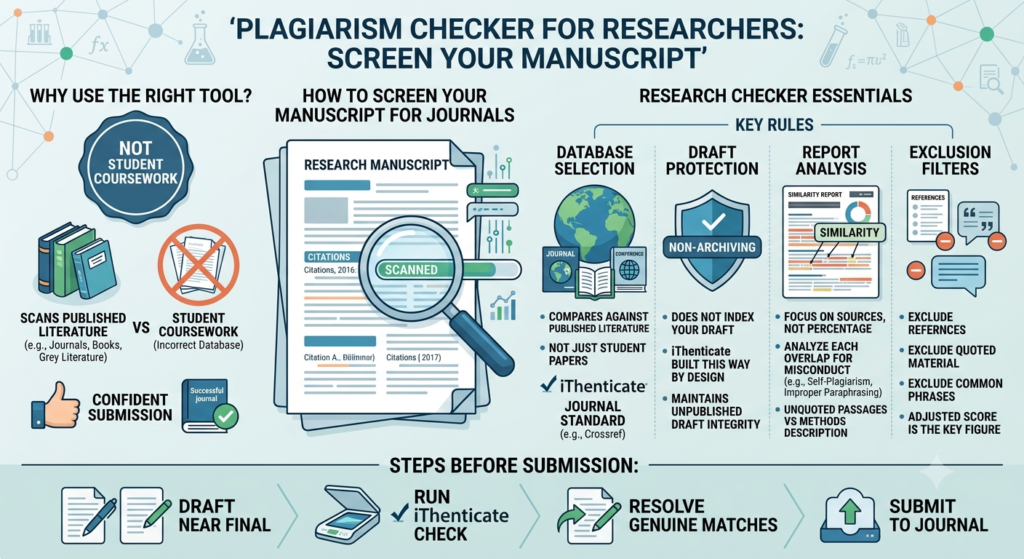
Researchers need a checker built for published literature, not student coursework. The standard is iThenticate, which powers the Crossref Similarity Check that journals run before peer review. The key rules are to check against research databases, use a tool that does not archive your unpublished draft, and read the report rather than the headline percentage. Why can’t researchers just use a student checker? Because the wrong database gives a false sense of security. A tool aimed at students is strongest at matching against previously submitted coursework, which is largely irrelevant to a journal article. A research manuscript needs to be compared against published journals, conference proceedings, books and grey literature, since that is what an editor’s system will check it against. Clearing a student-oriented tool tells you little about how a journal will see your paper. Which tool do journals actually use? Most reputable journals screen submissions with iThenticate, delivered through the Crossref Similarity Check programme, which has more than 1,500 publisher members according to Crossref. When you self-check with iThenticate before submitting, you are running the same software the editorial office will use, which is why it is the professional standard for pre-submission screening. For a full breakdown of how it differs from the classroom tool, see our comparison of iThenticate and Turnitin. What should a researcher’s checker do? How do you read a research similarity report? Do not stop at the percentage. Open the report and judge the largest single match first. Overlap concentrated in one unquoted passage of your discussion is a real problem. The same total spread thinly across your reference list and a standard methods description usually is not. A methods section will always match other papers describing the same standard procedure, which is expected rather than misconduct. Two matches deserve particular attention. First, overlap with your own earlier publications, which is self-plagiarism or text recycling, and which publishers expect you to disclose and cite. Second, any passage where you have paraphrased too closely, which our guide to quoting, paraphrasing and summarising helps you fix. When should you run the check? Before submission, not after. The value of a self-check is that you can still rewrite while the work is yours. Run a check once your draft is near final, resolve the genuine matches, then submit. Leaving it until the editor’s check is too late to fix anything, and a high similarity flag at that stage can delay or sink the submission. What similarity level is acceptable for a manuscript? There is no universal threshold, and it varies by journal and field. Many editors look at the adjusted score after excluding references and quotations, and at how the matches are distributed, rather than a fixed cut-off. A low overall figure with one large unattributed match can be more concerning to an editor than a slightly higher figure made up of many small, legitimate overlaps. Always check the specific journal’s author guidelines, which take precedence. How can you reduce genuine overlap before submitting? Frequently asked questions Is there a free plagiarism checker good enough for research? Free tools are fine for a quick early pass, but they rarely index the published literature a journal checks against, so they should not be your final screen. For a submission-grade check, use iThenticate or the tool your institution provides. Will checking my manuscript put it in a database? Not with iThenticate, which does not archive submissions. Avoid tools that store your draft, since an indexed draft can later match against your own published version. Does a plagiarism checker also detect AI writing? Some do, as a separate feature. iThenticate added AI writing detection for institutional subscribers with its 2.0 release. Treat any AI result as advisory, because false positives are a known risk. My university uses a different mandated tool. Which do I trust? For official evaluation, use whatever your institution mandates, since that is the result on record. Use iThenticate as an additional pre-submission check when you are heading to a journal, because it reflects what the journal will run.
iThenticate vs Turnitin: What Is the Difference?
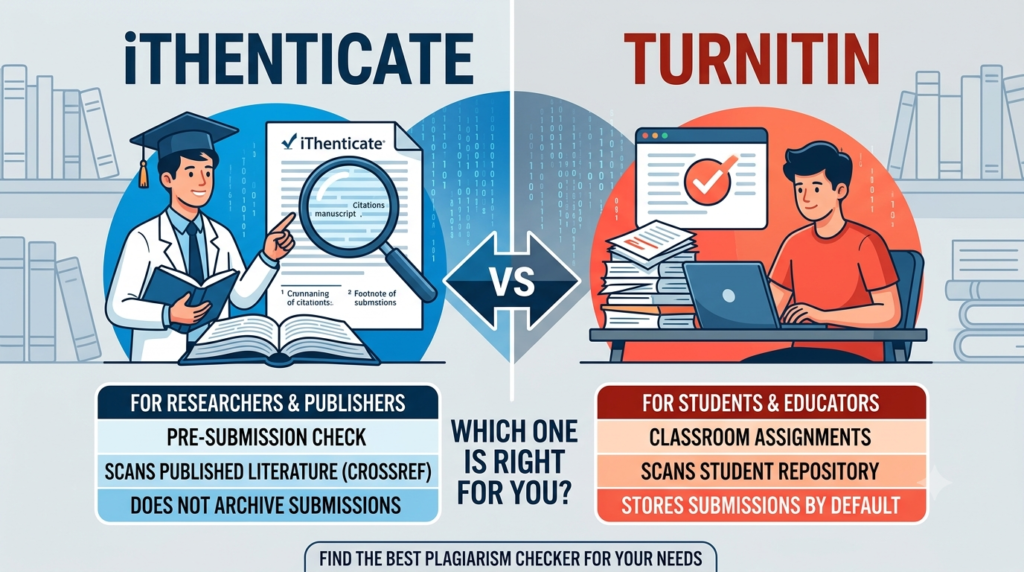
iThenticate and Turnitin are both owned by Turnitin LLC and share the same text matching core, but they serve different users. Turnitin checks student assignments and stores submissions in a repository. iThenticate screens research manuscripts and theses against published literature and does not archive your document. Publishers require iThenticate, not Turnitin. Are iThenticate and Turnitin the same company? Yes. iThenticate is owned by Turnitin LLC, which acquired it in 2014, and the two products share underlying matching technology. The difference is not the engine, it is the audience, the database they search and how they handle your file. Confusing them leads students and researchers to run the wrong check at the wrong stage. Who is each tool built for? This is the distinction that matters most. How do the databases differ? Both check against web pages and published journals, but their strengths diverge, and this is why the same document can return different scores. Feature Turnitin iThenticate Primary use Student assignments and theses Research manuscripts, PhD theses, grants Student paper repository Yes, a core feature No Published literature coverage 190+ million articles 90+ million articles from 1,500+ publishers, via Crossref, Elsevier, Springer and others Web pages indexed ~47 billion (per Turnitin) Extensive web and scholarly corpus Stores your submission Yes, by default No, submissions are not archived LMS integration Yes (Moodle, Blackboard, Canvas) No, folder-based tool and API Powers Crossref Similarity Check No Yes Figures above are drawn from Turnitin, Crossref and university library guidance (see Sources). Because Turnitin holds a large student paper repository that iThenticate lacks, Turnitin is better at catching a classmate’s reused coursework, while iThenticate is more sensitive to overlap with published research. Why do publishers require iThenticate and not Turnitin? iThenticate powers the Crossref Similarity Check programme, used by more than 1,500 publisher members to screen manuscripts before peer review, according to Crossref. When you submit to most reputable journals, the editorial office runs your manuscript through iThenticate. That is why a Turnitin report is generally not accepted for journal submission, and why researchers self-check with iThenticate to see what the journal’s system will find. Does the repository difference matter? It matters a great deal for unpublished work. Turnitin stores submissions by default, so a draft you check can become a database entry that your final version later matches against. iThenticate does not archive submissions, which is deliberate, so a researcher can run a pre-submission check without the draft being indexed. If you are checking an unpublished thesis or manuscript, this privacy difference is the deciding factor. How does AI detection compare? Turnitin added an AI writing detector in April 2023 and has updated it since, and the feature is available to institutional subscribers as part of the standard platform. iThenticate added AI writing detection with its 2.0 release in July 2024, but that layer is available to institutional subscribers rather than individual per-document users. Treat any AI score as advisory, since false positives are a known risk with every detector on the market. Which should you use? For a wider comparison of checkers by use case, see our guide to the best plagiarism checkers for students, and for researchers specifically, our guide to a plagiarism checker for researchers. If you only need to see a Turnitin-style figure without an institutional login, our Scribbr vs Turnitin comparison covers the accessible options. Frequently asked questions Is iThenticate stricter than Turnitin? Not stricter, but different. iThenticate compares against a large body of published literature, so a research manuscript can score higher there than in Turnitin, while Turnitin can catch reused student coursework that iThenticate would miss. Can a student use iThenticate? Usually only if your institution provides access, often through the library or research office for PhD scholars. It is not a classroom tool, and individual accounts are relatively expensive. Will my iThenticate check be stored and matched later? No. iThenticate does not archive submissions, which is why researchers use it for pre-submission checks of unpublished work. Does a good Turnitin score mean my paper will pass a journal check? Not necessarily. A journal runs iThenticate against published literature that Turnitin does not fully index, so you can clear Turnitin and still be flagged. Check with iThenticate before submitting to a journal.
120+ Finance Dissertation and Assignment Topics for 2026
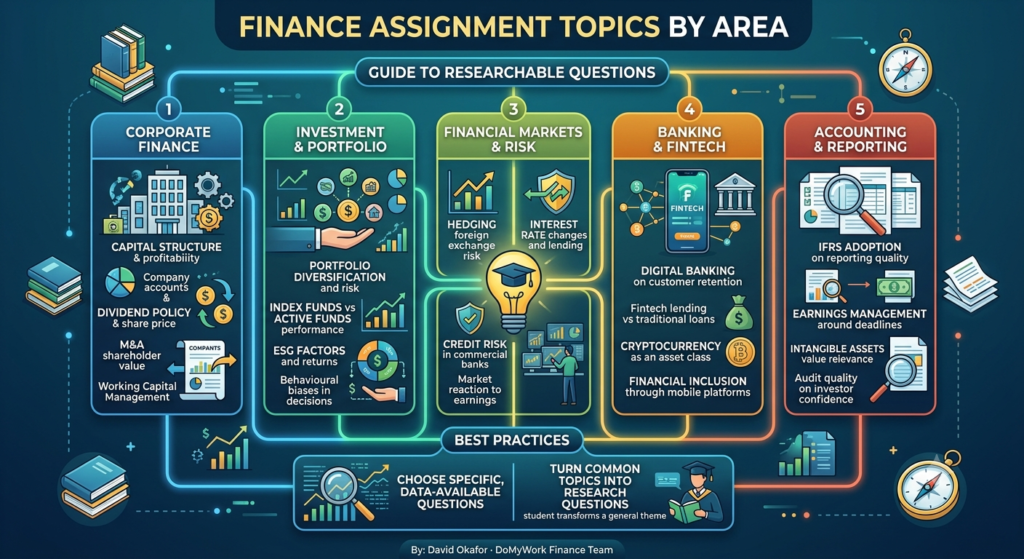
A strong finance topic is specific, backed by data you can actually get, and tied to a current issue in markets, policy or practice. Below are more than 120 finance topics for dissertations and assignments in 2026, grouped by field, from corporate finance and investment to fintech, banking, ESG and behavioural finance, each written so you can shape it into a clear research question. How do you choose a good finance topic? Start with the branch of finance you find genuinely interesting, then test each idea against data. Finance rewards topics where the numbers already exist, company accounts, market indices, central bank data, so a secondary, quantitative study is often the most realistic route within a student timetable. Our guide on primary versus secondary research helps you decide which fits your question. Then narrow it. A whole theme like market efficiency is too big; the effect of earnings announcements on a specific index over a set period is answerable. If you want worked techniques to build your analysis on, our guides to ratio analysis, NPV, IRR and payback and writing a financial analysis report show the methods markers expect, and our finance assignment help guide covers how to structure the write-up. Corporate finance and capital structure topics Capital structure and financing Mergers, acquisitions and valuation Investment, markets and portfolio topics Markets and asset pricing Portfolio and risk Banking and financial institutions topics Banking Fintech, digital finance and cryptocurrency topics Fintech and digital finance Cryptocurrency and digital assets Accounting, reporting and auditing topics Financial reporting and auditing Behavioural finance topics Investor behaviour International finance and risk management topics International finance Risk management ESG, sustainable and personal finance topics ESG and sustainable finance Personal and household finance Public finance, real estate and insurance topics Property and public finance Insurance and pensions Regulation, crises and governance topics Regulation and financial stability Taxation and financial policy Entrepreneurial, alternative and specialist finance topics SME and alternative finance Derivatives, Islamic and emerging-market finance Financial analysis and performance topics Ratio and distress analysis Financial technology risk How do you turn a finance topic into a research question? A topic is a theme; a research question is testable. Pick one idea above, define your sample and time period, and decide whether you are describing a relationship, testing a hypothesis or comparing two approaches. From there, choose your data source and method early, since finance dissertations live or die on data access. Our finance and accounting dissertation topics guide offers more research-focused angles, and if you are also studying management, our MBA assignment guide covers overlapping strategy themes. When you reach the write-up, our assignment structure guide keeps the report clear. Frequently asked questions How do I choose a finance dissertation topic? Pick a branch of finance you find interesting, then check you can access the data to study it. Narrow the theme to a single testable question tied to a sample and time period, and favour topics where company accounts or market data already exist. Should a finance dissertation use primary or secondary data? Most student finance dissertations use secondary quantitative data, such as company accounts or market indices, because it is reliable and available within your timetable. Primary surveys suit behavioural finance questions but need careful design and ethics approval. What makes a finance topic too broad? A topic is too broad when you cannot define the sample, period and variable you will measure. Narrow a theme like market efficiency to a specific index over a set period so the question can actually be answered with evidence. Can I get help with my finance assignment or dissertation? Yes. If you would like a subject expert to help you choose a topic, source the data and structure the analysis, our finance assignment writing help and dissertation writing help services are built around that kind of guided support.
Ratio Analysis Explained: A Student Guide With Worked Examples
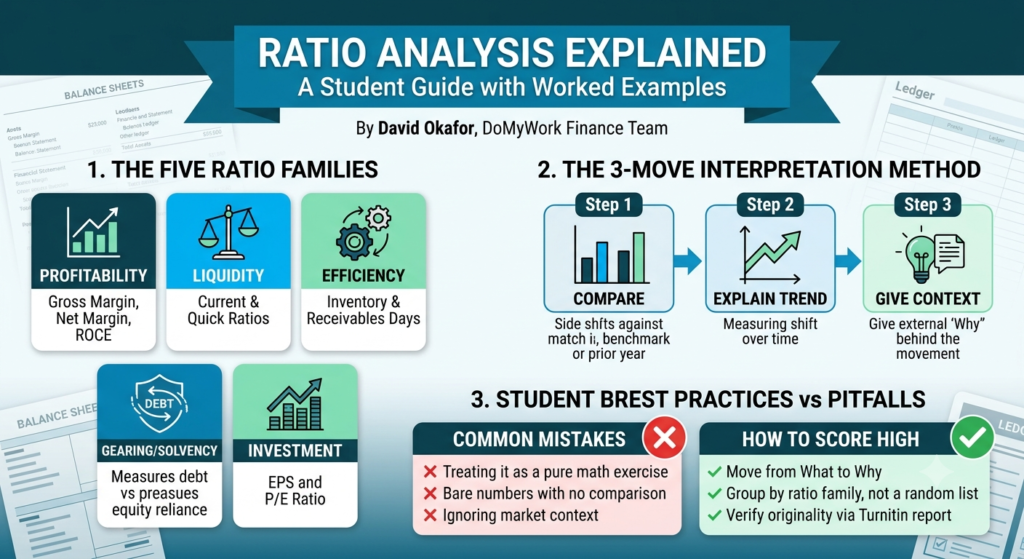
Ratio analysis turns a set of financial statements into a story about a company’s performance. You calculate ratios across profitability, liquidity, efficiency, then gearing, compare them to prior years or competitors, then explain what they reveal. The marks sit in the interpretation, not the calculation. A common mistake is treating ratio analysis as a calculation exercise. Working out a current ratio is easy; explaining what it says about the company, then why it changed, is the actual assignment. This guide covers the main ratio categories with worked examples, then shows how to turn the numbers into the interpretation that earns marks. What is ratio analysis? Ratio analysis is the practice of relating one figure from the financial statements to another to reveal something about performance or position. A single number, revenue of two million pounds, tells you little. Related to something else, revenue against capital employed, or profit against sales, it becomes meaningful. Ratios let you compare companies of different sizes, then track one company over time. What are the main categories of ratios? Ratios group into a few families, each answering a different question. A strong analysis usually covers several families, since a company can be profitable yet short of cash, or liquid yet heavily indebted. The full picture comes from reading them together. How do you calculate profitability ratios? Three are commonly used. Gross profit margin is gross profit divided by revenue, times one hundred. Net profit margin is net profit divided by revenue, times one hundred. Return on capital employed, ROCE, is operating profit divided by capital employed, times one hundred. For a company with revenue of one million pounds, gross profit of four hundred thousand, then net profit of one hundred thousand, the gross margin is 40 per cent then the net margin is 10 per cent. That gap tells you how much operating cost sits between the two. How do you calculate liquidity ratios? Two matter most. The current ratio is current assets divided by current liabilities. The quick ratio, or acid test, is current assets minus inventory, divided by current liabilities. A company with current assets of three hundred thousand pounds then current liabilities of two hundred thousand has a current ratio of 1.5, meaning it holds one pound fifty of short-term assets for every pound of short-term debt. Whether that is healthy depends on the industry, which is why comparison matters. → Working through a ratio analysis assignment? A model finance assignment with full working shows how each ratio is calculated then interpreted for a real company, as a reference for your own How do you calculate gearing and efficiency ratios? Gearing measures reliance on debt: total debt divided by equity, or debt divided by debt plus equity, times one hundred. A highly geared company carries more risk, since interest must be paid whatever profit it makes. Efficiency ratios show how hard assets work: inventory days show how long stock sits before selling, then receivables days show how long customers take to pay. Rising receivables days can signal a company struggling to collect cash, even while it looks profitable on paper. How do you interpret ratios? Interpretation is where the marks live, then it rests on three moves. Compare the ratio to a benchmark, prior year, competitor, or industry average. Explain the trend, is it improving or worsening. Then give context, a reason the number moved. A falling net margin “because rising material costs squeezed profit while prices held” is analysis; simply stating the margin fell is description. Always push from what to why. What are common ratio analysis mistakes? Three recur. Calculating ratios without interpreting them, which leaves the assignment half done. Presenting no comparison, so the numbers float without meaning. Then ignoring context, treating a ratio as good or bad in isolation when the industry, or a one-off event, explains it. Avoid all three by pairing every ratio with a comparison then a reason. For the wider report structure that often surrounds a ratio analysis, see our guide to writing a financial analysis report. How do you compare a company against its industry? A ratio only becomes meaningful against a benchmark, then the industry average is the most useful one. Find sector averages from industry reports, databases, or a set of comparable listed firms, then place your company’s ratios beside them. A net margin of eight per cent looks weak against a software sector averaging twenty, but strong against a supermarket sector averaging three. Always state the benchmark you compare to, since a ratio in isolation tells the reader nothing about whether it is good. How do you structure a ratio analysis assignment? Group your analysis by ratio family rather than listing ratios at random. Cover profitability, then liquidity, then efficiency, then gearing, with a short interpretation after each. Open with a brief introduction to the company then its context, then close with an overall assessment that pulls the families together into a single view of financial health. This structure stops the assignment reading as a disconnected list, then guides the reader to your conclusion. What are investment ratios? Investment ratios matter most to shareholders, then often appear in assignments that take an investor’s view. Earnings per share divides profit after tax by the number of shares, showing the profit attributable to each share. The price to earnings ratio divides share price by earnings per share, indicating how much the market pays for each pound of earnings. Dividend yield shows the income return on the share price. These ratios connect a company’s accounts to its value in the market, which is why an investor reads them first. When you write up ratios, present each with its figure, a comparison, then a sentence of interpretation, rather than a bare table. A short paragraph per ratio family reads far better than a wall of numbers, then it turns calculation into the analysis that earns the marks. → Turn numbers into analysis. See pricing for a model ratio analysis to benchmark against, then
How to Write a Financial Analysis Report (Structure and Example)
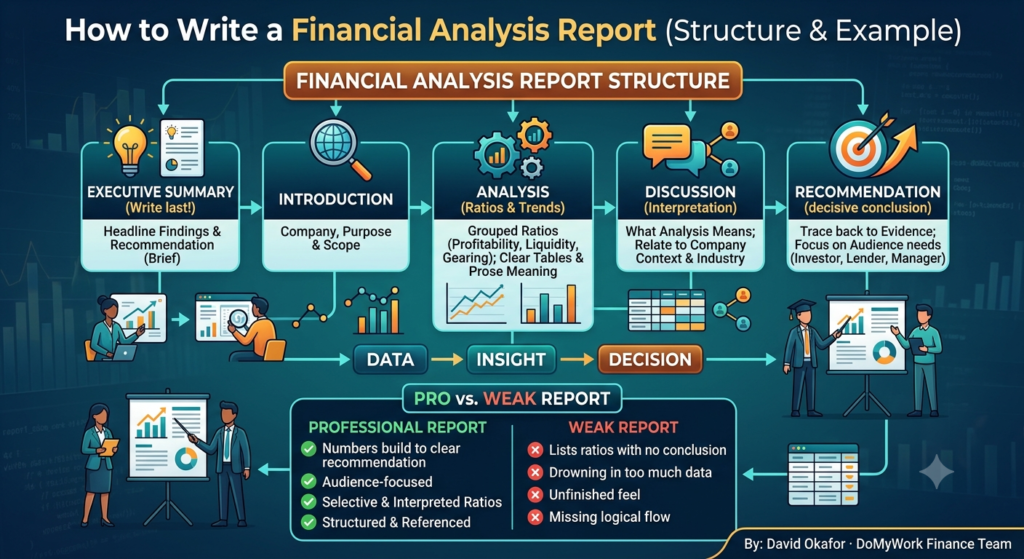
A financial analysis report examines a company’s financial health, then presents a reasoned conclusion for a specific audience, an investor, a lender, or a manager. It moves from data to insight: ratios and trends first, then interpretation, then a recommendation. Structure then clarity carries as many marks as the analysis itself. The difference between a report that scores a 2:2 then one that scores a first is rarely the maths. It is whether the numbers build to a clear, audience-focused recommendation. A report that lists ratios without a conclusion reads as unfinished. This guide sets out the structure, then shows how to turn analysis into a recommendation. What is a financial analysis report? A financial analysis report is a structured document that evaluates a company’s performance, position, then prospects using its financial statements, then draws a conclusion for a defined reader. Unlike a raw set of calculations, it is written for a purpose: to inform a decision, whether to invest, to lend, or to change strategy. That audience shapes what you emphasize. What sections does a financial analysis report include? A typical report follows a clear order. This report shape mirrors the labelled structure of any formal report, which our guide to structuring a university assignment sets out in general terms. How do you write the executive summary? Write it last, once the report is finished, even though it sits first. In a short paragraph, state the key findings then the recommendation, so a busy reader grasps the conclusion without reading the whole report. Resist the urge to include working here; the summary is for outcomes, not calculations. A sharp executive summary signals a writer in command of their material. How do you present the analysis? Lead with the ratios then trends that matter for your audience, grouped logically, profitability, then liquidity, then gearing. Show each calculation, then interpret it immediately rather than saving all analysis for later. Use tables for the numbers, then prose for the meaning. Our guide to ratio analysis with worked examples covers the calculations that usually sit at the core of this section. → Writing a company analysis report? A model financial analysis report shows how the sections connect, from ratios to recommendation, as a reference for your own. How do you turn analysis into a recommendation? The recommendation is where the report earns its top marks, then it must follow from the evidence. Tie your conclusion to your audience: an investor wants to know whether returns justify risk, a lender whether the company can repay. State the recommendation plainly, then support it with the specific findings that drove it. A recommendation that does not trace back to your analysis reads as an opinion, not a conclusion. How do you use tables and charts? Tables then charts should support the argument, not decorate it. Use a table to present ratios across years, or a chart to show a clear trend, then always refer to it in the text. A chart the reader has to interpret alone adds nothing. Label everything, keep it clean, then let each visual make one point. Analysis carried by a well-chosen chart reads as professional. How do you reference company data? Cite where your figures come from: the company’s annual report, a financial database, or published statements, with the year. Referencing data sources is not optional in a finance report, since your analysis is only as trustworthy as the numbers behind it. List sources in your required style, usually Harvard, then keep full statements in an appendix rather than the body. Who is the audience for a financial analysis report? Every strong report is written for someone, then that reader shapes what you emphasize. An equity investor cares about returns then growth prospects. A lender cares about liquidity then the ability to service debt. A manager cares about efficiency then where performance can improve. Identify your audience early, usually the brief tells you, then weigh your analysis toward what matters to them. The same set of ratios tells a different story depending on who is asking. What are common financial report mistakes? Three recur. Presenting ratios with no interpretation, which leaves the reader to do your job. Reaching a recommendation the analysis does not support, which breaks the logic. Then drowning the report in every ratio available, rather than selecting the ones that matter for the audience. A focused report that analyses six relevant ratios well beats one that calculates twenty then explains none. Select, interpret, then conclude. How long should each section be? Balance matters. The analysis then discussion should carry the bulk of the report, since that is where the marks sit. Keep the executive summary to a short paragraph, the introduction brief, then let the recommendation be decisive rather than long. A report that spends half its length introducing the company then rushes the analysis has its weight in the wrong place. Aim to reach your first real analysis within the first page. How do you make a report read professionally? Small habits signal command of the material. Use consistent number formatting then units throughout. Round sensibly, then keep decimal places consistent. Refer to every table then chart in the text. Write in clear, direct prose, then cut padding. A report that looks like something a finance professional would hand to a client reads as confident, which quietly lifts the mark. Structure the written sections the way you would any formal piece, following our guide to structuring a university assignment. Should you include limitations in a financial report? A brief note on limitations strengthens a report rather than weakening it. Financial statements are historic, ratios can be distorted by one-off events, then a single year gives limited insight. Acknowledging these, in a sentence or two near your conclusion, shows the reader you understand the boundaries of your analysis. It also guards your recommendation, since you have shown what it does then does not rest on. Keep it short then honest, not a list of excuses. → Build
Capital Budgeting: NPV, IRR and Payback Period Made Simple
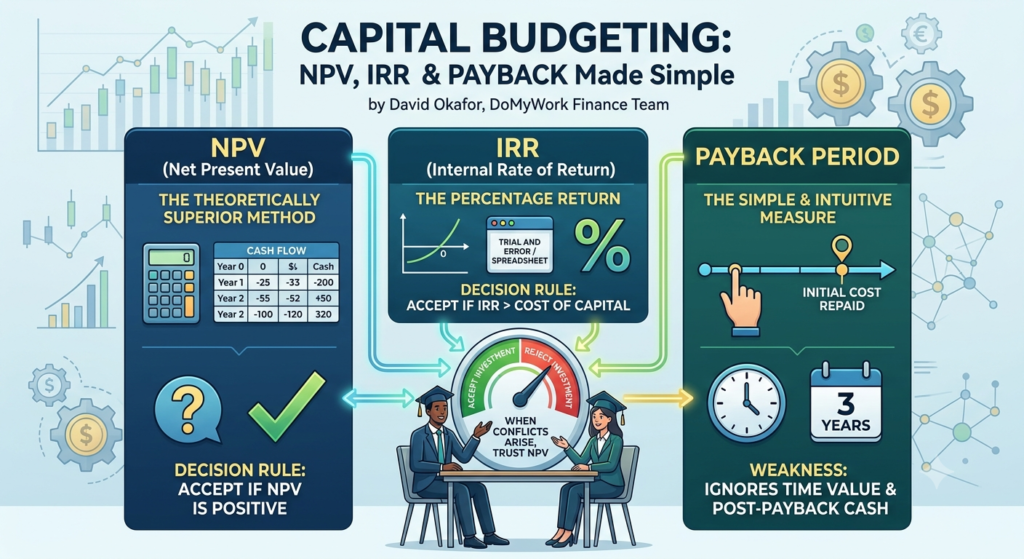
Capital budgeting decides whether an investment is worth making. The three core tools are payback period, net present value (NPV), then internal rate of return (IRR). NPV is the one examiners weigh most, since it accounts for the time value of money then gives a clear accept-or-reject rule. These calculations look intimidating, yet each follows a fixed recipe. Once you can build a cash flow table then apply a discount factor, capital budgeting becomes mechanical. This guide works through all three tools with examples, shows the decision rule for each, then flags the mistakes that cost marks. What is capital budgeting? Capital budgeting is the process of evaluating a long-term investment, a new machine, a project, or an acquisition, to decide whether the future cash it generates justifies the cost today. Because money has a time value, a pound received in five years is worth less than a pound today, the better methods discount future cash flows back to their present worth before comparing. What is the payback period? Payback period is the time it takes for an investment to repay its initial cost from its cash flows. If a project costs one hundred thousand pounds then returns twenty-five thousand a year, the payback period is four years. It is simple then intuitive, which is why it is popular. Its weakness is that it ignores the time value of money, then ignores any cash flows after payback, so it is best used alongside NPV rather than alone. What is net present value (NPV)? NPV discounts every future cash flow back to today, then subtracts the initial cost. Each year’s cash flow is multiplied by a discount factor, one divided by one plus the discount rate, raised to the power of the year. Add the discounted inflows, subtract the outlay, then you have the NPV. If a project costs one hundred thousand pounds then returns forty thousand a year for three years, discounted at ten per cent, the discounted inflows come to roughly ninety-nine thousand, giving an NPV of about minus one thousand pounds. The decision rule is simple: accept if NPV is positive, reject if negative. A negative NPV, as here, means the project does not quite cover its cost of capital. What is the internal rate of return (IRR)? IRR is the discount rate at which a project’s NPV equals zero. It represents the return the project itself earns. The decision rule is to accept if the IRR exceeds your cost of capital, then reject if it falls below. IRR is popular because it gives a single percentage that is easy to compare, though it is found by trial and error or a spreadsheet function rather than a neat formula. → Working through an appraisal question? A model capital budgeting solution lays out the cash flow table, discount factors, then NPV step by step, as a reference for your own working. NPV vs IRR: which should you use? When the two disagree, trust NPV. IRR can mislead on projects of different sizes, or ones with unusual cash flow patterns, and can even produce more than one value. NPV always points to the option that adds the most absolute value, which is the goal. Examiners expect you to know that NPV is the theoretically superior measure, then to explain why when a question sets the two against each other. How do you lay out a capital budgeting answer? Build a table with a row for each year, starting at year zero for the initial outlay. List the cash flow, the discount factor, then the discounted cash flow for each year. Sum the discounted figures to reach NPV. A clear table earns method marks even if one number is off, since the examiner can follow your logic. Label the discount rate then state your decision explicitly at the end. What are common capital budgeting mistakes? Three recur. Forgetting year zero, so the initial cost is left out of the discounting. Using accounting profit instead of cash flow, when capital budgeting works on cash. Then applying the wrong discount rate, or forgetting to discount at all. Reading the question carefully for the cost of capital, then building a clean year-by-year table, avoids all three. What discount rate should you use? The discount rate reflects the return the investment must beat, usually the company’s cost of capital. Questions often give it to you directly, so read carefully. Where you must reason about it, a higher rate reflects higher risk, which lowers the present value of future cash flows, then makes a project harder to justify. Using the wrong rate is one of the most common ways to reach a correct-looking but wrong NPV, so always state the rate you used then why. How do you handle uneven cash flows? Real projects rarely return the same amount each year, then that is where a clear table earns its keep. List each year’s specific cash flow, apply the correct discount factor for that year, then sum the discounted figures. For payback with uneven flows, accumulate the inflows year by year until they cover the initial cost, noting the point within the year where payback occurs. Laying this out in rows keeps uneven cash flows from becoming a source of error. How do you choose between competing projects? When a question gives two projects a limited budget, rank them by NPV, since the goal is to add the most value. Where the projects differ greatly in size, a profitability index, NPV divided by initial outlay, helps compare value per pound invested. Do not rank on IRR alone, since a smaller project can show a higher IRR yet add less total value than a larger one. State your ranking rule clearly, then apply it consistently across the options the question gives you. Watch for projects with different lifespans too. A three-year project then a six-year project are not directly comparable on raw NPV, since one runs twice as long. Where a question raises this, mention the