Cover Letter Examples and How to Write One (2026)
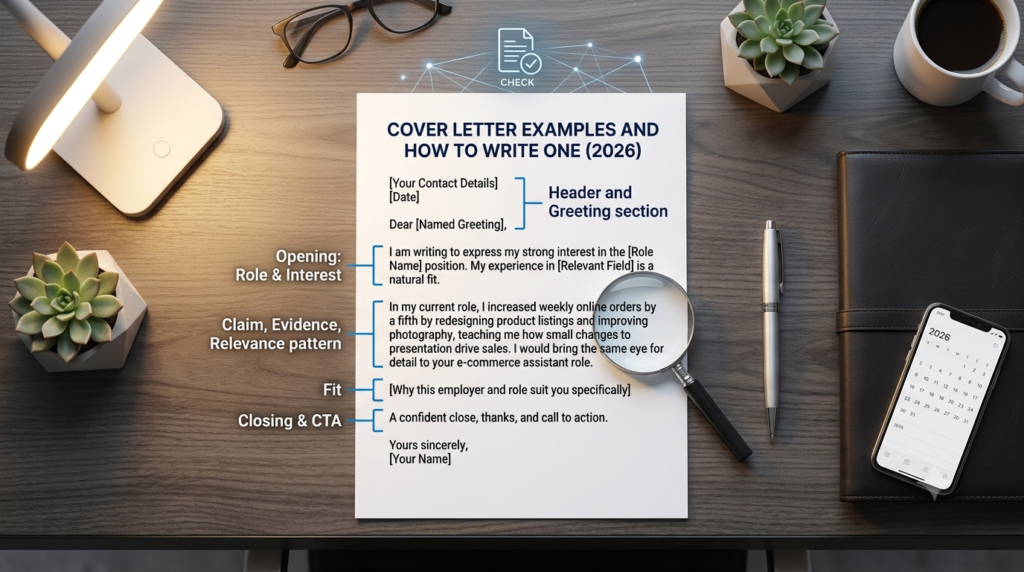
A cover letter is a one-page letter sent with your CV that explains why you want the job and why you are a good fit. A strong cover letter is tailored to the role, opens with a clear reason for applying, evidences your key skills with examples, and ends with a confident close. Keep it to three or four short paragraphs on a single page. A cover letter is your chance to connect your experience to a specific job in a way a CV cannot. The best ones are short, tailored and evidenced, not generic templates sent to every employer. This guide shows the standard structure, gives an example to learn from, and explains how to write one that gets read, so you can adapt it to your own application rather than copy it. What is a cover letter? A cover letter is a short letter, usually one page, that accompanies your CV when you apply for a job. Its job is to introduce you, explain why you are applying for this specific role, and show how your skills and experience match what the employer needs. A CV lists what you have done; a cover letter tells the employer why it matters for their role, and shows your written communication in the process. What is the structure of a cover letter? Most cover letters follow the structure below, kept to a single page. Section What it covers Header and greeting Your contact details, the date, and a named greeting where possible. Opening paragraph The role you are applying for and a clear reason you are interested. Body paragraph(s) Your most relevant skills and experience, evidenced with examples. Fit paragraph Why do you suit this employer and role specifically? Closing paragraph A confident close, thanks, and a call to action such as an interview. Cover letter example (what good looks like) Below is a short illustrative body paragraph. Notice it evidences a skill with a specific result rather than just claiming it. Use it as a model, then write your own with your details. In my current role at a busy retail store, I increased weekly online orders by a fifth by redesigning the product listings and improving the photography, which taught me how small changes to presentation drive sales. I would bring the same eye for detail to your e-commerce assistant role. The strong version names a specific action, a result and what it taught you, then links it to the job. That is the pattern to repeat: claim, evidence, relevance. Clear, well-structured writing matters throughout, the same clarity our how to write a first-class essay guide covers. How do you write a cover letter? For the step-by-step process in more detail, see our how to write a cover letter guide, which expands each stage. Cover letter dos and don’ts Frequently asked questions What should a cover letter include? A header and greeting, an opening that states the role and why you are applying, body paragraphs evidencing your relevant skills, a paragraph on why you fit the employer, and a confident close with a call to action. How long should a cover letter be? One page, usually three or four short paragraphs. Employers read many applications, so make every line count and keep it concise and specific. Can I use a cover letter example? Use examples to learn the structure and style, but tailor the content to the specific job and employer. A generic or copied letter is easy to spot and rarely works. What is the difference between a cover letter and a CV? A CV lists your experience, skills and qualifications; a cover letter explains why that experience makes you right for a specific role, and shows your written communication.
130 Statistics Project Ideas for Students (2026)
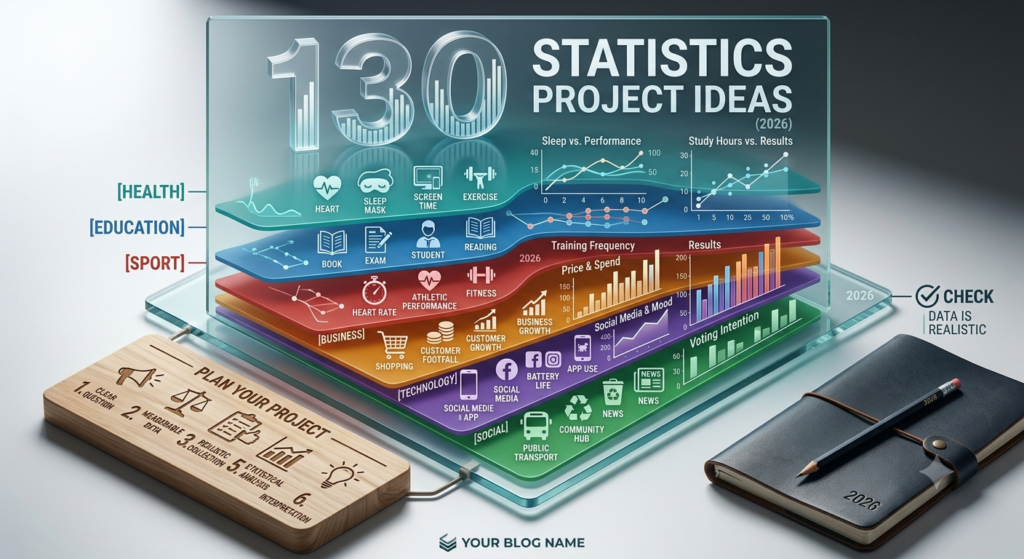
A strong statistics project asks a clear question you can answer by collecting and analysing data. Good areas include health and lifestyle, education and student life, sport, business and economics, technology and social data. Choose a question where the data is realistic to gather and the analysis is within your skills. A statistics project stands or falls on its data: the best ideas are questions you can actually collect numbers on and analyse with the methods you know. Because a project usually means gathering your own data, it is really a piece of primary research in miniature, so it helps to understand the difference between primary and secondary research before you choose, since some questions are far easier to answer with an existing dataset than with a survey of your own. This guide gives 130 project ideas grouped by area, then shows how to plan and run one. What makes a good statistics project? A good project has three qualities. It asks a clear, measurable question, usually about a relationship between two things you can count or measure. Its data is realistic to gather, whether through a survey, a simple experiment or an existing dataset, because an idea you cannot collect data for is not a project. And its analysis suits the methods you have been taught, since a question needing techniques beyond your course will stall. Deciding whether your question calls for numerical measurement or a mix of numbers and description also matters, which is where our qualitative vs quantitative research guide helps, as many student projects blend a survey with a little context. 130 statistics project ideas by area The ideas below are grouped by area. Choose one where you can realistically gather data within your time. Health and lifestyle Education and student life Sport and fitness Business and economics Technology and media Social and community data Psychology and behaviour Food and consumer choices Everyday and observational projects Environment and sustainability How do you plan and run your project? Once you have a question, plan the whole project before collecting anything. Decide exactly what you will measure and how, choose whether to gather your own data or use an existing dataset, and work out a realistic sample size for your time. If you are surveying or observing people, consider the ethics of doing so, and if your course expects it, set the plan out in a short research proposal first. Collect the data carefully, since messy data undermines the analysis, then apply the statistical methods you have been taught and interpret what the results actually mean rather than just reporting numbers. When you write it up, a clear structure, question, method, results, then interpretation, makes the project easy to follow. Choosing the right project for your assignment With 130 ideas above, the deciding factor is data. Favour a question you can realistically collect data for in the time you have, with an analysis that matches the methods you know, since an ambitious idea you cannot finish is worse than a modest one done well. Check the project suits your course and the level expected, and keep the sample achievable. A smaller, well-collected dataset always beats a large one you cannot complete. Whichever idea you choose above, the same rule holds: pick a measurable question, make sure you can gather the data, and let a clear analysis, not a big dataset, carry the project. Ready to develop your capstone project? Let our experts help. Once you’ve chosen your topic, the next step is turning your idea into a structured project with clear research, analysis and presentation. Explore our capstone project writing support for guidance throughout your project. Explore capstone project writing support
APA Referencing: A Full Guide with Examples (7th Edition, 2026)
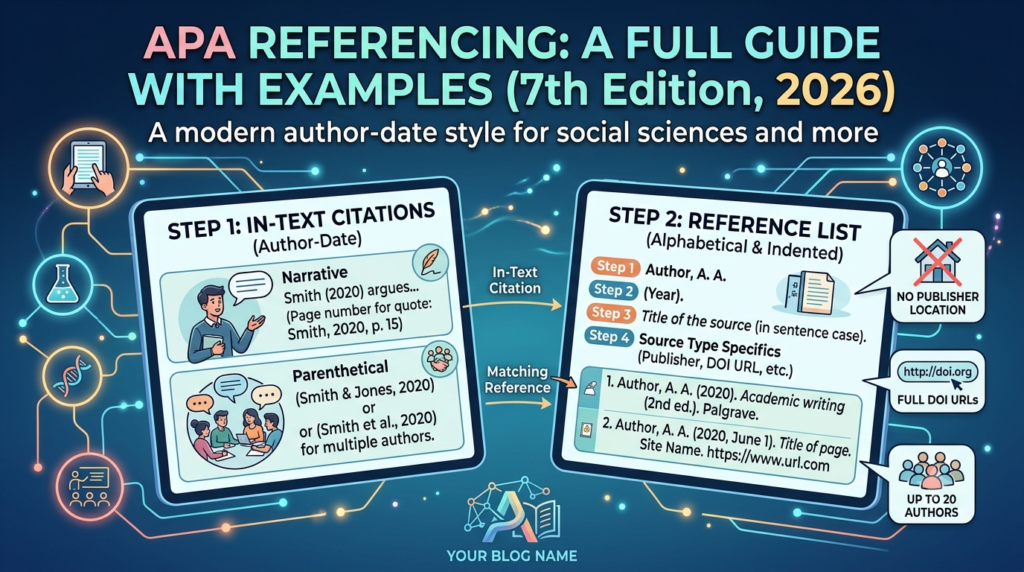
APA referencing is an author-date style where you cite the author’s surname and year in the text, such as (Smith, 2020), and give full details in an alphabetical reference list. This guide covers APA 7th edition: how to write in-text citations, how to format references for books, journals and websites, and the main changes in the 7th edition. APA is one of the most widely used referencing styles, common in psychology, education, nursing and the social sciences. It is an author-date system: a short citation in the text points the reader to a full entry in the reference list. This guide explains how to do both in APA 7th edition, with formats and examples for the sources you will use most, so you can reference accurately and avoid losing easy marks. Always confirm any details against the official APA manual or your department’s guidance. What is APA referencing? APA referencing is the citation style of the American Psychological Association, now in its 7th edition. It has two parts that work together: an in-text citation, giving the author’s surname and the year at the point you use a source, and a reference list at the end, giving the full details of every source, ordered alphabetically by author surname. The reader can move from any in-text citation to the matching reference, and every reference must have at least one in-text citation. How do APA in-text citations work? An in-text citation gives the author surname and year, and a page number for a direct quotation. You can use it in two ways: For two authors, name both every time, joined by an ampersand in brackets, such as (Smith & Jones, 2020). For three or more authors, use the first author followed by et al. from the first citation, such as (Smith et al., 2020). How do you format an APA reference list? The reference list starts on a new page, is ordered alphabetically by author surname, and uses a hanging indent. The table below shows the format and an example for the most common source types. Source APA 7th format and example Book Author, A. A. (Year). Title of the book (edition). Publisher. -> Smith, J. (2020). Academic writing (2nd ed.). Palgrave. Journal article Author, A. A. (Year). Title of article. Journal Name, Volume(Issue), pages. https://doi.org/xxxx Chapter in an edited book Author, A. A. (Year). Title of chapter. In E. Editor (Ed.), Title of book (pp. 10-25). Publisher. Website Author, A. A. (Year, Month Day). Title of the page. Site Name. https://www.url.com What changed in APA 7th edition? If you have seen older APA guidance, several things changed in the 7th edition. Knowing them avoids common errors. How do you reference APA step by step? APA is one style among several. For the wider principles of citing, see our how to cite sources guide, and for another common style, our Harvard referencing guide. If you are compiling sources with commentary, our annotated bibliography guide uses the same reference formats. Common APA mistakes to avoid Accurate referencing protects easy marks. For help checking your work, our assignment writing help and essay writing help services can review it. Frequently asked questions What is APA referencing? APA is an author-date referencing style where you cite the author surname and year in the text, such as (Smith, 2020), and list full source details alphabetically in a reference list at the end. How do you write an APA in-text citation? Give the author surname and year, either in brackets, such as (Smith, 2020), or in your sentence with the year in brackets, such as Smith (2020). Add a page number for direct quotations. What is the difference between APA 6th and 7th edition? APA 7th uses et al. for three or more authors from the first citation, lists up to 20 authors in references, drops the publisher location for books, and formats DOIs as full URLs. How do you reference a website in APA? Author, year with month and day, title of the page in italics, the site name, and the URL, for example: Author, A. A. (2020, June 1). Title of page. Site Name. https://www.url.com
How to Write an Annotated Bibliography (with Example, 2026)
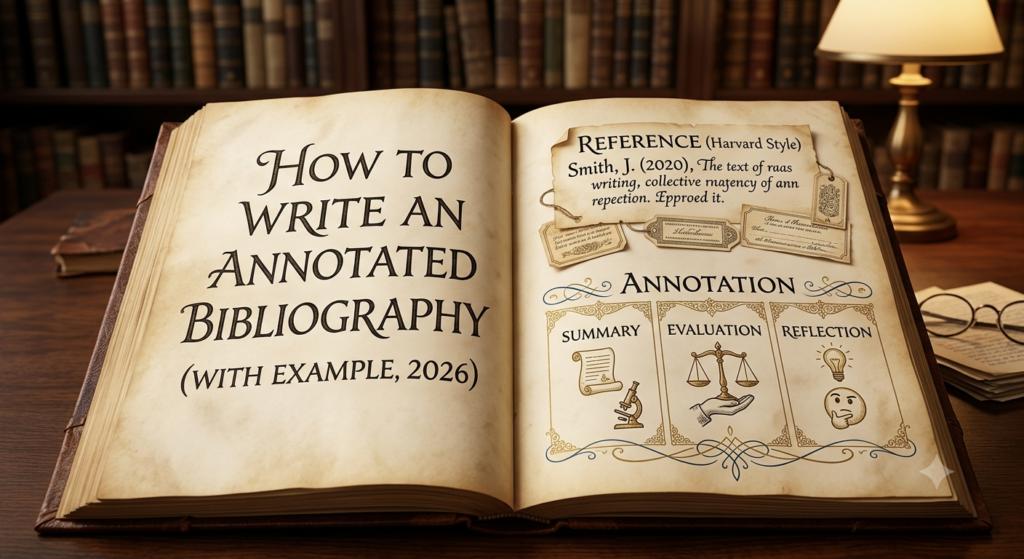
An annotated bibliography is a list of sources where each reference is followed by a short paragraph, the annotation, that summarises the source, evaluates it, and reflects on how it fits your research. To write one, format each reference in the required style, then write an annotation of roughly 100 to 200 words covering those three elements. An annotated bibliography looks like a reference list with extra text, but the extra text is the whole point, and it is where most of the marks sit. Where an ordinary reference list simply records the sources you used, an annotated bibliography asks you to show that you have read, understood and judged each one. That makes it a test of critical engagement as much as of referencing, and it is why a strong annotation does far more than restate what a source is about. This guide explains what an annotated bibliography is, what belongs in each annotation, how to write one step by step, and gives a worked example in Harvard style you can model your own on. What is an annotated bibliography? An annotated bibliography is a list of citations to sources, books, journal articles, reports and so on, where each citation is followed by a short descriptive and evaluative paragraph called an annotation. It serves several purposes at once. It shows your tutor that you have engaged critically with your reading rather than simply collected sources; it helps you organise and remember what each source offers as you plan a larger piece of work; and it demonstrates the quality and relevance of the research base you are building an argument on. Tutors set it partly as a task in its own right and partly as a stepping stone towards a literature review or dissertation, because the thinking it forces, judging each source on its merits, is exactly what those larger tasks demand. The key thing to understand is that an annotation is not a neutral summary. A summary tells the reader what the source says; an annotation also tells them how good it is and why it matters to you. That evaluative layer is what separates a strong annotated bibliography from a list of paragraphs that merely paraphrase abstracts, and it is the same critical move that lifts marks throughout academic writing. What goes in an annotation? A strong annotation usually blends three elements. Not every annotation needs all three in equal measure, your tutor’s brief decides the emphasis, but knowing them keeps your writing purposeful rather than vague. The table sets them out. Element What it does What to write Summary Describes the source The main argument, purpose, scope and key findings Evaluation Judges the source Its credibility, strengths, limitations and bias Reflection Links it to your work How and why it is relevant to your research question The most common weakness is an annotation that is all summary and no evaluation or reflection. If your annotations only ever describe what each source says, you are writing an extended reference list, not an annotated bibliography. Aim to give at least as much space to judging and connecting the source as you give to summarising it, because that is where the critical thinking, and the marks, are demonstrated. How do you write an annotated bibliography? The process is straightforward once you break it into steps, and following them in order keeps the quality consistent across every entry. Reading critically is the step that makes the biggest difference, because the evaluation and reflection in your annotation come directly from it. If you find yourself able to summarise a source but not to judge it, that is a signal to read more actively, which is exactly the skill our how to write critically guide develops. The referencing itself must be precise too, since accuracy in the citation is part of what is being assessed. Annotated bibliography example (Harvard) Here is a single worked entry in Harvard style, showing the reference followed by an annotation that moves through summary, evaluation and reflection. Reference and annotation Smith, J. (2020) The future of remote work. London: Academic Press. Smith examines how remote working affects productivity and wellbeing, drawing on survey data from office-based employees across several industries. The book’s main strength is its breadth of data, which gives a broad picture of post-pandemic trends. However, it relies heavily on self-reported measures, which may overstate productivity gains, and it focuses on office roles, limiting how far the findings apply to other sectors. It is relevant to my research because it provides recent evidence on remote-work productivity, though I will treat its conclusions cautiously and set them against studies using objective measures. Notice how the annotation moves deliberately through the three elements: the first sentence summarises, the middle sentences evaluate the strengths and the key limitation, and the final sentence reflects on relevance and on how the source will be used. That structure is a reliable template you can apply to every entry, adjusting the balance to suit the source and the brief. How is an annotated bibliography different from a literature review? The two are closely related and often confused, but they do different jobs. An annotated bibliography treats each source separately, with its own reference and annotation, and does not connect the sources to one another. A literature review, by contrast, synthesises sources: it groups them by theme, compares their findings, and weaves them into a continuous argument about the state of knowledge on a topic. An annotated bibliography is frequently the preparation for a literature review, because once you have judged each source individually, you are ready to draw them together. If your next task is the review itself, our how to write a literature review guide covers that synthesis step. Common mistakes to avoid Getting this right builds the research foundation for larger tasks, so it is time well spent. For accurate references, see our Harvard referencing guide and our how to cite sources guide. For expert help, our assignment writing help
Vancouver Referencing: A Full Guide with Examples (2026)
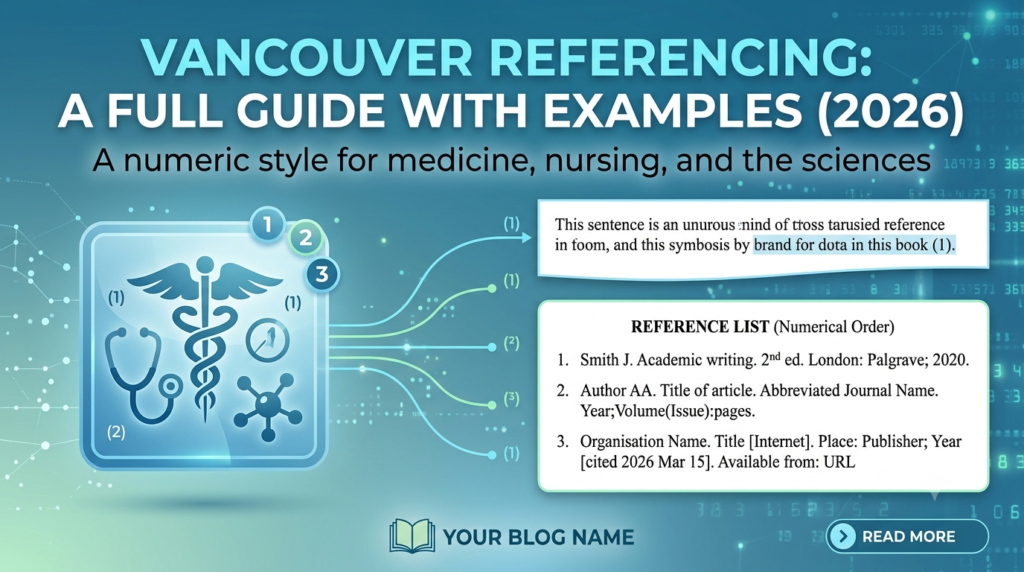
Vancouver referencing is a numeric style used mainly in medicine, nursing and the sciences. You number sources in the order they first appear in the text, cite them with that number in brackets or superscript, such as (1), and list them in numerical order in the reference list. The same source keeps the same number throughout. Vancouver is the standard referencing style across medicine, nursing and many science subjects. Unlike author-date styles, it is numeric: each source gets a number the first time you use it, and that number stands in for it every time after. This guide explains how Vancouver in-text citations and the numbered reference list work, with examples for common sources, so you can reference accurately in a health or science assignment. Confirm details against your university’s Vancouver guide, since versions vary slightly. What is Vancouver referencing? Vancouver referencing is a numeric citation style overseen originally by the International Committee of Medical Journal Editors. It works differently from author-date styles: instead of giving an author and year in the text, you give a number that matches a numbered entry in the reference list. Sources are numbered in the order they first appear, so the reference list is in citation order, not alphabetical order. It is valued in the sciences because it keeps the text clean and uncluttered. How do Vancouver in-text citations work? Each source is given a number the first time it is cited, shown in brackets or as a superscript, for example: this is supported by recent research (1). The same source always keeps that number, so if you cite source 1 again later, it stays (1). Your university will specify brackets or superscript, so check which to use. How do you format a Vancouver reference list? The reference list is numbered in the order sources first appeared in the text, not alphabetically. Author names are given as surnames followed by initials, with no full stops between initials. The table shows the format and an example for common sources. Source Vancouver format and example Book Author AA. Title of book. Edition. Place: Publisher; Year. -> Smith J. Academic writing. 2nd ed. London: Palgrave; 2020. Journal article Author AA. Title of article. Abbreviated Journal Name. Year;Volume(Issue):pages. Chapter in an edited book Author AA. Title of chapter. In: Editor AA, editor. Title of book. Place: Publisher; Year. p. 10-25. Website Author/Organisation. Title [Internet]. Place: Publisher; Year [cited Year Mon Day]. Available from: URL How do you reference Vancouver step by step? Vancouver is common in nursing and health subjects, so it often pairs with our how to write a nursing essay guide. For the general principles of citing, see our how to cite sources guide, and for other styles, our APA referencing guide and Harvard referencing guide. Common Vancouver mistakes to avoid Accurate referencing protects easy marks. For help checking your work, our assignment writing help and essay writing help services can review it. Frequently asked questions What is Vancouver referencing? Vancouver is a numeric referencing style used in medicine, nursing and the sciences. You number sources in the order they appear, cite them by number such as (1), and list them in numerical order. How do you write a Vancouver in-text citation? Give the source’s number in brackets or as a superscript at the relevant point, for example (1). The same source keeps that number every time you cite it. Is the Vancouver reference list alphabetical? No. Vancouver lists references in the order they were first cited in the text, so the list is numbered in citation order, not alphabetical order. What is the difference between Vancouver and Harvard? Vancouver is numeric, citing sources by number in citation order, and is common in the sciences. Harvard is author-date, citing the author and year, with an alphabetical reference list.
Russell Group Universities: The Full List and What It Means (2026)
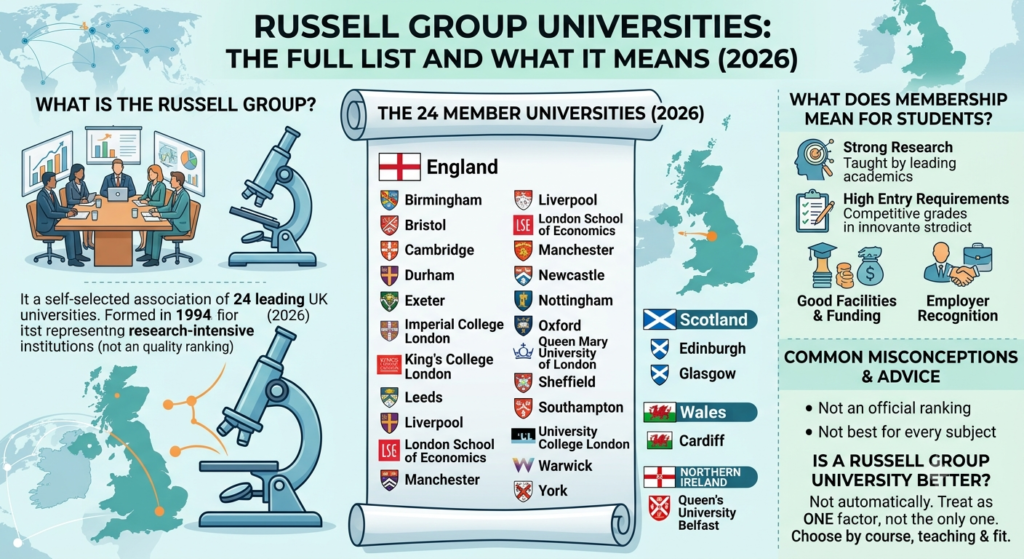
The Russell Group is an association of 24 research-intensive universities in the United Kingdom, including Oxford, Cambridge, Imperial, UCL and Manchester. Its members are known for research strength, high entry requirements and strong reputations. Being in the Russell Group signals research intensity, but it is not an official ranking, and excellent courses exist outside it too. If you are choosing a UK university, you will hear the phrase Russell Group a lot, often as shorthand for prestige. But what the Russell Group actually is, and what membership means for you, is more specific than that. This guide explains what the group is, lists all 24 members, and gives an honest view of what it does and does not tell you when choosing a course. Always check the official Russell Group website for the current membership, as it can change. What is the Russell Group? The Russell Group is a self-selected association of 24 leading UK universities, formed in 1994 to represent research-intensive institutions. It takes its name from the London hotel where its founding members first met. The group’s universities carry out a large share of the UK’s research and tend to have high entry requirements, extensive facilities and strong graduate reputations. It is essentially a membership body that lobbies on behalf of research-focused universities, not an official quality ranking. Which universities are in the Russell Group? There are 24 members. The table lists them, grouped by nation. Nation Russell Group universities England Birmingham, Bristol, Cambridge, Durham, Exeter, Imperial College London, King’s College London, Leeds, Liverpool, London School of Economics, Manchester, Newcastle, Nottingham, Oxford, Queen Mary University of London, Sheffield, Southampton, University College London, Warwick, York Scotland Edinburgh, Glasgow Wales Cardiff Northern Ireland Queen’s University Belfast That makes 20 in England and one each in Scotland (two, in fact: Edinburgh and Glasgow), Wales and Northern Ireland. Membership has changed over time, most recently expanding in 2012, so confirm the current list on the official Russell Group site. What does Russell Group mean for students? For applicants, Russell Group membership signals a few things: strong research, which can mean being taught by leading academics; high entry requirements, so competitive grades; good facilities and funding; and a widely recognised name with employers. Many students see it as a mark of quality, and some graduate schemes historically favoured these universities. Those are real advantages worth weighing. Is a Russell Group university better? Not automatically, and this is the honest part. The Russell Group is about research intensity, not teaching quality or student experience, and it is not a league table. Many excellent courses, and some of the best in the country for specific subjects, are at universities outside the group. The right university depends on the course, the teaching, the location, the support and the fit for you, not just the label. Use subject-level league tables and open days, and treat Russell Group membership as one factor among several rather than the deciding one. Common misconceptions about the Russell Group Wherever you study, strong study skills matter most once you are there. When you apply, our personal statement examples guide can help you write a strong application, and once you start, our how to write a first-class essay guide helps you get the most from your course. Frequently asked questions What is the Russell Group? The Russell Group is an association of 24 research-intensive UK universities, formed in 1994, known for research strength, high entry requirements and strong reputations. It is a membership body, not an official ranking. How many universities are in the Russell Group? There are 24 member universities across England, Scotland, Wales and Northern Ireland, including Oxford, Cambridge, Imperial, UCL and Manchester. Is a Russell Group university better than others? Not automatically. Russell Group membership reflects research intensity, not teaching quality or student experience, and many excellent courses exist outside it. Choose by course, teaching and fit, not just the label. Is the Russell Group a ranking? No. It is a membership association of research-intensive universities, not a league table. For quality by subject, use subject-level university rankings instead.
Case Study Format: How to Structure a Case Study Assignment (2026)
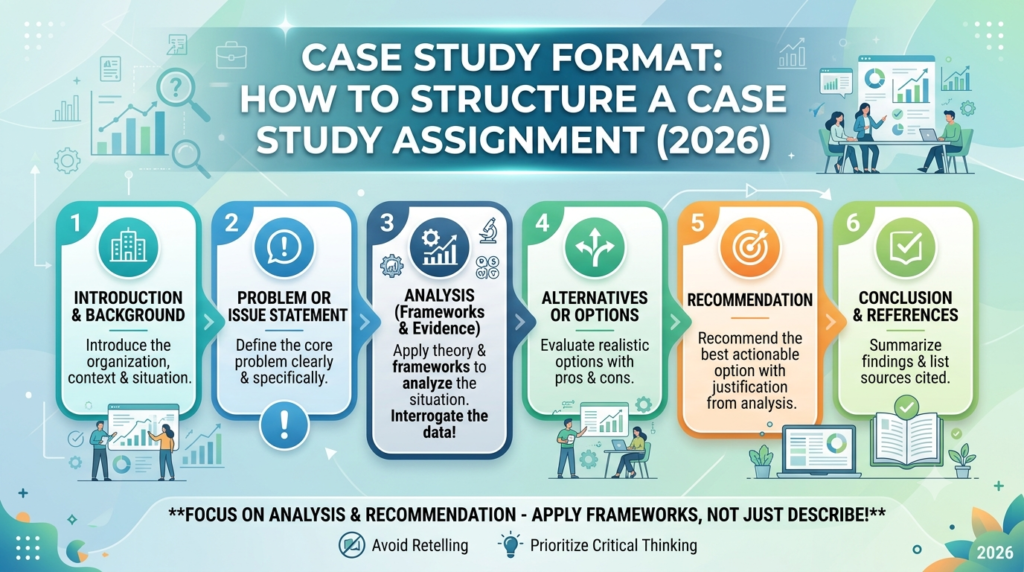
A case study assignment usually follows this format: an introduction and background, a statement of the problem or issue, an analysis using relevant theory and evidence, a discussion of alternatives, a recommendation, and a conclusion, followed by references. The marks are in the analysis and recommendation, so apply frameworks and evidence rather than just describing the case. A case study asks you to analyse a real or realistic situation, usually an organisation facing a problem, and apply what you have learned to it. Students often lose marks by retelling the story of the case instead of analysing it. This guide sets out the standard case study format section by section, explains how to analyse rather than describe, and shows how to reach a justified recommendation. What is a case study? In academic terms, a case study is an in-depth examination of a specific situation, organisation or event, used to apply theory to practice. You are given, or you choose, a case, and your job is to diagnose the key issue, analyse it using relevant concepts and evidence, and recommend a course of action. It is common in business, management, nursing, law and social sciences. The point is not to summarise the case but to demonstrate analysis and judgement. What is the standard case study format? Most case study assignments follow the structure below. Adapt the headings to your brief, but keep the logical flow from problem to recommendation. Section What it covers Introduction and background Introduce the case, the organisation and the context. Problem or issue statement State the central problem the case turns on, clearly and specifically. Analysis Analyse the problem using relevant theory, frameworks and evidence. Alternatives or options Set out the realistic options for addressing the problem. Recommendation Recommend the best option and justify it against the analysis. Conclusion Summarise the key findings and the recommended way forward. References and appendices Sources cited, plus any supporting data. A section-by-section walkthrough How do you analyse a case study? Analysis is where case studies are won or lost. Do not retell the case; interrogate it. Apply the frameworks from your course to structure the analysis, support every point with evidence from the case, and always link findings to the problem and to your recommendation. How do you write the recommendation? A strong recommendation follows directly from the analysis and is specific and actionable. State clearly what the organisation should do, why it is the best option given your analysis, and, briefly, how it could be implemented. Avoid vague advice such as ‘improve marketing’; say what, why and roughly how. Where useful, note the main risk of your recommendation and how to manage it, which shows balanced judgement. Common case study mistakes Getting the format and analysis right lifts the whole assignment. For structure, see our how to structure an assignment guide, and for expert support, our assignment writing help and MBA assignment writing services can help. Frequently asked questions What is the format of a case study? A case study usually has an introduction and background, a problem statement, an analysis using theory and evidence, alternatives, a justified recommendation, and a conclusion, followed by references. How do you analyse a case study? Apply relevant frameworks such as SWOT or PESTLE, support every point with evidence from the case, evaluate what each finding means, and connect the analysis to a clear recommendation, rather than retelling the case. How long is a case study assignment? Length varies by brief, commonly from around 1,500 to 3,000 words for an assignment. Always follow your own word count and weigh most of it towards analysis and recommendation. What is the difference between a case study and an essay? An essay argues a position on a question, while a case study analyses a specific situation and recommends action. A case study is more applied and usually ends in a justified recommendation.
How to Write Critically: Descriptive vs Critical Writing (with Examples, 2026)
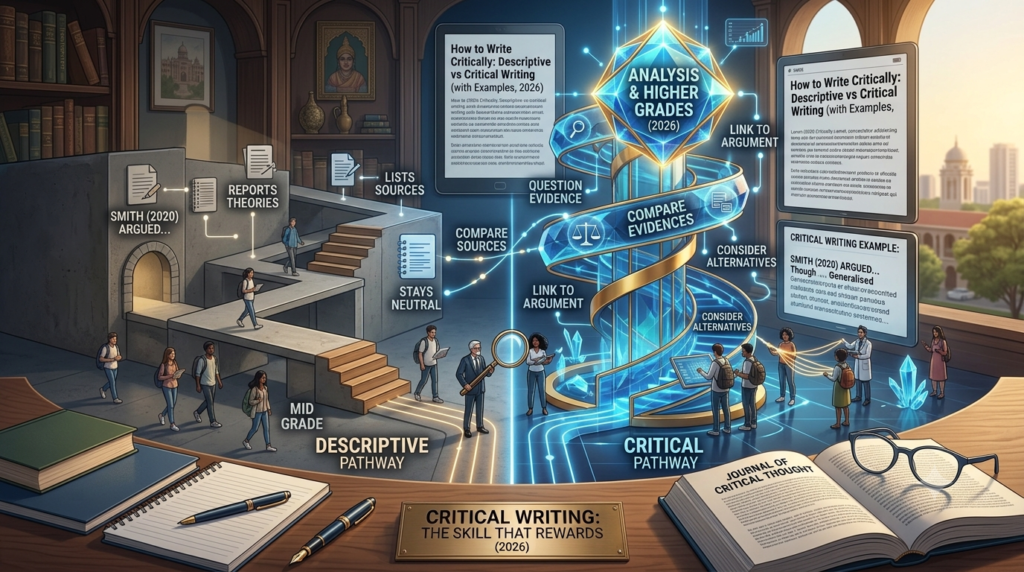
Critical writing means evaluating information rather than just reporting it. Where descriptive writing states what a source says, critical writing weighs the evidence, compares viewpoints, considers limitations, and links each point back to your argument. Moving from description to analysis is the single biggest step up in most grade bands. If your feedback keeps saying too descriptive or be more critical, this guide is the fix. Critical writing is the skill markers reward most, and the gap between a mid and a high grade is almost always analysis rather than more content. Below is what critical writing is, how it differs from description, and how to turn descriptive sentences into critical ones, with examples. It pairs directly with what we cover in understanding the marking rubric. What is critical writing? Critical writing is writing that does something with information rather than simply presenting it. It asks questions of the evidence: how strong is it, who says so, does it agree with other sources, what are its limits, and what does it mean for your argument. Description is necessary, you have to tell the reader what a source says, but on its own it stays at the lower grade bands. Critical writing takes that description and evaluates it, and that evaluation is where the marks are. Descriptive vs critical writing The table below shows the difference in what each does. Descriptive writing Critical writing States what happened or what a source says Evaluates how strong or convincing it is Lists sources or facts Compares and weighs them against each other Reports a theory Assesses the theory’s strengths and limitations Describes a method or result Judges what the result means and how reliable it is Stays neutral and general Builds and supports a specific argument Most assignments need some description to set the scene, but the balance should tip firmly towards analysis. A useful check: for every point you describe, add a sentence that evaluates it or connects it to your argument. How do you write more critically? Critical writing comes from asking the right questions of your material. Build these habits into every paragraph. A simple structure for a critical paragraph is: make a point, give the evidence, evaluate it, and link it to your argument. That final evaluate-and-link step is what turns description into critical writing, and it maps straight onto what markers reward, as our how UK universities mark essays guide explains. Critical writing examples The examples below show the same idea written descriptively, then critically. Descriptive Critical Smith (2020) argues that remote work increases productivity. Smith (2020) argues that remote work increases productivity, though the study relies on self-reported data from one sector, which limits how far the finding can be generalised. The company’s profits rose in 2024. The company’s profits rose in 2024, but this was driven largely by a one-off asset sale, so it may overstate the underlying performance. There are several leadership theories. While trait and situational theories both explain aspects of leadership, situational models better account for how effective leaders adapt, which is more useful for this case. In each case, the critical version adds an evaluation: a limitation, a cause, or a judgement that serves the argument. That is the move to practise. Words and phrases that signal critical writing Certain phrasing naturally pushes you from describing to evaluating. Use these to prompt analysis, not as filler. Common mistakes to avoid Sharpening this skill lifts every assignment. For structure, see our how to structure an assignment guide, and for the top-band standard, our how to write a first-class essay guide. If you would like expert feedback on how critical your writing is, our essay writing help and assignment writing help services can review your work. Frequently asked questions What is critical writing? Critical writing evaluates information rather than just reporting it: it weighs evidence, compares viewpoints, considers limitations, and links each point to your argument. It is the skill markers reward most. What is the difference between descriptive and critical writing? Descriptive writing states what happened or what a source says; critical writing evaluates how strong or convincing it is and what it means for your argument. Most marks come from the critical part. How do I write more critically? Question the evidence, compare sources, weigh strengths and limitations, consider alternatives, and link each point back to your argument. Follow point, evidence, evaluation, then link in each paragraph. Why does my feedback say I am too descriptive? It means you are reporting information without evaluating it. Add analysis: after describing a source, assess how convincing it is and connect it to your argument to move up the grade bands.
How to Write a SWOT Analysis for an Assignment (with Example, 2026)

A SWOT analysis examines an organisation’s internal Strengths and Weaknesses and its external Opportunities and Threats. To write one for an assignment, research the organisation, place each factor in the right quadrant with evidence, and then analyse what the combination means and what the organisation should do, rather than just listing points. SWOT analysis is one of the most common tools set in business, marketing and management assignments, and one of the easiest to do badly. Because it looks simple, four boxes with a few bullet points in each, students often stop at the surface: they list some strengths and weaknesses, add a couple of opportunities and threats, and hand it in. That version scores poorly, because a marker can produce the same list in two minutes and it demonstrates no analysis. A SWOT that is researched, evidenced and, above all, interpreted is a completely different piece of work, and it is what earns the marks. This guide explains what SWOT is, how to build each part properly, and how to turn the finished grid into analysis and recommendations, with a worked example you can model your own on. What is a SWOT analysis? A SWOT analysis is a strategic framework that summarises the key internal and external factors affecting an organisation, so that you can see its position at a glance and use that picture to inform strategy. The four letters split neatly into two pairs. Strengths and Weaknesses are internal: they are things the organisation itself controls or owns, such as its brand, its people, its costs, its technology or its processes. Opportunities and threats are external: they come from the environment around the organisation, such as market trends, competitor behaviour, regulation, technology shifts or changes in customer taste. Setting these four elements side by side gives a structured snapshot that is quick to read and, when done well, points clearly towards what the organisation should prioritise. The value of SWOT is not the grid itself but what it enables. On its own, a filled-in grid is just an organised list. Its purpose is to be a springboard: once you can see strengths, weaknesses, opportunities and threats together, you can start asking the questions that matter, which strengths could be used to seize which opportunities, and which weaknesses leave the organisation exposed to which threats. That is where SWOT stops being descriptive and becomes strategic. What goes in each SWOT quadrant? Getting each factor into the correct quadrant is the foundation, and it trips up more students than any other part. The table below shows what belongs in each part and gives examples. Quadrant What it covers Examples Strengths (internal) Advantages the organisation has and controls Strong brand, loyal customers, low costs, skilled staff Weaknesses (internal) Internal limitations the organisation can address Weak online presence, high debt, narrow product range Opportunities (external) Favourable external factors to exploit Growing market, new technology, a competitor exiting Threats (external) External risks to manage or defend against New competitors, regulation, rising costs, changing tastes The most common structural mistake is mixing internal and external factors, for example putting a growing market under Strengths or rising costs under Weaknesses. The test is simple: if the organisation controls or owns it, it is internal and belongs in Strengths or Weaknesses; if it comes from the outside world and the organisation can only respond to it, it is external and belongs in Opportunities or Threats. Applying that test to every factor before you place it keeps the grid clean and stops the analysis unravelling later. How do you write a SWOT analysis for an assignment? Moving from a list to a proper analysis is a matter of process. Follow these steps and the analytical quality follows naturally. The final two steps are where almost all the marks sit. A SWOT that stops at four evidenced lists is still fundamentally descriptive; one that interprets the combination and reaches a conclusion is analytical, which is exactly the distinction our how to write critically guide explains in more depth. If your feedback on framework assignments tends to say ‘too descriptive’, this is almost always the step you are missing. SWOT analysis example Here is a short worked example for a fictional small coffee chain, showing evidenced points rather than bare bullets, followed by the analysis that turns them into a recommendation. The analysis then connects these factors rather than leaving them as a list. The brand strength and the competitor’s exit together point towards expansion, because there is loyal demand and a gap in the local market. However, the weak delivery presence means the chain is missing a fast-growing revenue stream, and rising costs make opening new physical sites risky in the short term. Taken as a whole, the safest high-return move is to invest first in online ordering and delivery, which uses the existing brand strength, captures the growing at-home demand, and does not carry the fixed-cost risk of a new site. That linking judgement, drawing several factors into a single reasoned recommendation, is the analytical payoff a marker is looking for. How do you turn SWOT into strategy? Strong assignments go one step further and cross the quadrants deliberately to generate strategy, an approach sometimes formalised as a TOWS analysis. The idea is to pair the internal and external factors and read what each pairing suggests. Match strengths to opportunities to find growth moves the organisation is well placed to make. Use strengths to defend against threats. Address the weaknesses that leave the organisation most exposed to its threats, since that is where it is most vulnerable. Consider whether any weakness blocks an otherwise attractive opportunity, because fixing it may unlock real value. Working through these pairings shows a marker that you can use SWOT as a decision-making tool rather than a description, and it is the clearest way to demonstrate strategic thinking. Pairing SWOT with another framework, such as a PESTLE analysis of the wider environment, strengthens the assignment further by showing where the
How to Write a PESTLE Analysis for an Assignment (with Example, 2026)
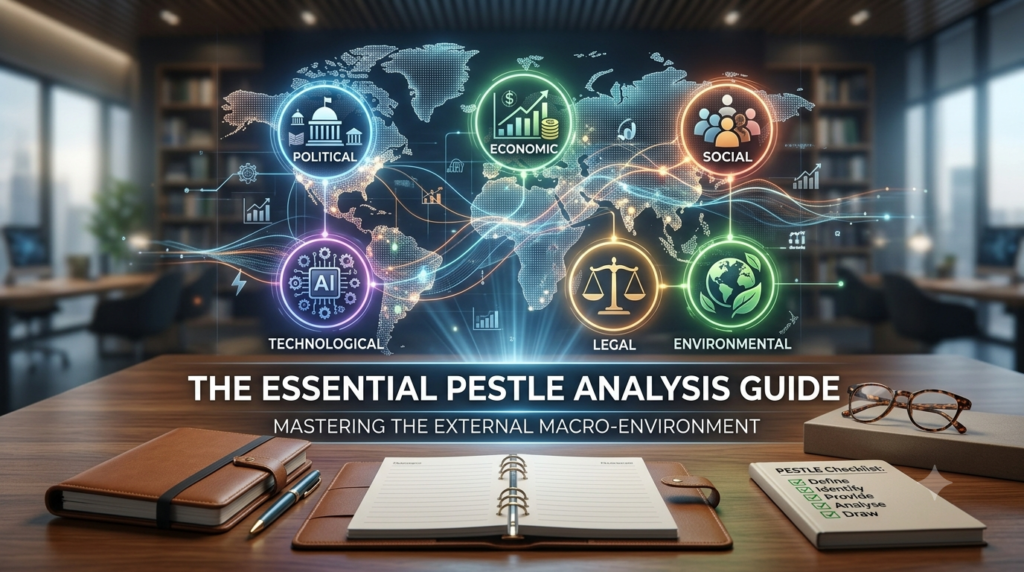
A PESTLE analysis examines the external macro-environment affecting an organisation across six factors: Political, Economic, Social, Technological, Legal and Environmental. To write one for an assignment, identify the relevant factors in each category with evidence, then analyse how each affects the organisation and what it should do, rather than just listing them. PESTLE is one of the most widely set frameworks in business, marketing and management assignments, used to analyse the outside forces shaping an organisation. Like SWOT, it is easy to list and hard to analyse well, and the marks lie in the analysis. This guide explains what each letter covers, how to build a PESTLE, and how to turn it into evidence-based analysis, with a worked example. It pairs with our SWOT analysis guide, since the two are often used together. What is a PESTLE analysis? A PESTLE analysis is a strategic framework that maps the external macro-environmental factors influencing an organisation. Unlike SWOT, which covers both internal and external factors, PESTLE looks only outward, at the broad forces an organisation cannot control but must respond to. It helps you understand the context an organisation operates in, spot risks and opportunities, and support strategic recommendations with evidence about the wider environment. What do the six PESTLE factors mean? The table below explains each factor and gives examples of what to consider. Factor What it covers Examples to consider Political Government and policy influences Tax policy, trade rules, political stability, government support Economic The economic environment Inflation, interest rates, growth, unemployment, exchange rates Social Society and culture Demographics, lifestyle, attitudes, consumer trends Technological Technology and innovation New technology, automation, research and development, digital change Legal Laws and regulation Employment law, health and safety, consumer and data protection Environmental Ecological and sustainability factors Climate, sustainability expectations, waste rules, energy Legal and Political can overlap, so keep Political for government direction and policy, and Legal for specific laws and regulations the organisation must comply with. How do you write a PESTLE analysis for an assignment? Turn the framework into analysis with these steps. Steps four and five are where the marks are. Listing factors is descriptive; explaining their impact and significance is the analysis markers reward, the same distinction our how to write critically guide covers. PESTLE analysis example Here is a short worked example for a fictional UK electric-vehicle company, showing evidenced, analysed points. The analysis then connects these: strong social and legal tailwinds point to growth, but economic pressure and fast-moving technology mean the company should prioritise cost control and continuous product updates. That linking judgement is the analytical payoff. How does PESTLE fit with other frameworks? PESTLE is most powerful when combined with other tools. Feed its findings into the Opportunities and Threats of a SWOT analysis, since PESTLE factors are largely external. Many strong assignments run a PESTLE to map the environment, then a SWOT to bring in internal factors, then use both to justify a strategy. Our SWOT analysis guide shows how to build that half of the picture. Common PESTLE mistakes to avoid PESTLE underpins many business tasks, so doing it well lifts the whole assignment. For structure, see our how to structure an assignment guide, and for expert support, our MBA assignment help guide and our assignment writing help and MBA assignment writing services can help. Frequently asked questions What is a PESTLE analysis? A PESTLE analysis examines the external macro-environment affecting an organisation across six factors: Political, Economic, Social, Technological, Legal and Environmental. What do the letters in PESTLE stand for? Political, Economic, Social, Technological, Legal and Environmental, the six categories of external factors that influence an organisation. How do you write a PESTLE analysis in an assignment? Define the organisation, identify the most relevant factors in each category with evidence, analyse how each affects the organisation, and draw conclusions, rather than only listing factors. What is the difference between PESTLE and SWOT? PESTLE analyses only the external macro-environment, while SWOT covers both internal (strengths and weaknesses) and external (opportunities and threats) factors for one organisation. They are often used together.