How to Write a Thesis Statement (with Examples, 2026)
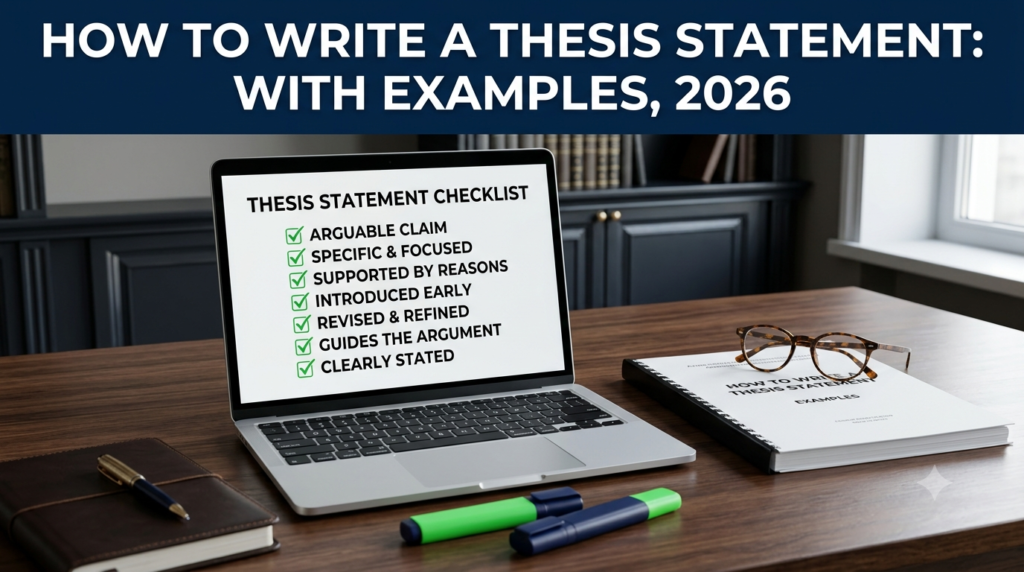
A thesis statement is one or two sentences, usually at the end of your introduction, that state the main argument of your essay and how you will support it. A strong thesis is specific, arguable and focused: it makes a clear claim that the rest of the essay proves, rather than just stating a topic or a fact. The thesis statement is the most important sentence in an essay. It tells the reader exactly what you are arguing and sets up everything that follows, and markers often judge the whole essay by how clear and arguable it is. Yet it is where many students go wrong, stating a topic instead of an argument. This guide explains what a thesis statement is, what makes a strong one, and how to write and refine yours, with examples of weak and strong versions. What is a thesis statement? A thesis statement is a short statement, usually one or two sentences, that expresses the central argument of your essay. It appears near the end of your introduction and acts as a promise to the reader: this is my position, and here is broadly how I will defend it. Everything in the essay should connect back to it. A thesis is not the same as a topic or a research question: the topic is what you are writing about, the question is what you are investigating, and the thesis is your answer, the claim you will argue. What makes a strong thesis statement? A strong thesis has three qualities. The table below sets them out against the weak versions to avoid. A strong thesis is… Rather than… Arguable: makes a claim someone could disagree with A statement of fact that nobody would dispute Specific: focused on a narrow, defined position A broad, vague generalisation Supported: signals the reasons or evidence behind it A bare opinion with no indication of why The single most common weakness is a thesis that is not arguable. If nobody could reasonably disagree with your statement, it is a fact, not a thesis, and the essay has nothing to prove. A good test: could a sensible person argue the opposite? If yes, you have a thesis. Weak vs strong thesis examples The examples below show how to turn a weak thesis into a strong one. Weak Strong Social media affects teenagers. Because it reshapes how teenagers compare themselves to others, social media is a leading driver of anxiety among under-eighteens and should be regulated like other harmful products. This essay is about renewable energy. Although renewable energy has high upfront costs, its falling long-term price and climate benefits make it a better investment than gas for the UK over the next decade. Shakespeare uses imagery in Macbeth. In Macbeth, Shakespeare uses blood imagery to trace Macbeth’s descent from guilt into moral numbness, showing how ambition corrodes conscience. Notice the strong versions each make a specific, arguable claim and hint at the reasoning. That is what the rest of the essay then proves. How do you write a thesis statement? Build your thesis in steps rather than trying to write it perfectly first time. A useful structure is a claim plus a because, for example this policy is effective because of X and Y. That because forces you to signal your reasons, which lifts a bare opinion into an arguable thesis, the analytical move our how to write critically guide explains in more depth. Where does the thesis statement go? The thesis statement usually sits at the end of your introduction, after you have introduced the topic and given the reader some context, so it lands as the natural conclusion of the opening. In a longer piece such as a dissertation, the equivalent is your central argument or research aim, set out in the introduction. Our how to structure an assignment guide shows how the introduction leads into it, and our how to write a first-class essay guide shows how a sharp thesis raises your grade. Does a thesis statement change by essay type? Slightly. An argumentative essay has the clearest thesis, a single contestable claim. An analytical essay’s thesis states what your analysis reveals rather than a position to defend. An expository essay’s thesis explains what the essay will set out, with less of an arguable edge. Whatever the type, the thesis should still be specific and tell the reader what to expect, and in most academic writing an arguable thesis scores best. Common thesis statement mistakes A clear thesis lifts the whole essay. For expert feedback on your argument, our essay writing help and assignment writing help services can review your work. Frequently asked questions What is a thesis statement? A thesis statement is one or two sentences, usually at the end of the introduction, that state the main argument of your essay and signal how you will support it. What makes a good thesis statement? A good thesis is arguable (someone could disagree), specific (a narrow, defined claim), and supported (it signals the reasoning behind it), rather than a broad fact or a bare opinion. Where does the thesis statement go? Usually at the end of the introduction, after you have introduced the topic and given context, so it reads as the natural conclusion of your opening paragraph. What is the difference between a topic and a thesis? The topic is what you are writing about; the thesis is your specific, arguable claim about that topic, the position the essay sets out to prove.
7 Best Note-Taking Methods for Students (with Examples, 2026)
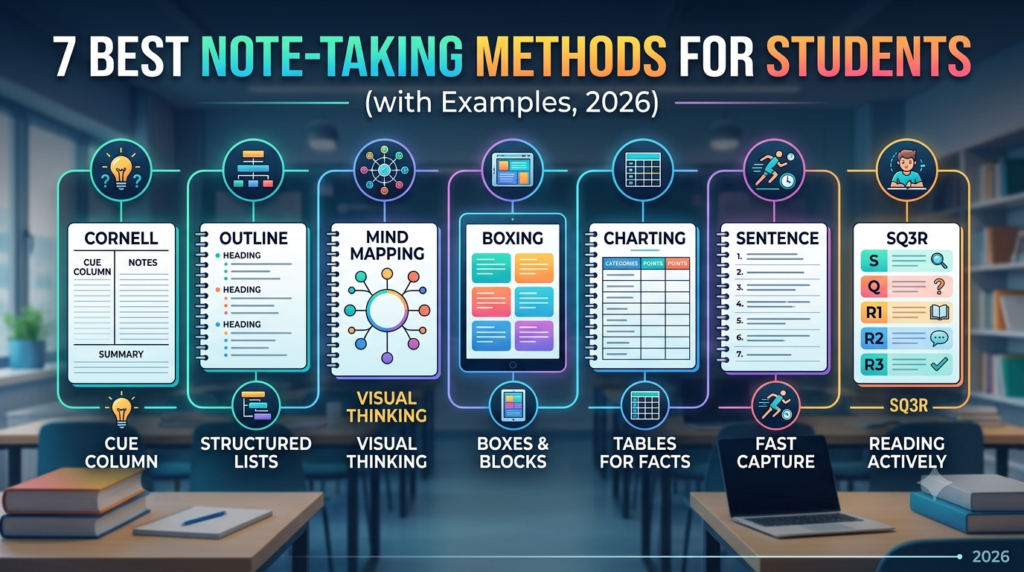
The best note-taking methods are the Cornell method, the outline method, mind mapping, the boxing method, the charting method, the sentence method, and the SQ3R method. The right one depends on the subject and setting: Cornell suits lectures and revision, outlines suit structured topics, and mind maps suit visual or linked ideas. Good notes are selective and reviewed, not word-for-word. Note-taking is one of the highest-return study skills, yet most students are never taught a method and simply try to write down everything. That leaves you with pages you never reread and little understanding. This guide explains seven proven note-taking methods, when each works best, and how to choose, so you can capture ideas in a way that actually helps you learn and revise. What are the best note-taking methods? There is no single best method; the strongest choice depends on the material and how you will use the notes. The table below summarises the seven methods and where each fits. Method Best for How it works, in short Cornell Lectures and revision Split the page into cues, notes and a summary Outline Structured, hierarchical topics Headings and indented sub-points Mind mapping Visual thinkers, linked ideas A central idea with branching connections Boxing Digital notes, separate themes Group related notes into boxes or blocks Charting Comparisons and lots of facts A table with columns for each category Sentence Fast-paced lectures One idea per numbered line SQ3R Reading and textbooks Survey, Question, Read, Recite, Review 1. The Cornell method The Cornell method divides your page into three areas: a narrow left column for cues or questions, a wide right column for your notes during the lecture, and a strip along the bottom for a short summary written afterwards. During class you take notes on the right; soon after, you add key questions or keywords in the cue column and a summary at the bottom. It is powerful because the review step is built in, and the cue column turns your notes into self-test prompts. It suits lectures and revision better than almost any other method. 2. The outline method The outline method uses headings and indented sub-points to capture the structure of a topic. Main points sit at the left margin, with supporting detail indented beneath them, so the hierarchy of ideas is visible at a glance. It is quick, tidy, and ideal for well-structured material such as a clearly organised lecture or textbook chapter. It works less well when a session jumps around, since it relies on a logical order you can follow in real time. 3. Mind mapping A mind map places the central topic in the middle of the page, with related ideas branching outwards and sub-ideas branching from those. It suits visual thinkers and any subject where ideas connect in a web rather than a list, such as brainstorming an essay or linking themes across a topic. Mind maps are excellent for seeing the big picture and making connections, though they are harder to use for dense, detailed information that needs to be recorded in order. 4. The boxing method The boxing method groups related notes into separate boxes or blocks on the page, one theme per box. It has become popular for digital note-taking on tablets, where boxes are easy to move and resize. It keeps distinct topics visually separate, which makes later review and revision easier, and works well when a session covers several loosely related themes you want to keep apart. 5. The charting method The charting method records information in a table, with columns for the categories you are comparing and rows for each item or point. It is the best choice when you have a lot of facts to compare, such as theories, dates, or the features of different models, since it forces the information into a structure you can scan quickly. It needs a little planning, because you have to know your columns in advance, so it suits material you can anticipate. 6. The sentence method The sentence method is the simplest: write each new idea on its own numbered line as you hear it. It lets you capture a lot quickly in a fast-paced lecture where more structured methods cannot keep up. The trade-off is that it produces long, loosely organised notes, so it works best as a fast capture that you tidy or convert into another format afterwards. 7. The SQ3R method SQ3R is a reading and note-taking method for textbooks, standing for Survey, Question, Read, Recite and Review. You first survey the chapter to get an overview, turn headings into questions, read to answer them, recite the answers in your own words, and review at the end. It is less about the layout of your notes and more about reading actively, which makes it excellent for getting more out of dense academic reading rather than passively highlighting. How do you choose a note-taking method? Match the method to the material and how you will use the notes, and do not be afraid to combine them. Whatever method you choose, the two habits that matter most are being selective, capturing ideas rather than transcribing, and reviewing your notes soon after, since notes you never reread do little. Good notes also make later work faster, from planning an essay to building a reference list, which connects to how you structure an assignment and cite your sources. Common note-taking mistakes Better notes support every stage of study. If you would like help turning your research and notes into a strong piece of work, our assignment writing help and essay writing help services can support you. Frequently asked questions What are the best note-taking methods? The most effective are the Cornell method, the outline method, mind mapping, the boxing method, the charting method, the sentence method, and SQ3R. The best one depends on the subject and how you will use the notes. What is the Cornell note-taking method? A method that splits the page into a cue column, a notes column
How to Write a Capstone Project Proposal (with Example)
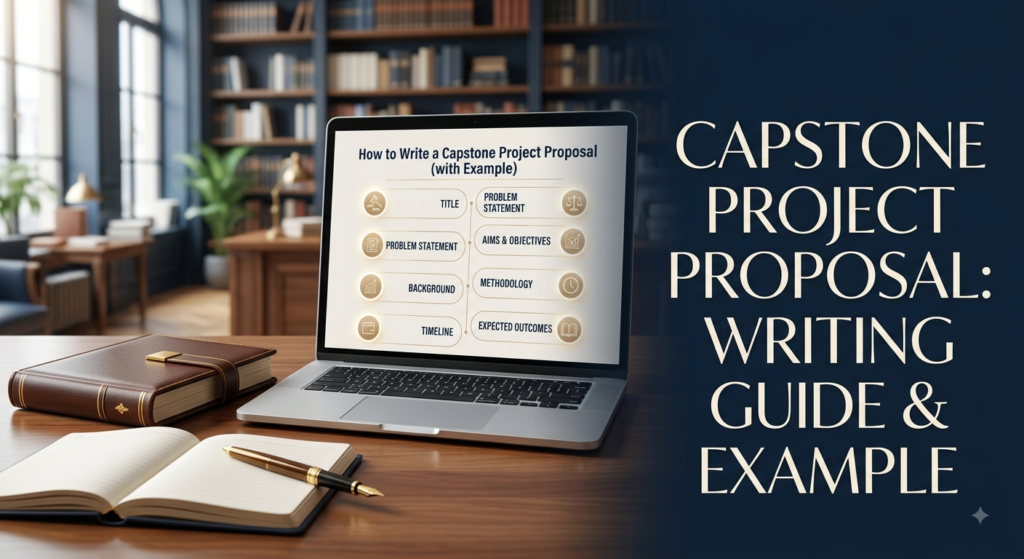
A capstone project proposal is a short document that sets out what you plan to investigate for your capstone, why it matters and how you will do it. It usually includes a title, problem statement, aims and objectives, brief background, methodology, timeline and references, and is submitted for approval before you begin the project. What is a capstone project proposal? A capstone proposal is the plan you write and get approved before starting your capstone. Its job is to prove your idea is worth doing and doable: it defines the problem, sets the scope, and shows your supervisor exactly how you intend to tackle it. A clear proposal now saves you from a stalled or rejected project later. If you are still deciding on format, our capstone versus dissertation guide explains how the two differ, and our what is a capstone project guide covers the basics. For the structure of the final project itself, see our capstone project outline guide. What should a capstone proposal include? Most capstone proposals contain the same core sections. The table below shows what each one covers. Section What it covers Title A clear, specific working title naming the focus of your project. Problem statement The specific issue or gap your capstone addresses, and why it matters. Aims and objectives One overall aim, broken down into a few SMART objectives. Background A brief review of what is already known, showing the gap you will fill. Methodology How you will gather and analyse evidence, or build and test your solution. Timeline A realistic schedule of milestones from start to submission. Expected outcomes What you expect to produce or find, and its practical value. References The key sources informing the proposal, in your required style. How do you write each section? Write the sections in order, keeping each one specific and realistic. Title. Make it precise rather than catchy. A good title names the topic, the context and often the approach, so a reader knows the project at a glance. Problem statement. State the specific problem, who it affects and why it is worth solving. This is the heart of the proposal, so avoid vague themes and pin down one issue you can actually address. Aims and objectives. Give one overall aim, then three or four SMART objectives, meaning specific, measurable, achievable, relevant and time-bound, that break the aim into steps. Objectives are what a marker uses to judge whether you delivered. Background. Summarise briefly what is already known and where the gap sits. You are not writing a full literature review here, just enough to justify the project. A capstone proposal shares much of its shape with a dissertation proposal, so that guide is a useful companion. Methodology. Explain how you will do the work, whether that is collecting and analysing data, or designing and testing a practical solution. Say what you will do, with what, and why that approach fits the problem. Timeline. Map your weeks to milestones and be honest about how long each stage takes. Supervisors reject timelines that leave no room for analysis or revision. Expected outcomes and references. State what you expect to produce and its value, then list the key sources in the style your course requires; our guide to citing sources shows how to reference them cleanly. Capstone project proposal example Here is a short worked example for an applied business capstone, showing how each section fits together. Element Worked example Title Reducing Customer Churn at a Subscription Streaming Service: An Evaluation of Retention Strategies. Problem statement The company loses an estimated 8 per cent of subscribers each month, which threatens revenue. The project investigates why customers cancel and which retention strategies reduce churn. Aim To evaluate the effectiveness of targeted retention strategies in reducing monthly customer churn at the company. Objectives Identify the main drivers of cancellation from customer data; assess two retention interventions; recommend the most cost-effective approach. Methodology Secondary analysis of 12 months of anonymised subscription data, supported by a short customer survey, comparing churn before and after each intervention. Timeline Weeks 1 to 2 planning; weeks 3 to 6 data collection; weeks 7 to 9 analysis; weeks 10 to 12 writing and review. Expected outcome A costed recommendation the business can act on, plus evidence of which cancellation drivers matter most. What are common mistakes in a capstone proposal? How do you make a capstone proposal strong? A strong proposal is narrow, measurable and clearly doable. Pick one specific problem, tie every objective to it, choose a method that genuinely answers the question, and set a timeline you can meet. Ground it in a few solid sources and keep the practical value in view, since capstones are judged partly on real-world usefulness. For inspiration on topics, our capstone project ideas guide can help, and if you would like a subject expert to help you shape and write the proposal, our capstone project help guide and capstone project writing service are built around that support. Ready to develop your capstone project? Let our experts help. Once you’ve chosen your topic, the next step is turning your idea into a structured project with clear research, analysis and presentation. Explore our capstone project writing support for guidance throughout your project. Explore capstone project writing support Frequently asked questions What is a capstone project proposal? It is a short document, approved before you start, that sets out what you will investigate, why it matters and how you will do it, usually covering the title, problem, aims, background, methodology, timeline and references. How long is a capstone project proposal? Most capstone proposals run to roughly 1,000 to 2,000 words, or two to four pages, though the exact length depends on your brief. Always follow the word count your programme sets. What is the difference between a capstone proposal and a dissertation proposal? They share a structure, but a capstone proposal is usually shorter and more applied, focused on solving a practical problem, while a dissertation proposal tends to be
120+ Law Dissertation Topics and Ideas for 2026

A strong law dissertation topic is specific, grounded in a live legal debate, and answerable through doctrinal or empirical analysis within your word count. This guide gives more than 120 law dissertation topics for 2026, grouped by area, from criminal, contract and tort to human rights, company, intellectual property and technology law. The featured topics below each come with a research aim to help you turn an idea into a clear question. Featured law dissertation topics with research aims These 14 topics span the main areas of law. Each includes a short research aim showing what the study would set out to argue. 1. Reforming the Law on Joint Enterprise Research aim: This doctrinal study analyses the law on joint enterprise after recent reform, aiming to assess whether the current test strikes a defensible balance between accountability and fairness. 2. Good Faith in English Contract Law Research aim: This study examines the uneven treatment of good faith across English contract law, aiming to argue whether a general duty of good faith should be recognised. 3. The Expanding Boundaries of Vicarious Liability Research aim: This study analyses recent case law on vicarious liability, aiming to determine whether its expansion is principled or has left the doctrine incoherent. 4. Prorogation and the Justiciability of Prerogative Powers Research aim: This constitutional study examines the courts’ willingness to review prerogative powers, aiming to assess the limits of justiciability after recent litigation. 5. Balancing Privacy and Free Expression Under the Convention Research aim: This study analyses how the courts balance Article 8 privacy against Article 10 expression, aiming to identify whether the current approach is consistent and principled. 6. Piercing the Corporate Veil Research aim: This study reviews when courts disregard separate corporate personality, aiming to argue where the boundary of veil-piercing should properly sit. 7. The Employment Status of Gig-Economy Workers Research aim: This study examines how the courts classify gig-economy workers, aiming to assess whether the current tests adequately protect those in insecure work. 8. No-Fault Divorce and the Family Justice System Research aim: This study evaluates the effect of no-fault divorce on the family justice system, aiming to assess whether the reform has achieved its stated aims. 9. Reforming Leasehold and the Rights of Long Leaseholders Research aim: This study analyses recent and proposed leasehold reform, aiming to assess how far it rebalances the relationship between leaseholders and freeholders. 10. Copyright and Generative Artificial Intelligence Research aim: This study examines how copyright law applies to AI-generated works and training data, aiming to identify the gaps that current doctrine leaves unresolved. 11. The Regulation of Artificial Intelligence and Liability Research aim: This study analyses how existing liability rules apply to harm caused by AI systems, aiming to assess whether a dedicated liability regime is needed. 12. Climate Change Litigation and the Duties of the State Research aim: This study examines the growth of climate litigation against governments, aiming to assess whether the courts are an effective route to enforcing climate obligations. 13. Consent to Medical Treatment After Montgomery Research aim: This study analyses the standard of consent following the Montgomery decision, aiming to assess its effect on clinical practice and patient autonomy. 14. Access to Justice and the Effect of Legal Aid Cuts Research aim: This socio-legal study examines the impact of legal aid reductions on access to justice, aiming to identify who is most affected and how the gap might be closed. How do you choose a law dissertation topic? Start with the module you found most engaging, then look for a live debate you can argue about. Criminal law dissertation topics Criminal law Contract law dissertation topics Contract law Tort law dissertation topics Tort law Constitutional and administrative law dissertation topics Constitutional and administrative law Human rights law dissertation topics Human rights law Company and commercial law dissertation topics Company and commercial law Employment law dissertation topics Employment law Family law dissertation topics Family law Property and land law dissertation topics Property and land law Intellectual property law dissertation topics Intellectual property law International law dissertation topics Public international law Technology, data and AI law dissertation topics Technology, data and AI law Environmental, medical and jurisprudence dissertation topics Environmental law Medical and healthcare law Jurisprudence and criminal justice How do you turn a law topic into a research question? A topic names an area; a research question commits you to a position you can defend. Take one idea above and narrow it to a specific doctrine, reform or line of authority, then phrase it as a question you can answer with a thesis rather than a description. A good law question usually asks whether the law is coherent, adequate or in need of reform. Scope the key authorities before you commit. Our guides to writing a dissertation proposal and writing a literature review help you test the idea, and our assignment structure guide keeps the writing clear. Ready to take your dissertation further? Get specialist support. From refining your research question and literature review to methodology, analysis and final structure, dissertation work requires careful planning at every stage. Explore our dissertation writing support for your research project. Explore dissertation writing support Frequently asked questions How do I choose a law dissertation topic? Start with a module you enjoyed, then find a live debate within it, a recent reform, conflicting authority or an unsettled question. Narrow that to a single doctrine you can argue about, and check the key cases and commentary exist before you commit. Should a law dissertation be doctrinal or empirical? Most undergraduate law dissertations are doctrinal, analysing statute, case law and commentary to build an argument. An empirical or socio-legal study is possible but needs data collection and ethics approval, so confirm what your programme expects. What are good law dissertation topics for 2026? Strong current areas include AI and copyright, the regulation of artificial intelligence, gig-economy employment status, climate change litigation, and no-fault divorce. Each of the featured topics above sets out a ready research aim.
Results or Discussion: What Actually Goes Where
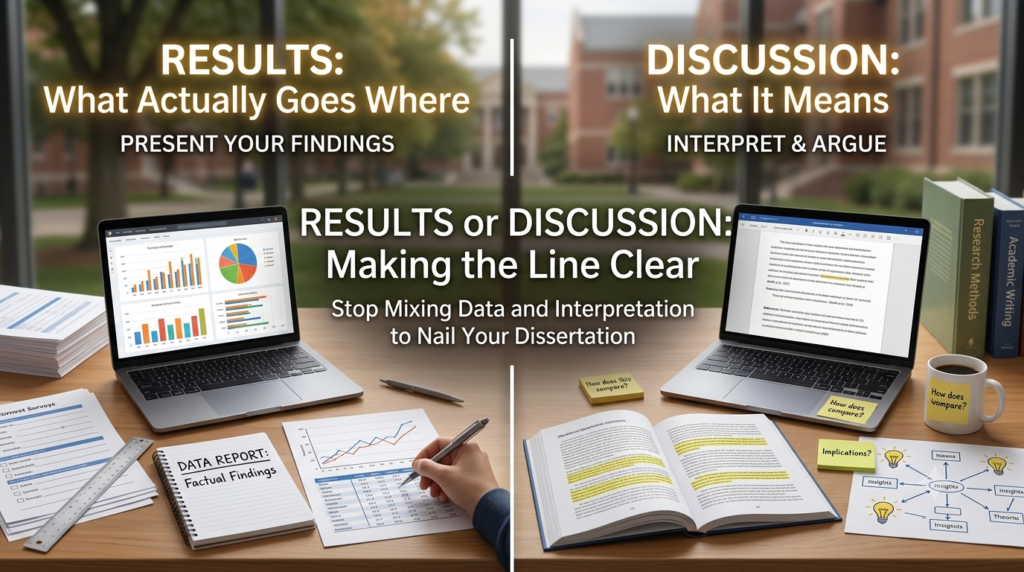
Results present what you found. Discussion explains what it means. If a sentence states a finding, it belongs in results. If it interprets that finding, compares it to the literature, or draws an implication, it belongs in discussion. Mixing the two is the most common structural error in dissertations. These two chapters confuse more students than any other part of a dissertation, and getting the line between them wrong quietly costs marks. The good news is that the rule is simple once you see it, and a couple of quick tests will tell you which chapter any sentence belongs in. What is the actual difference? Results are a factual report. This is what the data showed, presented clearly, with no interpretation. A reader should be able to disagree with your conclusions and still accept your results chapter completely. Discussion is where you argue. What does this finding mean, does it agree with the literature you reviewed, what explains it if it does not, and what follows from it. This is the chapter that carries the most marks per word in the whole dissertation, which is why squeezing it costs so much. Why does keeping them separate matter? Credibility. If your interpretation is woven into your reporting, a reader cannot tell where the data ends and your reading of it begins. Keeping them apart is what lets a marker trust your findings independently of your argument about them. Think of it like a court case. Results are the evidence, presented plainly so everyone can see it. Discussion is the argument about what the evidence means. A good lawyer does not blur the two, because the evidence has to stand on its own before the argument can build on it. What belongs in the results chapter? That last point matters more than students expect. Leaving out an inconvenient result is a research integrity issue, not a presentation choice, and a marker who spots a gap between your data and your discussion will look for it. What belongs in the discussion? How do you tell which chapter a sentence belongs in? Two quick tests settle almost every case. Ask this If yes, it goes in Could this be checked against the data alone? Results Does it interpret, or say what a finding means? Discussion Does it compare to another study? Discussion Is it a number, a rate, or a theme with no comment? Results Sixty per cent of respondents reported the opposite is a result, because anyone could check it against your dataset. This suggests policy framing matters more than incentive design is discussion, because it is an interpretation people could dispute. How should you order your findings? Order them by research question, or by theme, and keep the same order in both the results and the discussion. If you have three research questions, present the findings for question one, then two, then three, and discuss them in the same sequence. This lets the reader hold one structure in their head across both chapters, rather than having to reassemble your findings when the discussion jumps around. What does not work is ordering by the tool you used or the order you collected data, because that reflects your process rather than your argument. Should you ever combine them? Sometimes, and your department will tell you. Combined results and discussion chapters are common in qualitative research, where separating a theme from its interpretation can feel artificial, and in dissertations built on secondary sources where there is no separate dataset to report. If you do combine them, keep the distinction visible inside the writing. Present the finding, then interpret it, in that order, within each section. The risk of a combined chapter is that the interpretation swallows the evidence and the reader loses track of what was actually observed. Do you need a separate findings chapter? Most dissertations have one, but some subjects merge findings into the discussion, especially in qualitative or secondary source work. Follow your department structure. If you are unsure, a separate results chapter is the safer default, because it keeps your evidence clearly visible before you argue about it. Why do most dissertations lose marks here? Because the discussion describes instead of discussing. A student presents their results, then writes a discussion that restates the same findings in prose with a few citations added. It reads as thorough and earns very little, because nothing in it is an argument. The fix is mechanical: for every finding, write what it means, whether it agrees with the literature, and what follows. This is the same skill that separates the grade bands across the whole dissertation. How do you present quantitative results? Lead with the finding in words, then support it with the number. Repeat purchase was higher among frequency scheme members, then the statistic. A results chapter that opens every paragraph with a test statistic forces the reader to decode before they can understand. Use tables and figures for anything that would be tedious as prose, but do not repeat a full table in the text. Pull out the one or two figures that matter and point to the table for the rest. Every table needs a number, a caption, and a mention in the body, or it reads as decoration. How do you present qualitative results? Organise by theme, and open each theme with a plain statement of what it is before any quote appears. Then use quotes as evidence for that statement, not as the statement itself. A results chapter built from long quotes with linking sentences between them makes the reader do your analysis for you. Keep quotes short enough to read in one pass, label them consistently with whatever anonymised identifier you set up in your methodology, and choose the clearest example rather than the longest. Resist interpreting as you go, because that is what the discussion is for, and holding that line is what makes the discussion feel earned when it arrives. How long should each chapter be?
How to Understand Your Marking Rubric and Get a Better Grade
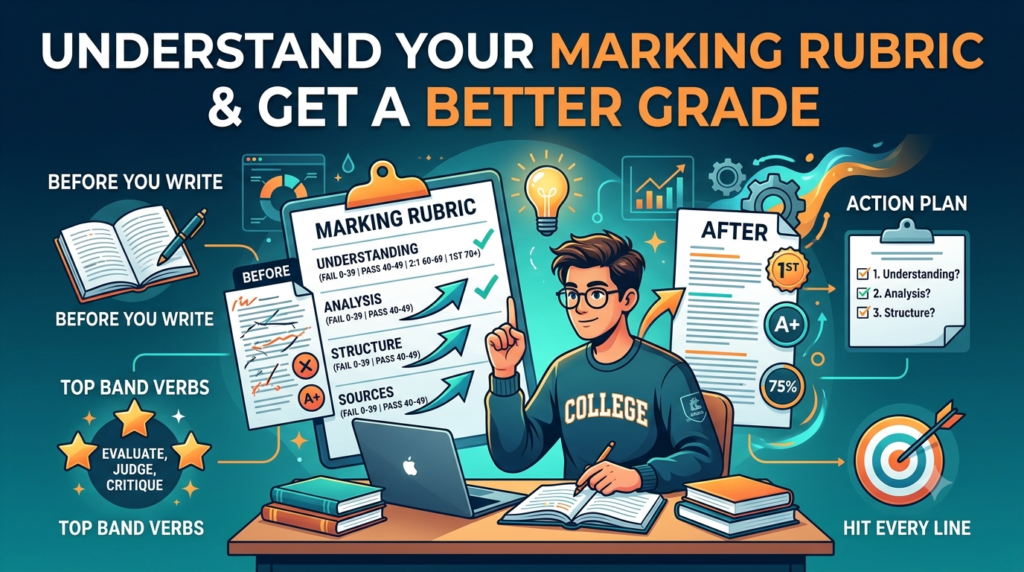
A marking rubric is the exact list of things your marker scores your work against. To use it, read it before you write, turn each criterion into a question about your draft, and pay closest attention to the wording of the top grade band, because those words describe what you have to actually do to reach it. Most students never read the rubric properly, which is exactly why reading it is such an easy advantage. The rubric is not admin. It is the answer key. It tells you precisely how your work will be judged, and writing to it is one of the simplest ways to lift a grade without working any harder. What is a marking rubric? A rubric is the breakdown of criteria your marker uses to grade your work. It lists what is being assessed, often with a description of what each grade band looks like for each criterion. It usually sits in the module handbook or the assignment brief, and it is written for you to read. Think of it as the marker showing you their scorecard in advance. Once you know what is on it, you can make sure your work hits every line, rather than guessing what they want and hoping you got it right. What is usually on a rubric? Rubrics vary by subject and university, but most assess a similar set of things. Knowing the common criteria helps you read any rubric quickly. Criterion What the marker is looking for Understanding You engaged with the right material and got it right Analysis You judge and evaluate, rather than just describing Structure A clear argument the reader can follow throughout Use of sources Relevant, credible sources used and referenced well Presentation Formatting, referencing accuracy, and clarity These map closely onto what UK markers look for across the board, so once you understand one rubric, most others feel familiar. What is the difference between a rubric and a brief? Students often mix these up, so it helps to be clear. The brief is the instruction: it tells you what task to do, the word count, the deadline, and the question to answer. The rubric is the scorecard: it tells you how that task will be judged and what earns each grade. You need both, and they work together. A common mistake is reading the brief carefully and ignoring the rubric, or the other way round. The brief tells you what to write about. The rubric tells you what a good version looks like. Miss the brief and you answer the wrong question. Miss the rubric and you answer the right question in a way that does not score. Reading both before you start is what keeps your work on target from the first draft. Why should you read it before you write? Because it changes what you write, not just how you check it. A student who reads the rubric first writes towards the criteria from the first draft. A student who reads it after, or never, writes in the dark and hopes. The most common expensive mistake is answering the wrong thing. If the rubric rewards analysis and you hand in description, you can write beautifully and still miss the marks, because you did not do the thing being scored. Reading the rubric first stops this before it happens. How do you turn a rubric into an action plan? A rubric is only useful if you act on it. Turn each criterion into a question you ask of your own draft. If you can answer yes to each, your work hits the rubric. If not, you know exactly where to improve before you submit. Why does the top band wording matter most? Because it tells you what a top grade actually requires, in the marker own words. Rubrics usually describe each grade band separately, and the difference between the wording of the top band and the one below it is the difference you are trying to achieve. Look at the verbs in the top band. Words like evaluate, judge, critique, and defend describe active thinking, while the band below often uses describe, explain, and outline. If the top band asks you to evaluate and your draft only explains, you now know the exact gap to close. This is the same skill that separates a first from a 2:1. What if there is no detailed rubric? Some modules give only a short brief rather than a full grade by grade rubric. When that happens, the brief still contains the criteria, just in less detail, so read it as carefully as you would a rubric. Underline the instruction words, note any weighting it mentions, and look at the learning outcomes for the module, which describe what you are meant to be able to do. If it is still unclear, ask your tutor what a strong submission looks like. Most are happy to explain, and the question shows you are taking the work seriously rather than guessing. How do rubrics differ between subjects? The core criteria stay similar, but the balance shifts by subject. An essay based subject like history or politics weights analysis and argument heavily. A science report weights method and accurate results. A practical or creative subject may weight process and reflection. This is why reading your own rubric matters even if you have written good work before in another module. The same effort placed against the wrong criterion does not score, so always check where the marks actually sit for this specific assignment. One more habit helps: keep the rubric open in a second window while you write, not just while you check. Glancing at it between paragraphs keeps you honest about whether you are still answering what is scored, rather than drifting into what is easy to write. How do you check your work against the rubric? Before you submit, go through the rubric line by line with your finished draft open. For each criterion, find the place in your
How to Write Management Assignments That Apply Theory to Practice
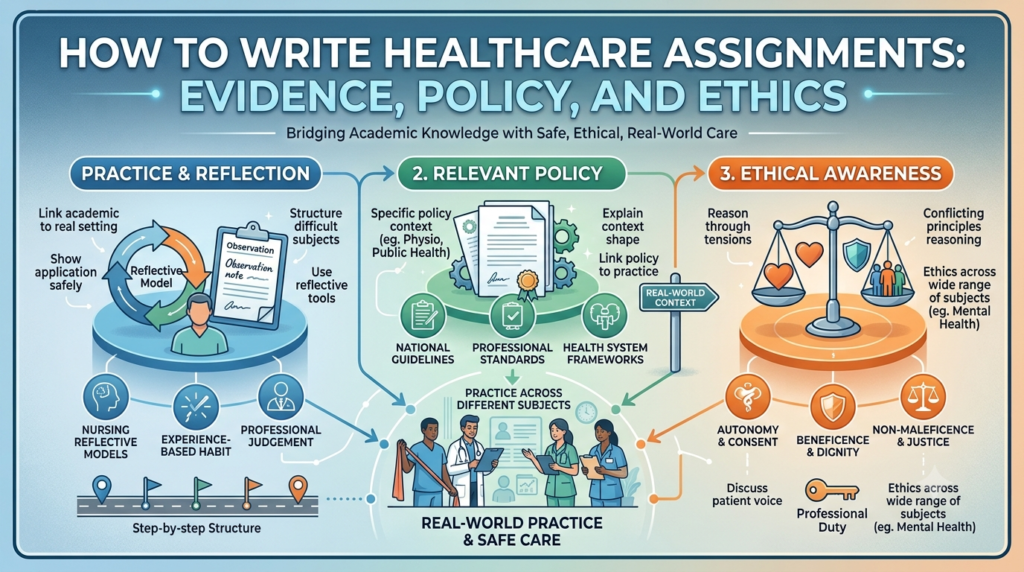
Strong management assignments apply theory to real organisations rather than just explaining it. Use a recognised management model, support your analysis with examples and evidence, and connect it to practical implications. What sets management writing apart is showing how a concept works, or fails, in a real organisational setting. Management is a broad subject, and its assignments reward a specific skill: taking a theory and showing what it means in practice. Students who only explain theories score in the middle. Students who apply them to real situations, with evidence, reach the top. Here is how to do that consistently. What makes management writing different? The core skill is application to organisations. A management assignment is not a summary of theories, it is an analysis of how those theories play out in real workplaces. Markers want to see that you can connect an academic concept to organisational reality. This is why description alone falls short. Explaining a leadership theory accurately shows knowledge, but it is only the setup. The marks come from applying it: showing how it works in a real organisation, where it succeeds, and where it runs into limits. How do you apply theory to practice? The method is to pair every theory with a real example. Introduce the concept, then show it in action in a named organisation or a realistic scenario, then analyse how well it fits. That final step matters. A strong management answer does not treat a theory as gospel. It shows where the theory helps and where it breaks down, which demonstrates genuine critical thinking. Which management theories come up most? Management assignments draw on a wide body of theory. You do not need all of it, just the models that fit your question. Area Common theories and models Leadership Transformational, transactional, situational leadership Motivation Maslow, Herzberg, expectancy theory Organisational culture Handy, Schein, Hofstede Change management Lewin, Kotter Use one or two that fit your question well rather than listing many. These overlap with the frameworks in our MBA assignment guide, applied here to organisational analysis. How do you use examples and evidence? Examples are what make a management assignment convincing, but they have to be specific. A vague reference to some companies is weak. A named organisation, with detail about what it did and what happened, is strong. Support your examples with evidence rather than assertion. Use case studies, company reports, and academic research to back your analysis. An argument that a leadership style improved performance is far stronger when evidence supports it than when it rests on your opinion. This is the same evidence based habit that lifts work across every subject. Working on a nursing paper or assignment? Get subject-specific support. Nursing coursework often requires clinical reasoning, evidence-based research and accurate academic referencing. Explore our nursing paper writing support for university-level nursing work. Explore nursing paper writing help How do you choose the right theory? With so many management theories available, choosing the right one is a skill in itself. The wrong choice makes even good writing feel forced, while the right one makes your analysis flow. Start from the question, not the theory. Ask what the assignment is really about, whether that is leadership, motivation, culture, or change, then choose the model that most directly addresses it. Avoid picking a theory just because you know it well, if it does not fit. And resist using several at once to look thorough, because a single model applied deeply beats three mentioned briefly. The test is whether the theory helps you explain the situation better. If it does not add insight, it is the wrong choice. What is the difference between describing and analysing a theory? This distinction decides most management grades. Describing a theory explains what it says. Analysing it shows what it means in a real situation and how well it holds up. For example, explaining the stages of a change management model is description. Applying it to a real company that went through change, showing where the model matched what happened and where it did not, is analysis. The first shows you read the textbook. The second shows you can think with the theory. A strong management assignment is mostly the second kind of writing, using description only as the setup for analysis. How should a management assignment be structured? How do you use real organisations as examples? Named organisations make management writing convincing, but they have to be used well. Choose organisations you can find real information about, so your analysis rests on evidence rather than assumption. Well known companies work because there is plenty written about them, but a smaller organisation you know well can work just as well if you can support your points. Give enough detail that the example actually illustrates the theory, rather than just naming a company in passing. And be accurate, because a marker who knows the organisation will notice if you misrepresent it. A specific, well evidenced example is one of the fastest ways to lift a management assignment from description into analysis. How do you show critical analysis in management writing? Critical analysis in management means weighing theories rather than accepting them. Where two models explain the same situation differently, discuss which fits better and why. Where a popular theory has been criticised, engage with that criticism. Where a model worked in one context but not another, ask what explains the difference. This is the same skill that separates the top grade bands across academic writing: not describing what theories say, but judging how well they hold up against real evidence. How do you write a strong introduction and conclusion? In a management assignment, the introduction should set up the organisational problem or question and signal the theory you will use, so the reader knows where the analysis is heading. Avoid spending it on general background about the subject. Get to the specific focus quickly. The conclusion should draw out practical implications, not just summarise. Management markers want to
Coursework Referencing Checklist: Everything to Check Before You Submit
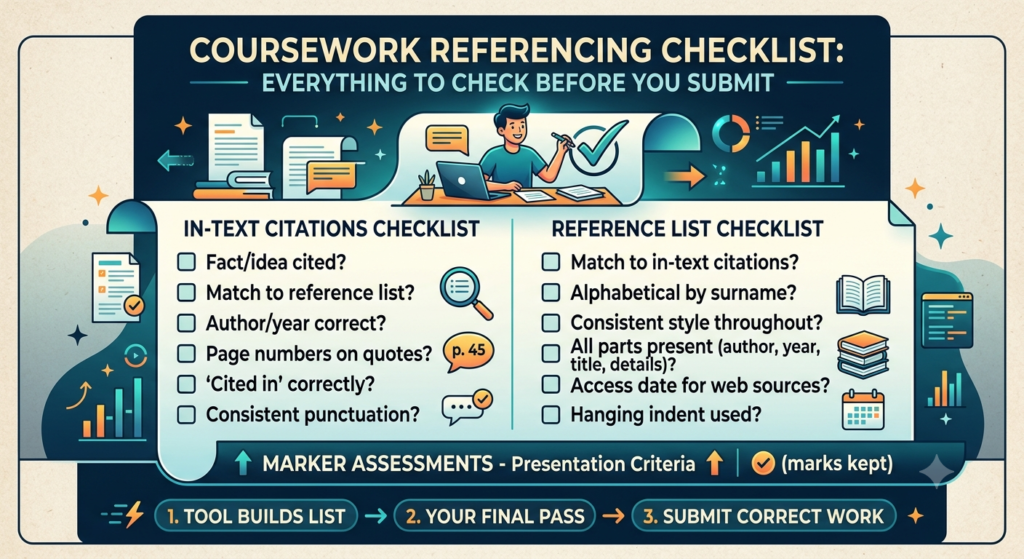
Before submitting coursework, check that every in-text citation has a matching reference list entry and the other way round, that your style is consistent throughout, that direct quotes have page numbers, that secondary sources are marked correctly, and that your reference list is alphabetical and complete. Referencing marks are among the easiest to keep and to lose. Referencing is where students give away easy marks, not because it is hard, but because it is left to the last minute and checked in a rush. This checklist walks through everything to confirm before you submit, so you keep the marks that referencing accuracy is worth. Work through it as a final pass, separate from proofreading your writing. Why does referencing affect your grade? Because referencing accuracy sits inside the presentation criteria that markers assess directly. It will not earn you a top grade on its own, but sloppy referencing loses marks that have nothing to do with how good your ideas are. It also protects you from accidental plagiarism, which is a far more serious problem than a lost presentation mark. This is one of the easiest places to keep marks with a bit of care, and it links straight to how markers assess your work. The in-text citation checklist Start with your in-text citations, the ones inside your writing. The reference list checklist Now check the list at the end. If you are using Harvard, our full Harvard referencing guide has the exact format for each source type. What are the most common referencing mistakes? Knowing the usual mistakes helps you catch them faster, because most students make the same handful. Every one of these is quick to fix once you spot it, which is the whole point of a dedicated referencing pass. You are not rewriting anything, just catching small errors that each cost a mark. How do you check for consistency? Consistency is the thing markers notice fastest, because a list that drifts between styles looks careless even when every entry is nearly right. The quickest way to check is to read only your reference list, entry by entry, and confirm they all follow the same pattern. Check What to confirm Punctuation Full stops, commas, and brackets are the same in every entry Italics The same element is italicised every time, such as the journal or book title Author format Surname and initials are formatted the same way throughout Dates Years are in the same place and format in every entry How do you avoid accidental plagiarism? Most plagiarism in coursework is accidental, from weak paraphrasing or a citation that got lost during editing. The referencing checklist catches most of it, but one more step confirms you are clear. Which referencing style should you use? Use whichever style your department tells you to, because that is what your marker checks against. Different subjects favour different styles: Harvard is common in business and social sciences, APA in psychology and education, OSCOLA in law, and numbered styles like Vancouver in the sciences. If your brief does not say, ask your tutor rather than guessing, because mixing styles or using the wrong one costs presentation marks even when every entry is otherwise correct. Once you know your style, use one referencing tool consistently, and check its output rather than trusting it blindly, since automatic tools make small errors that a marker will still spot. Do referencing tools do this for you? Partly, and they are worth using, but they do not replace this check. Reference managers and citation generators format entries quickly and keep your list organised, which saves real time. What they do not do reliably is catch every error. They pull incorrect data from sources, miss page numbers, and format some source types wrongly, especially websites and reports. So use a tool to build your list, then check its output against this checklist yourself. The tool does the heavy lifting, and your final pass catches the small mistakes it makes. Trusting a tool blindly is how students end up with a neat looking reference list that still loses presentation marks, because neat and correct are not the same thing. A simple workflow works best: let the tool build and order the list, then run this checklist over it once by hand. That combines the speed of the tool with the accuracy of a human check, and it takes only a few minutes on a finished piece of coursework. When should you do this check? As a separate final pass, after you have finished writing and proofreading. Checking your argument and checking your referencing are different jobs, and doing them together means doing neither well. Give referencing its own pass with fresh eyes, ideally the day before you submit, so you have time to fix anything you find. The one page summary If you only have five minutes, confirm these five things. Those five protect most of the marks referencing is worth, and most of the risk it carries. Frequently asked questions What should I check in my referencing before submitting? That every in-text citation has a matching reference and the other way round, that your style is consistent, that direct quotes have page numbers, that secondary sources are marked, and that your list is alphabetical and complete. Does referencing affect my grade? Yes. Referencing accuracy sits inside the presentation criteria markers assess, and it protects you from accidental plagiarism. It is one of the easiest places to keep or lose marks. How do I keep my referencing consistent? Read only your reference list, entry by entry, and confirm they all follow the same pattern for punctuation, italics, author format, and dates. Using one referencing tool from the start also helps. How do I avoid accidental plagiarism? Make sure paraphrases are genuinely in your own words, check no citation went missing during editing, mark quotes clearly, and run an originality check before you submit. When should I check my referencing? As a separate final pass, after writing and proofreading,
Coursework Resit and Resubmission: How to Pass the Second Time
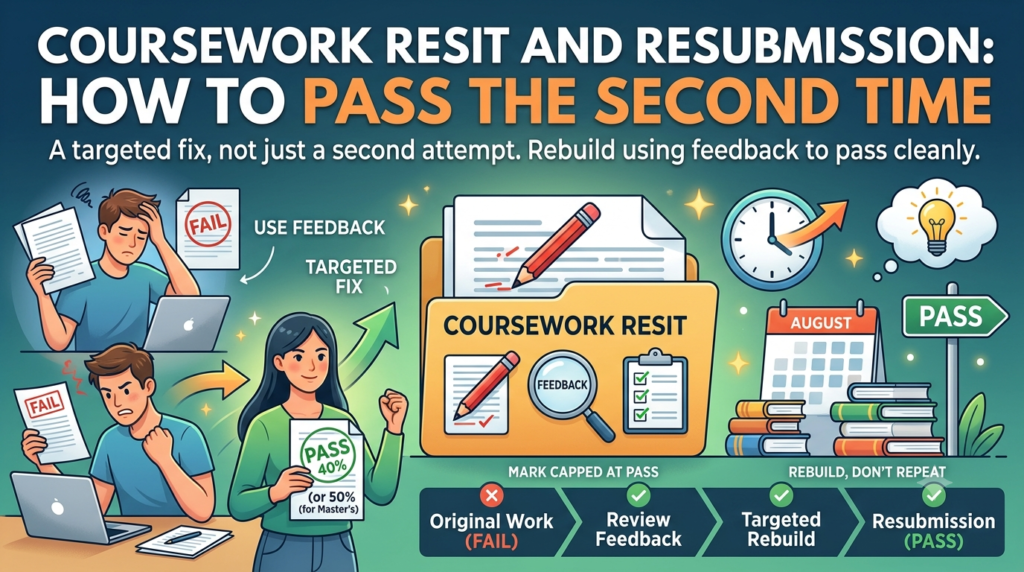
A coursework resit is a chance to resubmit failed work, usually with the mark capped at the pass threshold. To pass, read the feedback closely, because it tells you exactly what the marker wanted and did not get, then rebuild the work around that. A resit is not the same task again, it is a targeted fix. Failing a piece of coursework feels awful, but a resit is recoverable, and most students who approach it the right way pass. August is when many UK resits fall due, so if you are facing one now, the key is to treat it as a different task from your first attempt, not a repeat of it. What is a coursework resit? A resit, sometimes called a resubmission or a referral, is the chance to submit a failed assessment again. It is a normal part of how universities work, not the end of your degree. Most institutions build resits into the calendar precisely because they expect some students to need them. The most important thing to understand is what a resit is for. It is not a second identical attempt. It is a targeted second chance to fix the specific things that failed the first time, which is why the feedback matters more than anything else you have. Is the mark capped on a resit? Usually, yes. Most UK universities cap a resit mark at the bare pass threshold, often 40 per cent at undergraduate level or 50 per cent at master level, regardless of how good the resubmitted work is. This is standard, and it is worth knowing so you can plan realistically. The cap changes your goal. You are not aiming for a brilliant mark, because you cannot get one. You are aiming to pass cleanly and move on. That actually makes a resit less stressful once you accept it, because the target is clear and achievable rather than open ended. Rules vary between institutions, and some allow an uncapped resit if you had mitigating circumstances, so always check your own regulations rather than assuming the cap applies. How is a resit different from the first attempt? The mindset is the whole difference. On the first attempt you were producing something new, guessing at what the marker wanted. On a resit you are not guessing at all, because the feedback tells you exactly what was missing. That makes a resit, in one sense, easier than the original, since you are aiming at a clear target rather than an unknown one. The trap is treating it as the same task. Students who reopen the original file and tinker tend to fail again, because they are still inside the thinking that failed the first time. The students who pass usually start with the feedback and the rubric, plan the fixes, and only then return to the work. Same content, completely different result. How do you use the feedback? This is the single most important step, and the one students skip most. Your feedback is a map of exactly why the work failed, written by the person who will mark it again. Read it slowly, more than once, and turn every comment into an action. Feedback like needs more critical analysis is not a criticism to feel bad about. It is an instruction. It tells you the work described too much and judged too little, and it tells you exactly where to add value in the resit. Why do most resits fail again? Because students resubmit a lightly edited version of the same work, fixing the surface without addressing the real problem. If the first attempt failed on weak analysis, tidying the spelling will not save the resit, because the thing that failed is still there. The fix is to rebuild around the feedback rather than polish the original. If the marker said the argument was unclear, restructure the argument. If they said it was too descriptive, replace description with judgement. A resit that reads as a genuinely different piece of work passes. One that reads as the same essay with a fresh coat of paint usually does not. How should you approach the resit step by step? How do you stay motivated for a resit? A resit over the summer, when friends have finished, is hard to face, so it helps to reframe it. The capped mark means the bar is a clean pass, not perfection, which is a smaller and clearer target than your first attempt. Break the work into the specific fixes from your feedback, do one at a time, and the task feels manageable rather than like carrying a failure around. Most students who fail a piece of coursework go on to pass the resit, so it is a setback, not a verdict on whether you belong on your course. Can you get help with a resit? Yes, and it is sensible to. Your tutor can clarify feedback, student support can explain your options and deadlines, and study support services can help you plan the rebuild. Getting a second read on your resit before you submit is especially useful, because a fresh pair of eyes spots whether you have actually addressed the feedback or just moved around it. Our coursework support can look at a resit against its feedback before you resubmit. What if you fail the resit too? It is not usually the end. Depending on your university, the next options can include repeating the module, an academic appeal if something went wrong with the process, or in some cases a further attempt. The routes vary, so speak to your tutor or student support early, because they can explain your specific options and the deadlines that apply. If the failure was linked to circumstances outside your control, that is worth raising formally, and our guide to coursework extensions and mitigating circumstances explains how. Frequently asked questions What is a coursework resit? A chance to resubmit failed work, sometimes called a resubmission or referral. It is a normal part of
How to Write a Dissertation Abstract, With Examples

A dissertation abstract carries four things in around 150 to 300 words: the problem and question, the method, the main finding, and why it matters. Write it last, once you know what your dissertation actually says, and make every sentence do one of those four jobs. The abstract is the only part of your dissertation most people will ever read, and the first thing your marker sees. That makes it worth far more care than its length suggests. It has to work on its own, so someone who never opens the full document still knows what you asked, how you answered it, what you found, and why it matters. What is an abstract for? It is a complete, standalone summary of your whole dissertation. That standalone requirement is what students miss most. An abstract cannot refer to chapters, cannot use undefined abbreviations, and cannot rely on citations. It has to stand entirely on its own, or it fails at its one job. How long should it be? Usually 150 to 300 words, though your department sets the limit and some specify 250 or 500. Check before you write, because an abstract is one of the few places where going over the limit is instantly visible. Whether it counts towards your total word count also varies, which is another thing to confirm rather than assume. What structure should it follow? Four parts, roughly equal, each doing one job. Part What it does Context and problem One or two sentences on why the question matters Aim and question What you set out to find, stated precisely Method Your design, data, and analysis, in a sentence or two Findings and significance What you found and what follows from it The most common mistake is spending half the abstract on context and squeezing the findings into a final clause. The findings are the reason anyone is reading. Give them at least a quarter of the space. Why is the abstract worth extra care? Because it is read more than any other part of your dissertation and read first. Examiners, and later anyone searching a repository, often decide from the abstract alone whether to read on. A weak abstract can make strong work look thin, while a sharp one sets up a good first impression before the marker reaches page one. For the effort it takes, no other 250 words in your dissertation carry as much weight. A worked example, quantitative Loyalty schemes are common in UK fast fashion, but evidence on whether reward structure affects repeat purchase among younger shoppers is limited. This study examined whether frequency based rewards produce different repeat purchase rates from spend based rewards among UK consumers aged 18 to 25. A survey of 214 respondents was analysed using logistic regression. Frequency based schemes were linked to higher repeat purchase, with the effect strongest among monthly shoppers. Spend based rewards showed no significant link once purchase frequency was accounted for. The findings suggest that reward structure, rather than reward value, drives repeat engagement in this group, with implications for scheme design in a sector where acquisition costs are rising. The single sector sample limits how far the results generalise. A worked example, qualitative Hybrid working is now common in UK professional services, but its effect on how junior staff access informal support is not well understood. This study explored how first and second year employees in mid sized accountancy firms experience access to senior colleagues under hybrid arrangements. Semi structured interviews with fourteen junior staff across four firms were analysed thematically. Three themes emerged: the loss of casual contact, a shift towards scheduled and more formal questions, and a reluctance to interrupt senior colleagues remotely that participants did not feel in person. Participants described holding back questions rather than raising them. The findings indicate that hybrid work may affect early career development through reduced informal learning, which has implications for how firms structure junior support. How many drafts does an abstract take? Usually three. The first gets the four parts onto the page in roughly the right proportions. The second cuts it to the word limit, which is where most of the improvement happens, because compression forces you to keep only what matters. The third reads it cold, ideally a day later, checking that it stands alone with no undefined abbreviations and no reference to chapters. A useful final check is to give it to someone outside your subject. If they can tell you what you asked, what you did, and what you found, it works. If they cannot, the problem is almost never their background. When should you write it? Last, with the introduction. Both describe what the dissertation says, and you only know that once the other chapters exist. An abstract written early commits you to findings you have not confirmed and almost always has to be rewritten. This is the same reason the conclusion is written at the end too. Expect it to take longer than its length suggests. Compressing a year of work into 250 words is genuinely hard, and it is worth two or three passes rather than one. Do you need keywords? Many departments ask for four to six keywords under the abstract, and they are worth a minute of thought rather than being filled in at random. They exist so your work can be found, so use the terms someone searching for research like yours would actually type. Include the topic, the group or setting, and the method, and avoid words already in your title, since those are indexed anyway. How do you cut an abstract that has run long? Almost always from the context. The opening is where students over write, because it is the easiest part to draft and the hardest to feel is finished. Two sentences of context is usually plenty, and one is often better. After that, cut hedging. Phrases like it could be argued that and the findings appear to suggest add words and remove force. If