How to Write a Dissertation Literature Review
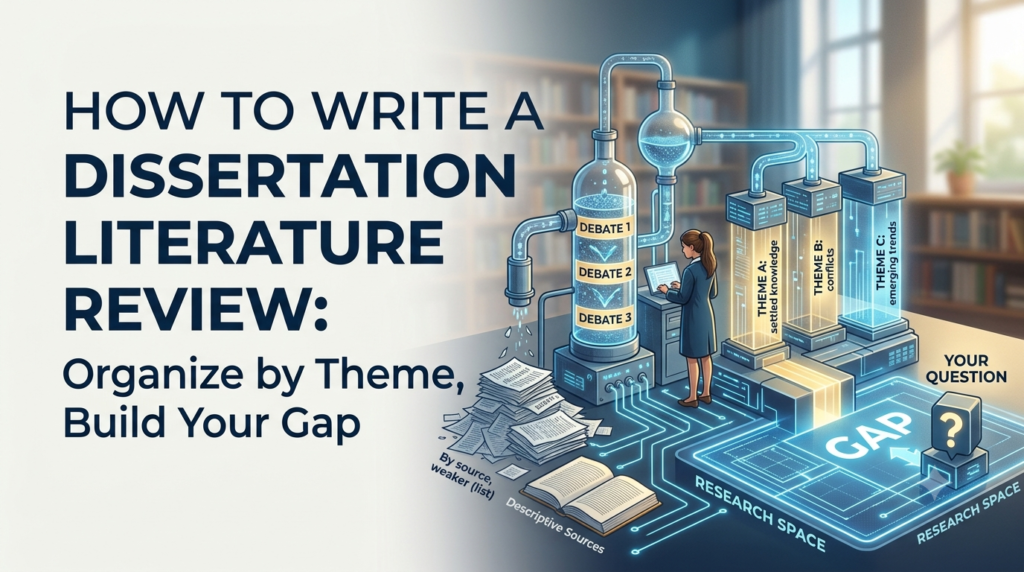
A literature review is not a summary of everything written on your topic. Its job is to show that a specific gap exists, so your research question becomes the obvious next step. Organise it by theme, not by source, and expect it to take around a quarter of your total word count. The literature review is the longest chapter in most dissertations and the one that swallows the most time, because reading always feels productive. It is also the chapter most students misunderstand. It is not a reading list with your notes attached. It is an argument about what is known, built to make your question look necessary. What is a literature review for? It has one main job: to make your research question look inevitable. By the end, a reader who has never seen your project should be able to guess what you are about to ask, because you have shown the gap rather than just claimed it exists. This changes what belongs in it. You are not proving you read a lot, though it will show that. You are building a case: here is what is settled, here is where the research disagrees or runs out, and that is where my question fits. How should a literature review be structured? By theme, not by source. This is the single most important decision, and the one most students get wrong on the first draft. A source by source review walks through one study after another: Smith found this, then Jones found that. It reads as a list and marks as one. A thematic review organises around three or four debates in your field, with sources appearing inside them as evidence. Same material, but now it reads as analysis, and it is usually shorter too. By source, weaker By theme, stronger One paragraph per study, in a row One section per debate or theme Reader does the synthesis You do the synthesis Reads as a reading list Reads as an argument Repeats context for each source Groups sources, so it is tighter How long should a literature review be? Around a quarter to thirty per cent of your total, so roughly 3,750 to 4,500 words in a 15,000 word dissertation. It is the longest chapter because it does the most structural work, not because it should hold the most sources. If yours has run long, the cause is almost always organisation by source, and switching to themes usually shortens it while making it better. What is the difference between describing and analysing sources? This is the distinction that decides your mark, so it is worth being concrete. Describing a source tells the reader what it said. Analysing it tells the reader what that means for your argument. Take an example. Writing that one study found a link between price and loyalty is description. Asking whether that link would hold in a different market, what the study’s sample could not show, and whether a rival study contradicts it, is analysis. A strong literature review is mostly analysis, with just enough description to support it. A weak one is mostly description with a little analysis added at the end. If you want to lift a review, the fastest route is to cut a paragraph that only reports and replace it with one that judges. How do you avoid the most common trap? The most common trap is reading forever because it feels like progress. There is always another paper, and stopping feels risky, so students keep reading and never start writing. This is how the literature review swallows a whole timeline. The fix is to set a boundary before you begin, in both weeks and words, and to trust the saturation test. Once new papers stop changing your argument, you have read enough. More reading past that point adds time without adding value, and the review does not get better, it just gets later. Writing is where the synthesis actually happens, so the sooner you start shaping what you have, the sooner the chapter takes form. How do you find and choose sources? Start with recent review articles in your field, because someone has already mapped the area and their reference lists are a curated starting point. Then follow the citations that keep reappearing, which leads you to the foundational work everyone argues with. Choosing is harder than finding. Not everything you read belongs in the review. The test is whether a source does a job: does it establish a position, complicate one, or show the gap. If it does none of those, leave it out. And record full citation details as you read, because rebuilding a reference list from memory at the end is where marks are lost. How do you write critically, not just describe? The test that works on any paragraph: if you deleted the author names, would anything of your own remain? If not, you are reporting, not analysing. Critical writing compares rather than lists. Where two studies disagree, ask what in their methods explains it. Where a finding is widely cited, ask what it was actually based on. A quick signal of a critical review is that your paragraphs open with your own point and use sources as evidence, which is the same skill that markers reward across the whole dissertation. When should you write it? After your methodology in most cases. The review needs a settled research question to organise around, and writing the methodology first often sharpens that question. Give the review a hard limit in both weeks and words before you start, because it is the chapter most likely to take over your whole timeline. How does the literature review connect to your other chapters? The review is not a standalone chapter. It sets up your research question, which your methodology then answers, and it gives you the studies your discussion later argues with. A review that never connects to the rest of the dissertation reads as background reading rather than as part
How to Write a Dissertation Conclusion
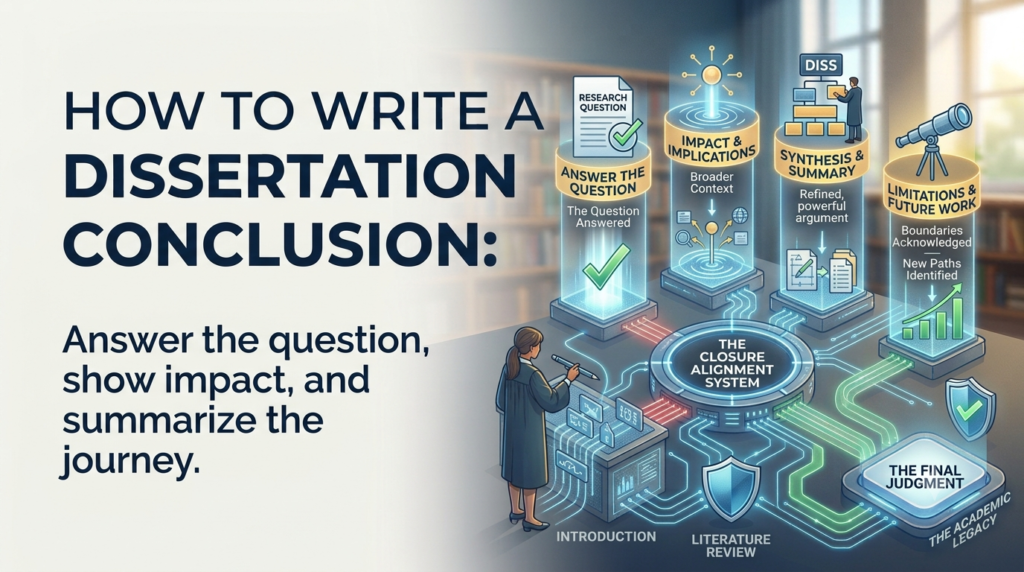
A dissertation conclusion answers your research question directly, states what your work contributes, admits its limits, and says what should happen next. It is not a summary. If your conclusion could be swapped into another dissertation on the same topic, it is not doing its job. The conclusion is the last thing your marker reads before deciding your grade, which makes it far more important than its length suggests. Yet it is often written last, in a rush, and treated as a summary. Done properly, it is where you state plainly what your whole dissertation achieved. What should a conclusion actually do? Answer the question you asked in chapter one, in plain words, in the first paragraph. A surprising number of dissertations never do this directly. They discuss findings at length and leave the reader to assemble the answer, which is work you should have done for them. After that, it does three more things: states what your work contributes, admits honestly what it cannot claim, and points to what would be worth doing next. That is the whole chapter. What is the difference between summarising and concluding? This distinction decides whether your conclusion works. Summarising repeats what each chapter said. Concluding tells the reader what it all adds up to. A summary looks backward and lists. A conclusion looks at the whole and answers. A quick test: if a sentence in your conclusion could have been written before you did the research, it is summary, not conclusion. In this dissertation I reviewed the literature and collected data is summary, because it was true from the start. My findings show that reward structure matters more than reward value is a conclusion, because only your research could have produced it. A strong conclusion is full of the second kind of sentence. Why is the conclusion so important? Because it is the last thing your marker reads before deciding your grade, it shapes their final impression of the whole dissertation. A sharp conclusion that answers the question cleanly leaves the marker confident you understood your own work. A vague one that trails off in summary leaves doubt, even after a strong middle. The conclusion cannot rescue a weak dissertation, but it can lift or sink a borderline one, which is why it deserves proper time rather than the leftover hours of the final night. How is it different from the discussion? The discussion interprets your findings one by one and engages with the literature in detail. The conclusion steps back and pulls it all together: given everything, what is the answer, and what does it add. The practical difference is scope. The discussion works at the level of individual findings. The conclusion works at the level of the whole dissertation, and it introduces no new evidence, no new citations, and no new arguments. Anything that needs a source belongs back in the discussion. What structure works? A short closing that returns to why the question mattered. How long should it be? Five to ten per cent of the total, so roughly 750 to 1,500 words in a 15,000 word dissertation. It is the shortest substantive chapter and it should feel tight. A conclusion running to three thousand words is almost always repeating the discussion. How do you write limitations well? Specifically, and about your own design rather than about research in general. Time and resource limits apply to every student project, so saying so tells a marker nothing. What earns credit is naming the actual consequence: a single organisation sample means the findings cannot be extended to the sector, self reported data may overstate behaviour, a snapshot design cannot show cause and effect. Students often feel that admitting limits weakens the work. The opposite is true. A limitations section that names a real weakness before the marker does shows exactly the judgement the top band rewards, and a dissertation with no limitations reads as though the writer did not understand their own design. How do you state your contribution? Your contribution is what is known now that was not known before you started. It does not have to be a big discovery. For most dissertations it is modest and specific, such as showing that an established idea holds, or does not hold, in a new setting or for a new group. State it plainly and honestly, matched to what your evidence can support. This study provides evidence that reward structure affects repeat purchase among younger shoppers in one UK sector is a defensible contribution. This study proves that reward structure drives loyalty is not, from the same data. Markers respect a modest, accurate claim far more than a grand one your findings cannot carry, so keep the wording precise and let the specifics do the work. How do you write recommendations that are worth something? They have to follow from your findings and be specific enough to act on. Organisations should improve communication is not a recommendation. It follows from nothing in particular and nobody can do it. Tie each recommendation to a specific finding and say who should do what. If your data showed junior staff hold back questions under remote working, the recommendation is a specific low cost way to invite those questions, aimed at team leaders, and the finding it rests on is named. How do you avoid ending too abruptly? Many conclusions stop dead after the last recommendation, which leaves the dissertation feeling unfinished. A short closing paragraph fixes this. Return briefly to why the question mattered in the first place, and place your contribution in that wider frame. Two or three sentences are enough. This is not a summary, it is a final reminder of the point of the whole project, and it gives the marker a clean, deliberate ending rather than a sentence that simply runs out. The last impression should feel intended, not accidental. What are the common mistakes? Ready to take your dissertation further? Get specialist support. From refining your research question and
How to Write a Dissertation Introduction That Sets Up Your Whole Project
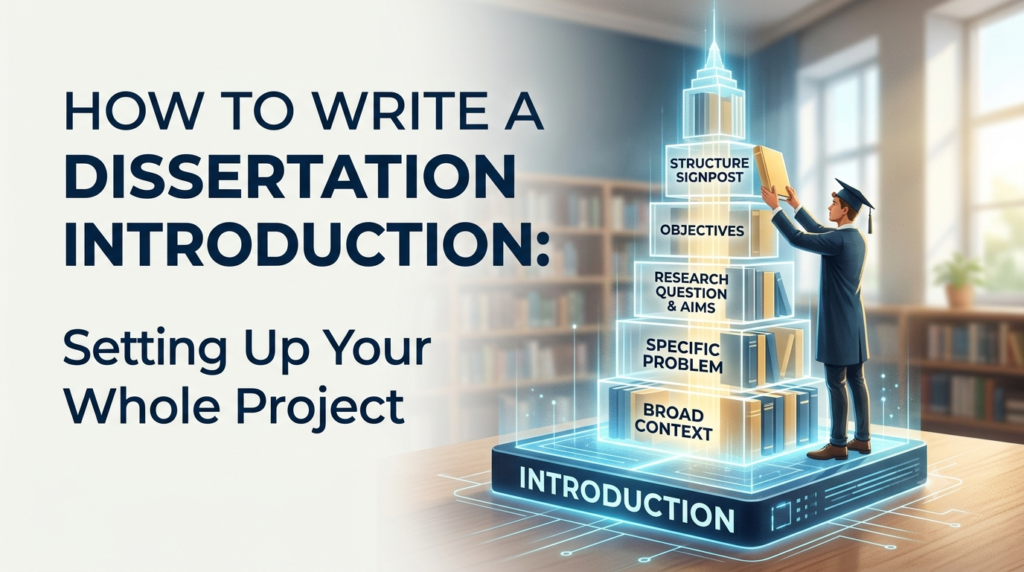
A dissertation introduction introduces the topic, explains why it matters, states the research question and aims, and signposts the structure. It should move from the broad context to your specific question, and leave the reader knowing exactly what you will investigate and why. Write it early in rough form, then finish it last. The introduction is the first thing your marker reads, so it shapes their whole impression of your dissertation. A sharp introduction signals a controlled, well planned project. A vague one raises doubt before the reader reaches your research. The good news is that a strong introduction follows a clear pattern you can learn. What is the introduction for? It has one main job: to make the reader understand what you are investigating and why it is worth investigating, before they reach any of your research. By the end of the introduction, they should know your topic, your question, your aims, and how the dissertation is organised. It is not a place for findings or detailed literature. It sets the stage. Detail belongs in the chapters that follow, and cluttering the introduction with it blurs the one thing it needs to do clearly, which is frame the project. What should a dissertation introduction include? Most strong introductions contain the same elements, in roughly this order. Not every dissertation needs all six as separate sections, but a good introduction covers all of them in some form. How do you start an introduction? Start broad, then narrow. Open with the wider context that any educated reader would recognise, then funnel down to your specific question. This is often called the funnel approach, and it works because it takes the reader from familiar ground to your precise focus without a jump. Avoid two common openings. Do not start so broadly that the first paragraph could belong to any dissertation in your field. And do not open with a dictionary definition, which reads as filler. Begin with something specific enough to signal your actual topic, then narrow from there. How do you write the research question and aims? This is the heart of the introduction. Your research question should be specific, answerable, and clearly stated, so the reader knows exactly what the dissertation delivers. Narrow it by group, setting, and focus until a method suggests itself. If you are still shaping it, our guide to choosing a dissertation topic helps you get from a broad area to a sharp question. Keep the aim and the objectives distinct. The aim is your overall goal, phrased as what you want to achieve. The objectives are the specific steps that get you there, and they often map onto your chapters. Markers notice when students blur the two, so keep them separate and clear. How long should the introduction be? Around ten per cent of your total, so roughly 1,500 words in a 15,000 word dissertation. It should feel focused rather than exhaustive. If your introduction is running much longer, it is probably straying into literature review or methodology territory, which belongs in those chapters. The full breakdown is in our dissertation word count guide. How do you signpost the structure? Near the end of your introduction, include a short paragraph that tells the reader what each chapter does. This is signposting, and it helps the reader navigate a long document by knowing what is coming. It does not need to be long, just a sentence or two mapping the journey. For example, you might say that the next chapter reviews the existing research and identifies the gap, the following one explains the method, and so on. This small paragraph does real work, because it frames the whole dissertation as a planned argument rather than a series of chapters the reader discovers one by one. Markers read it as a sign of a controlled project. How does the introduction relate to the conclusion? They are a matched pair, and the strongest dissertations treat them that way. The introduction poses the research question and explains why it matters. The conclusion returns to that exact question and answers it. Read one straight after the other, with the middle removed, and they should still make sense as a short, complete argument. This is a genuinely useful check at the end of your project. If the question you raised in the introduction is not the question you answered in the conclusion, something drifted during the writing, and it is worth fixing before you submit. Writing the final versions of both together is the easiest way to keep them aligned. When should you write it? Write a rough version early, to give yourself direction, then finish it last. This sounds contradictory but it is the approach that works. An early draft forces you to state your question and aims, which guides the whole project. But you only know exactly what your dissertation says once the other chapters exist, so the final polish comes at the end, alongside the conclusion. Writing the final introduction and conclusion together is a useful habit, because they mirror each other. The introduction poses the question the conclusion answers, and reading them back to back is a strong test of whether your project stayed on track. How do you make the introduction engaging? An introduction can be clear and still be dull, and a dull opening sets a flat tone for the whole dissertation. You do not need drama, but you do need to make the reader care. The way to do this is to show why your question matters in the real world, not just in the academic literature. A real problem, a current issue, or a genuine gap that has practical consequences gives the reader a reason to keep going. Establish that stake early, then let the precision of your question do the rest. Markers read a lot of dissertations, and one that opens with a clear sense of why it matters stands out immediately. What are the common mistakes? Ready to take your
Dissertation Extension Requests: What Counts as Mitigating Circumstances

Extensions are granted for circumstances that were unforeseen, outside your control, and that demonstrably affected your ability to work. Poor planning does not qualify anywhere in the UK. Evidence and timing carry as much weight as the reason itself, so apply before the deadline wherever it is still possible. What counts as mitigating circumstances? Almost every UK institution uses some version of the same three-part test, even where the wording differs. The circumstance has to have been unforeseen, it has to have been outside your control, and it has to have had a demonstrable effect on your ability to complete the work in the relevant period. All three matter, and applications usually fail on the third rather than the first. A student can describe a genuinely serious situation and still be refused because nothing in the application connects that situation to the specific weeks in which the dissertation was supposed to be written. Circumstances that are commonly accepted include serious illness or injury affecting you directly, a bereavement, a significant caring responsibility that arose during the assessment period, being the victim of a crime, and acute personal circumstances of a kind your institution recognises. Some universities also accept documented long-term conditions where the effect worsened during the period in question, though these are often handled through a separate support arrangement rather than through the mitigating circumstances route. What usually does not count? It is worth being direct about this, because a refused application costs you time you did not have and there is usually a better move available. The pattern is consistent. If a reasonable person could have anticipated it and planned around it, it is not mitigating. If it arrived without warning and you could not have prevented it, it probably is. How much extra time can you get? This varies more than anything else in the process. Short extensions of a few days to two weeks are commonly available and are often decided quickly at department level. Longer extensions usually require a formal mitigating circumstances panel and are decided against a fixed schedule rather than on demand. For dissertations specifically, there is often a hard outer limit set by the examination board calendar rather than by anyone’s discretion. Marking, moderation and the board itself have fixed dates, and no department can extend past the point where a mark cannot be processed in time for the award. This is why an early request is treated so differently from a late one: early, there is room to move, late, there may be no room at all regardless of the merits. Where an extension is not possible, the usual alternative is a deferral, meaning you submit at the next assessment opportunity as a first attempt with no cap on the mark. That is a better outcome than a capped resit and it is worth asking about explicitly. What evidence do you need? Evidence carries most of the weight, and this is the part students most often get wrong. Applications are refused for lack of documentation far more often than for lack of a genuine reason. Two practical points. Gather evidence at the time rather than afterwards, because obtaining a backdated letter is difficult and sometimes impossible. And if you genuinely cannot obtain documentation, say so explicitly in the application and explain why, rather than submitting without it and hoping the omission is not noticed. Panels handle stated gaps far better than silent ones. When should you apply? Before the deadline, always, if it is still possible. An application submitted in advance is assessed on its merits. A retrospective one is assessed on its merits plus an additional question about why you did not come forward sooner, and that second question is where retrospective claims are usually lost. Retrospective claims are accepted at most institutions within a stated window after the assessment, and the explanation for the delay becomes central to the application. Being too unwell to submit a form is an accepted explanation. Not realising you could apply is a weaker one, though it is still better stated than concealed. If the deadline has already passed, the timing of your first contact matters more than anything in the form itself. Email your supervisor and course administrator the same day, then follow the formal process. Our guide to what happens after a missed dissertation deadline covers the first 24 hours in detail. How to write the application Most forms are short, which misleads people into writing either two lines or two pages. Neither works. Four things need to be present, and nothing else does. Keep the tone factual. Panels read a great many of these and are not persuaded by emotion, but they respond well to a clear account with dates attached to it. Do not overstate the circumstance, because an overstated claim that does not match its evidence damages an application that would otherwise have succeeded on its own facts. What happens if it is refused? A refusal is not usually the end of the process. Most institutions allow an appeal, though almost always on procedural grounds or on the basis of new evidence rather than because you disagree with the decision. Read the appeal grounds before writing anything, since an appeal that does not engage them is dismissed without reaching the substance. The more practical response is usually to move to the position you are actually in and plan accordingly. If the deadline stands, work out what is realistically finishable and protect the chapters that carry the most marks. A four week finishing plan is achievable if your reading and data are already in place, and knowing how the late submission rules work at your own institution tells you exactly how much room you have. If a specific chapter is the blocker rather than the whole document, that is a narrower problem than it feels like at this stage. Our dissertation support works at chapter level, so a stalled methodology or an undeveloped discussion can be looked at on
Dissertation Word Count: How Many Words Each Chapter Should Be
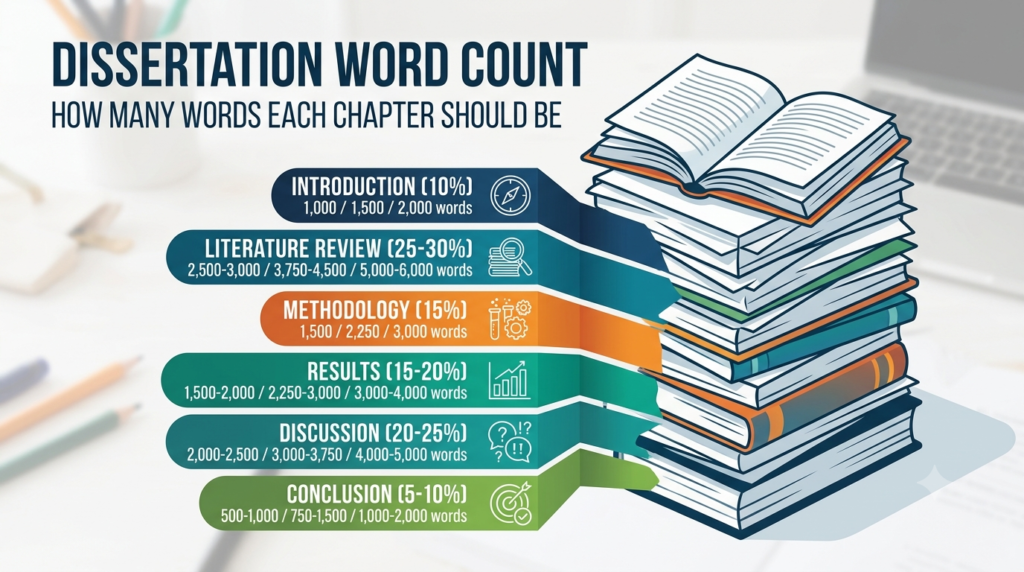
A typical UK dissertation splits roughly as follows: introduction 10 per cent, literature review 25 to 30 per cent, methodology 15 per cent, results 15 to 20 per cent, discussion 20 to 25 per cent, conclusion 5 to 10 per cent. Treat these as a starting frame, since your department may specify its own. How should a dissertation word count be split? By proportion rather than by page count, because the split holds reasonably well whether you are writing 10,000 words or 20,000. The percentages above are the conventional shape for an empirical dissertation in the social sciences, business, education and most health disciplines. Two chapters dominate. The literature review and the discussion together account for roughly half the document, and that is not an accident of convention. They are the two chapters where marks are actually distributed, because both require analysis rather than reporting. Everything else describes something. Knowing this early changes how you read and how you write, because you stop gathering material you have no room for. A student who knows their literature review is 4,000 words reads differently from one who knows only that the dissertation is 15,000. Word count by chapter for 10,000, 15,000 and 20,000 words Chapter Share of total 10,000 words 15,000 words 20,000 words Introduction 10% 1,000 1,500 2,000 Literature review 25 to 30% 2,500 to 3,000 3,750 to 4,500 5,000 to 6,000 Methodology 15% 1,500 2,250 3,000 Results or findings 15 to 20% 1,500 to 2,000 2,250 to 3,000 3,000 to 4,000 Discussion 20 to 25% 2,000 to 2,500 3,000 to 3,750 4,000 to 5,000 Conclusion 5 to 10% 500 to 1,000 750 to 1,500 1,000 to 2,000 Use these as targets to write towards, not as rules to defend. If your methodology needs an extra 500 words because your design is genuinely complicated, take them from somewhere that is describing rather than analysing. Why is the literature review the biggest chapter? Because it does the most structural work. Its job is not to summarise everything written on your topic. It is to build the case that a specific gap exists, so that your research question arrives as the obvious response rather than as a change of subject. That takes room. You have to establish what is known, show where the accounts disagree or run out, and connect that to the thing you are about to do. A review that is too short usually gives itself away by stating the gap rather than demonstrating it, which is the difference a marker notices immediately. The failure mode in the other direction is a review that has grown by accumulation rather than by argument. If yours has run long, the usual cause is organisation by source rather than by theme. Rearranging the same material around three or four debates, with sources grouped inside them, typically cuts length while improving the chapter. Because it does the most structural work. Its job is not to summarise everything written on your topic. It is to build the case that a specific gap exists, so that your research question arrives as the obvious response rather than as a change of subject. That takes room. You have to establish what is known, show where the accounts disagree or run out, and connect that to the thing you are about to do. A review that is too short usually gives itself away by stating the gap rather than demonstrating it, which is the difference a marker notices immediately. The failure mode in the other direction is a review that has grown by accumulation rather than by argument. If yours has run long, the usual cause is organisation by source rather than by theme. Rearranging the same material around three or four debates, with sources grouped inside them, typically cuts length while improving the chapter.Because it does the most structural work. Its job is not to summarise everything written on your topic. It is to build the case that a specific gap exists, so that your research question arrives as the obvious response rather than as a change of subject. That takes room. You have to establish what is known, show where the accounts disagree or run out, and connect that to the thing you are about to do. A review that is too short usually gives itself away by stating the gap rather than demonstrating it, which is the difference a marker notices immediately. The failure mode in the other direction is a review that has grown by accumulation rather than by argument. If yours has run long, the usual cause is organisation by source rather than by theme. Rearranging the same material around three or four debates, with sources grouped inside them, typically cuts length while improving the chapter.Because it does the most structural work. Its job is not to summarise everything written on your topic. It is to build the case that a specific gap exists, so that your research question arrives as the obvious response rather than as a change of subject. That takes room. You have to establish what is known, show where the accounts disagree or run out, and connect that to the thing you are about to do. A review that is too short usually gives itself away by stating the gap rather than demonstrating it, which is the difference a marker notices immediately. The failure mode in the other direction is a review that has grown by accumulation rather than by argument. If yours has run long, the usual cause is organisation by source rather than by theme. Rearranging the same material around three or four debates, with sources grouped inside them, typically cuts length while improving the chapter. Because it carries the most marks per word in the document, and because doing it properly takes more space than most students allow for. A discussion has to interpret each finding, place it against the literature you reviewed, account for anything that did not fit, and set out what follows. The common
What Happens If You Miss Your Dissertation Deadline in the UK

A missed dissertation deadline is rarely the end of a degree, but the rules vary by institution. Most UK universities either apply a daily penalty within a short late window, cap the mark at the pass threshold, or record a non-submission. What you do in the first 24 hours matters more than why you missed it. What actually happens if you miss the deadline? The first thing to understand is that there is no single UK rule. Late submission is governed by each institution’s own assessment regulations, and they differ enough that advice written for one university can be actively wrong at another. Anything you read online, including this, is the general shape rather than your answer. That said, most UK regulations fall into one of three patterns, and knowing which one applies to you takes ten minutes in your programme handbook and changes every decision that follows. Dissertations are also sometimes treated differently from coursework, because they carry more credits and because a capped mark on a dissertation affects a degree classification far more than a capped mark on a single module essay. Do not assume your general coursework policy applies. How late penalties usually work Where a sliding penalty applies, the window is typically short and the arithmetic is unforgiving, which is why the difference between submitting late tonight and submitting late on Friday is usually much larger than students assume. Two details are worth checking specifically, because they decide whether you still have time. The first is whether the penalty counts calendar days or working days, since a Friday deadline missed can mean a weekend that either does or does not count against you. The second is when the clock starts, which is usually the stated deadline time rather than the end of that day. A submission at 4pm against a 2pm deadline can count as a full day late. The other rule that matters is what happens at the end of the late window. In most regulations the work simply stops being accepted, and there is no partial credit for submitting a day after that point. This is why the practical advice is almost always to submit whatever exists rather than to keep working. What to do in the first 24 hours The single most common mistake at this stage is going quiet out of embarrassment and reappearing a fortnight later. Every regulation is more generous to a student who came forward on day one, and no regulation is generous to one who did not. Is it better to submit late or submit incomplete? Almost always incomplete and on time, or incomplete and inside the late window, rather than complete and outside it. The reason is that penalties for lateness are usually fixed and mechanical, while an incomplete dissertation is still marked on what is there. A dissertation missing a polished conclusion loses the marks that conclusion would have earned. A dissertation submitted outside the late window can lose everything. Those are not comparable risks. If you are choosing what to leave unfinished, protect the discussion chapter above everything else, since it carries the most marks, and make sure the document is coherent as a whole rather than strong in one place and absent in another. A marker can grade an under-developed dissertation. They cannot grade one that does not follow itself. Can you still claim mitigating circumstances after the deadline? Often yes. Most UK institutions accept retrospective claims within a stated period after the assessment, on the understanding that you explain why an advance application was not possible. That explanation is usually the substance of the claim, so it needs to be specific. What tends to be accepted is a circumstance that was unforeseen, outside your control, and that demonstrably affected your ability to work in the relevant period. Evidence carries most of the weight, and undocumented claims are refused far more often than students expect regardless of how genuine they are. What is generally not accepted is anything that amounts to planning. Underestimating how long the work would take, computer failure without backups, or several deadlines falling in the same week are not usually treated as mitigating circumstances anywhere in the UK. Our guide to what counts as mitigating circumstances goes through the distinction and how to write the application. What if you miss it entirely? Where no submission is recorded, you move into your institution’s resit, referral or deferral process rather than out of your degree. The specific route depends on whether a mitigating circumstances claim is upheld. If it is upheld, the usual outcome is a deferral, meaning you take the assessment again at the next opportunity as a first attempt with no cap on the mark. This is the significantly better outcome and it is the reason claims matter. If it is not upheld, you are typically offered a resit, often with the mark capped at the pass threshold, and sometimes with a fee and a delayed completion date. It is not a failed degree, but it does change your classification and your timeline, and for taught master’s students it can mean graduating in a later cohort. Does a late dissertation affect your degree classification? It can, and more than a late essay would, because the dissertation usually carries a large share of the credits for the year. A capped dissertation mark on a master’s programme can move a distinction to a merit on its own. This is worth knowing in advance rather than afterwards, because it changes the maths on whether to spend another two days improving a chapter. Check your programme’s weighting and any borderline rules before you make that decision, not after. The honest summary Missing a dissertation deadline is recoverable at almost every UK institution, and the students who recover well are the ones who submit something immediately, read their own regulations rather than general advice, and put the situation in writing to their department on day one. If the deadline has not passed yet and
How to Answer a Law Problem Question Using IRAC (With a Worked Example)
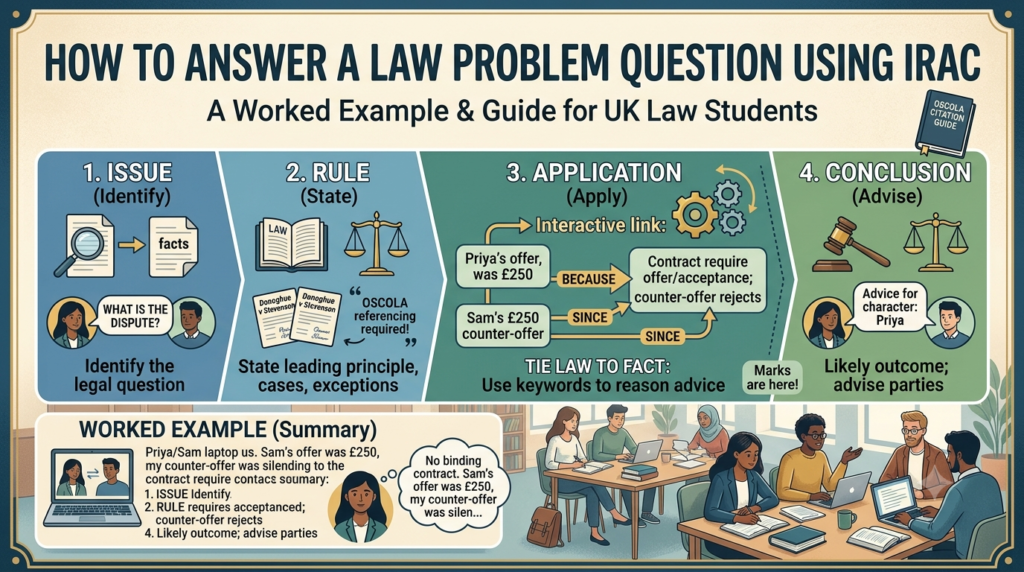
Problem questions are where law students win or lose the most marks, and where the gap between knowing the law and applying it shows up most clearly. You can memorise every case on the syllabus and still score a 2:2 if you cannot spot the issues in the scenario and advise the parties. The IRAC method is the framework that keeps your answer structured, complete and focused on exactly that — application. This guide explains what IRAC is, walks through a short worked example, and shows how a problem question differs from an essay question at UK law schools. What is a problem question testing? An essay question asks you to argue or evaluate a point of law. A problem question does something different: it gives you a factual scenario, usually with named characters, and asks you to advise one of them. The skill being marked is issue-spotting and application. Can you read a messy set of facts, identify the legal disputes that genuinely arise, pull in the right rules, and reason your way to advice? Reciting the law is only the raw material. The marks are in what you do with it. What does IRAC stand for? IRAC breaks your answer into four moves, repeated for each issue you spot. Step What you do Issue Name the specific legal question the facts raise. Be precise — “is there a valid contract?” not “what happens next?” Rule State the relevant law: the principle, the leading case or statute, and any exceptions. Application Apply that rule to these facts. This is the largest part and where most marks sit. Use words like “because” and “since” to tie law to fact. Conclusion State the likely outcome for the party you are advising. Where the law is uncertain, give the alternatives. A short worked example Scenario: Priya offers to sell her laptop to Sam for £300. Sam replies, “I’ll take it for £250.” Priya says nothing. Sam later insists there is a binding contract at £250. Advise Priya. Issue — Is there a binding contract between Priya and Sam, and if so, on what terms? Rule — A valid contract requires offer, acceptance, consideration and intention to create legal relations. A counter-offer rejects and destroys the original offer rather than accepting it, so no contract forms on the original terms unless the counter-offer is itself accepted. Application — Priya’s offer was to sell at £300. Sam’s reply of £250 is not an acceptance because it changes a material term; it is a counter-offer, which extinguishes Priya’s original £300 offer. Priya’s silence does not amount to acceptance of the £250 counter-offer, because acceptance generally cannot be inferred from silence alone. Conclusion — There is no binding contract. Priya is not obliged to sell at £250, and her original £300 offer no longer stands for Sam to accept. Notice that the analysis never just states the law and stops. Every rule is immediately pinned to the facts. That is the habit examiners reward. How is this different from a law essay question? Essay questions want a thesis, an argument and evaluation of competing views — the same critical-analysis skills that separate a First from a 2:1 in any subject. If your course mixes both formats, our guide on how to write a First-Class essay covers the essay side, and our breakdown of what UK markers actually look for explains how analysis, structure and use of authority translate into grade bands. Problem questions borrow the same analysis skill but aim it at a scenario rather than a debate. Common mistakes that cost marks The biggest is stating the law without applying it — long paragraphs of rules with no link to the facts read like revision notes, not advice. Close behind is poor issue-spotting, where students either miss an issue entirely or invent disputes the facts do not raise. Others forget to actually advise the named party, ignore the counter-arguments the other side would run, or bury a clear conclusion under hedging. Deal with each issue in its own IRAC block and the structure stays clean. On referencing, note that UK law uses OSCOLA, not Harvard, so cases and statutes go in footnotes. Get the format right early — it is straightforward marks. Facing a tricky problem question, or want a worked model answer in your subject to learn the method from? DoMyWork’s law assignment help is written by law specialists and delivered as original reference and study material you can check your own reasoning against. You can also confirm your final draft is clean with the $5 Turnitin Plag Check before you submit. Frequently asked questions Do I need an introduction in a law problem question? Usually not. A problem question rewards getting straight to the first issue. A one-line signpost of the issues can help, but a long essay-style introduction earns no marks. What is the difference between IRAC and ILAC? They are the same framework. ILAC uses “Legal application” and some courses use IPAC (Issue, Principle, Application, Conclusion). Whatever the label, the structure is identical. How do I reference cases and statutes? UK law schools almost always require OSCOLA, which uses footnotes. Cite the full case and citation first, then a short form afterwards, and follow your law school’s OSCOLA guide for the exact format.
Turnitin for a Full Dissertation: Checking 15,000 Words Before You Submit
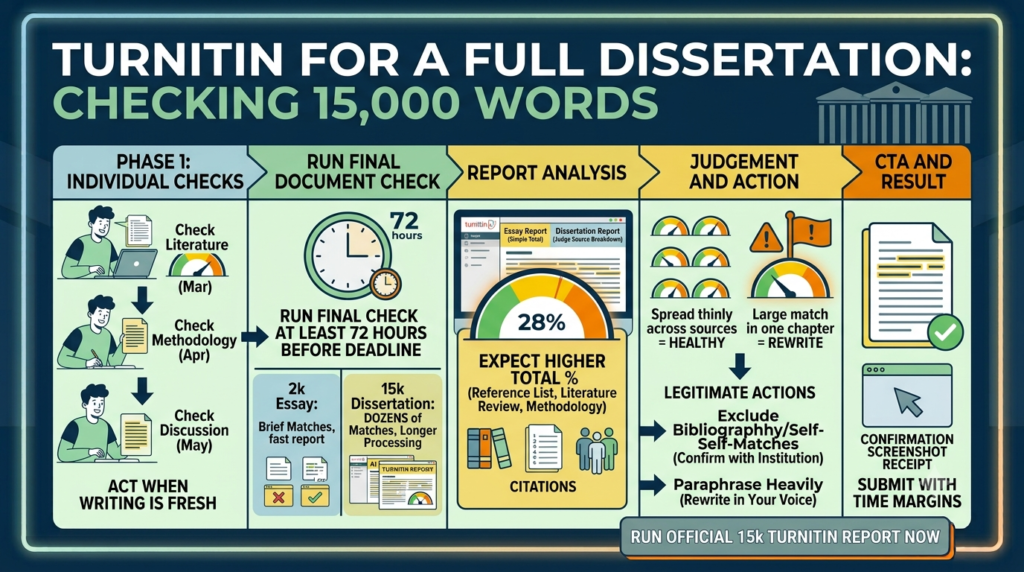
Turnitin treats a dissertation the same way it treats an essay, but the report reads differently. Expect a higher percentage, judge the source breakdown rather than the total, check each chapter as you finish it, then run the whole document at least 72 hours before your deadline. How does Turnitin handle a 15,000 word document? Mechanically, identically. It compares your text against archived student papers, licensed published material and the open web, then reports the passages that match. There is no separate dissertation mode and no different threshold. What changes is the shape of the report. An essay generates a handful of matches you can read through in a minute. A dissertation generates dozens across dozens of sources, which makes the headline percentage close to useless and the source list the only view worth opening. Processing time also changes, and this catches people out. Long documents take longer, and submission portals slow down as a deadline approaches because every student on the programme is uploading at the same time. If your plan depends on seeing a report before you commit, that plan needs hours of margin rather than minutes. What similarity score should a dissertation get? Higher than an essay, and that is expected rather than a problem. The reason is arithmetic. A 2,000 word essay might carry a dozen references. A 15,000 word dissertation carries sixty or more, and every one appears in a reference list that matches other reference lists, because author names and titles are fixed text that cannot be paraphrased. That block alone accounts for several percentage points before you have written a sentence of your own argument. Add a literature review whose entire purpose is to engage with existing work, and a methodology describing a standard procedure that thousands of others have also described accurately, and a healthy dissertation can sit comfortably in a range that would look alarming on a short essay. The judgement is the same as for any document, applied at scale. Open the breakdown, find the largest single source, and assess that. Twenty per cent spread across forty sources with nothing above two or three per cent each is a report doing its job. Twenty per cent where one source contributes most of it is a passage to rewrite, whatever the total says. Why does my literature review match so much? Because it is supposed to. A literature review quotes selectively, cites constantly and discusses work that other people have also discussed using the standard vocabulary of your field. It will always be your highest matching chapter, and a report where most of the matches sit there is usually behaving correctly. The thing to look for inside that chapter is concentration. Many small matches across many sources means you are engaged with a wide literature. One large match against a single source means a passage leaned too heavily on one place, and that is worth rewriting whether or not anyone would ever have noticed. Methodology is the second predictable source, for the same reason. There are only so many ways to describe a standard sampling approach accurately, and describing it accurately is what you are supposed to do. If you want a fuller explanation of why the percentage misleads, our guide to what a good similarity score means covers it. Should I check chapter by chapter or all at once? Both, in that order. Checking each chapter as you finish it is the more useful half, because the findings arrive while the writing is still fresh and while you still have months to act on them. A problem found in your literature review in March is a twenty minute fix. The same problem found in July is a crisis. Then run the full document once at the end regardless, because chapter checks are blind to one specific risk. A phrase or a paragraph reused between two chapters written months apart will not appear in either individual check and will appear immediately when the whole document goes through together. Self-overlap across your own chapters is more common than most students expect, particularly between a literature review and a discussion that revisits the same debates. Why did my dissertation match my own earlier draft? Because that draft was archived. When work is submitted through an institution, it may be added to Turnitin’s repository of student papers depending on the settings your department uses. If a chapter went through a formative check with archiving on, and the finished dissertation goes through again at submission, the second check can match against the first. Students see a large percentage, assume something has gone catastrophically wrong, and start rewriting work that was never a problem. Do not. Institutions can usually exclude a self-match once it is flagged, but only if you flag it, which means knowing this can happen before you see it. The related point is storage, and it matters more for a dissertation than for anything else you will submit. If your work contains research heading to a journal, or a project you intend to develop further, having it sit permanently in a shared repository is a genuine consideration. Check how any check you run handles your file, and prefer one that deletes the document after producing the report. When should you run the final check? At least 72 hours before your deadline. Not because the check takes that long, but because the point of running it is to have time to act on what it says, and a report you receive two hours before submission is information you cannot use. The sequence that works is to finish the document, do your formatting and referencing pass, then run the full check, then leave the three day gap. If it comes back clean, you have lost an hour. If it does not, you have the one thing that actually solves the problem, which is time. You can run an official Turnitin report on a finished dissertation for five dollars without needing an institutional login, which
Dissertation Submission Checklist: What to Check Before You Submit (2026)

Before submitting your dissertation, check that the content and structure are complete, the word count is within limit, every source is cited and referenced consistently, the similarity score is acceptable, and the whole document is proofread and correctly formatted. Then confirm the title page, declaration, appendices, file format and exact deadline before you upload. The final days before a dissertation deadline are when easy marks are won or lost. The research is done and the argument is written, but a missing reference, a broken PDF or an over-limit word count can still cost you. This checklist walks through everything to confirm before you submit, in the order most students find useful, with links to detailed guides for each stage. Work through it slowly, because the point of a checklist is to catch the things you are too close to the work to see. What should be on your dissertation submission checklist? The table below is the full checklist at a glance. Each row is unpacked in the sections that follow, so use this as the summary and read on for the detail. Area What to confirm Content and structure Every chapter present and in order, aims answered, no placeholder text left in. Word count Within the limit, counting only what your brief says counts. Referencing Every citation has a reference, one consistent style, list in alphabetical order. Academic integrity Similarity checked, quotes cited, no accidental plagiarism. Formatting Font, spacing, margins, page numbers and headings match the brief. Front matter Title page, abstract, contents page and acknowledgements complete. Admin Declaration signed, ethics approval attached if required, appendices labelled. Submission Correct file format, file named as instructed, portal and deadline confirmed. Is the content complete and in the right structure? Start with the whole document, not the details. Read the contents page and confirm every chapter is present, in the right order, and doing its job: the introduction sets up the problem, the literature review builds the context, the methodology explains the approach, the results present the findings, the discussion interprets them, and the conclusion answers the question you set. Check that your stated aims and objectives are all addressed somewhere in the work, because a marker will look for exactly that. Our dissertation structure guide sets out what each chapter should contain if you want to sense-check the shape. Then hunt for the small things that betray a rushed submission: highlighted placeholder text, notes to yourself, figures or tables with the wrong numbers, and cross-references that point to the wrong section. Confirm the conclusion genuinely concludes rather than introducing new material, our dissertation conclusion guide explains the difference, and that the abstract still matches what the finished dissertation actually says, since abstracts are often written early and forgotten. Is your word count within the limit? Confirm your exact word limit and, just as important, what counts towards it. Most universities exclude the reference list and appendices from the count, and some also exclude the abstract, tables or footnotes, but this varies by institution, so check your handbook rather than assuming. Going over the limit can be penalised, and going far under can suggest the work is thin. If you need to rebalance, our dissertation word count per chapter guide shows the usual split, so you can see which chapter has run long before you start cutting. Is every source cited and referenced? Referencing is where careful students pick up marks and rushed ones lose them. Check that every in-text citation has a matching entry in the reference list, and that every entry in the list is actually cited somewhere in the text, since orphaned references are an easy flag. Confirm you have used one consistent style throughout, that the list is in alphabetical order, and that the small details, dates, page numbers, italics and access dates, are consistent. Our Harvard referencing guide covers the format by source type, and our guide to citing sources covers the wider principles if you are working in another style. Have you checked the similarity report? Run a plagiarism or similarity check on your own work before you submit, so there are no surprises when your university runs theirs. The aim is not a score of zero, which is neither realistic nor expected, but a score in your university’s acceptable range with every match properly quoted and cited. Our good similarity score guide explains what figure to aim for and how to read the report, and our guide on checking your score before submitting covers how to run a pre-submission check. If your score is higher than expected, the fix is to quote less and paraphrase properly, not to disguise sources. Is it proofread and correctly formatted? Proofreading is most effective when the words feel slightly unfamiliar, so leave a gap between finishing writing and proofreading, and change how you read: print it out, read it aloud, or use text-to-speech to catch what your eye skips. Look for typos, missing words, inconsistent terminology and sentences that no longer make sense after editing. Then check the formatting against the brief: font and size, line spacing, margins, page numbers, heading styles, and captions on every figure and table. Consistent formatting signals a professional, finished piece of work, and inconsistent formatting is the first thing a marker notices. Have you completed the admin and front matter? The parts of a dissertation that carry no argument still carry marks and can hold up your submission. Confirm the title page has everything your template asks for, usually the title, your name, student number, course, supervisor and date. Check that the declaration or originality statement is included and signed, and that any required ethics approval is attached, since some departments will not accept a submission without it. Update the contents page so the page numbers are correct after your final edits, and make sure every appendix is labelled and actually referred to in the main text, because an unreferenced appendix looks like padding. Is the file correct and the deadline confirmed?
How to Write a Dissertation in Four Weeks: A Realistic Week by Week Plan
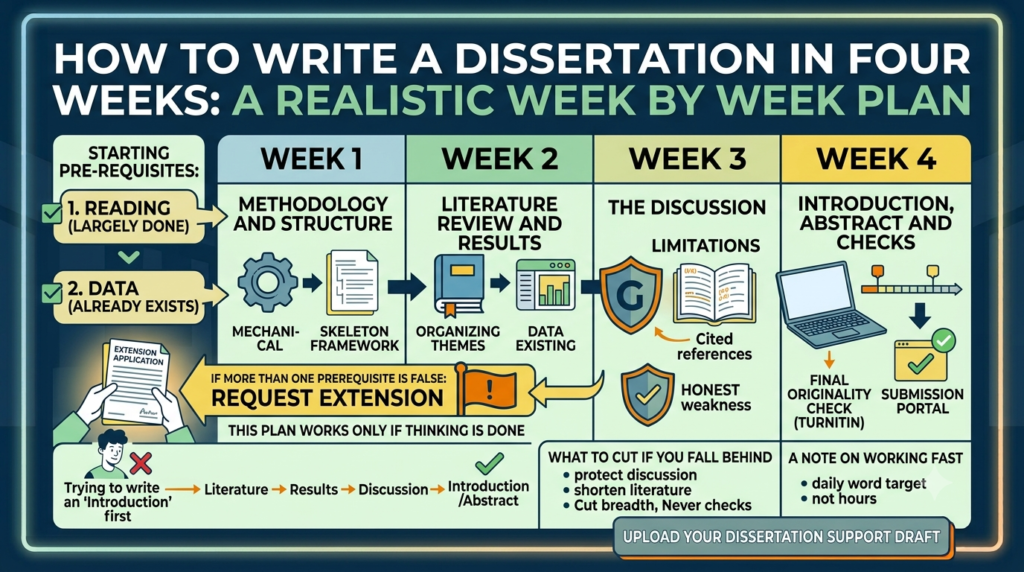
Four weeks is enough to write a dissertation only if your reading is largely done and your data already exists. If both are true, the working sequence is methodology first, then literature review and results, then discussion, then introduction and abstract last. Writing chapters in the order they appear is the mistake that costs people the deadline. Can you actually write a dissertation in four weeks? You can finish one. Starting one from nothing is a different question, and the honest answer is that four weeks is not enough to choose a topic, get ethics approval, collect data, read a field and write 15,000 words to a standard you would want marked. What four weeks genuinely allows is the writing itself, provided the thinking is already done. Most students in this position are not starting from zero. They have a supervised topic, months of reading in notes and half-read PDFs, and data sitting in a spreadsheet. What they do not have is a single chapter finished, which feels identical to having nothing and is not. So the first thing to do is separate those two states honestly, because the plan below only works for one of them. What has to be true before you start Run through this before you commit to the timeline. If more than one of these is false, your realistic move is an extension conversation rather than a sprint, and that conversation goes better before the deadline than after it. Week one: methodology and structure Start with methodology, which is counterintuitive and is the single most useful thing in this plan. Everyone wants to start with the introduction, and the introduction is the worst possible first chapter because you do not yet know what you are introducing. Methodology is the right opening move for three reasons. It is the most mechanical chapter, so it is the easiest to write when you are not yet warmed up. Its content is already fixed by decisions you made months ago, so there is nothing to invent. And it is where dissertations quietly lose grade bands, because most students write what they did without ever writing why they chose it over the obvious alternative, or what it could not tell them as a result. Give it the week and write it properly. Alongside it, build the skeleton of the whole document. Every chapter heading, every subheading, and a target word count against each one. This takes an afternoon and it changes the next three weeks, because you stop writing to a vague total and start writing to a specific number that tells you when to stop. End the week with a methodology chapter you would show your supervisor and a full outline. If you have those, you are ahead of where most people are at this point. Week two: literature review and results The literature review is the longest chapter and the one most likely to swallow the whole timeline, so it gets a hard boundary rather than an open week. You are not reading the field. You are organising what you have already read into an argument that makes your research question look inevitable. The structural trick is to organise by theme rather than by source. A review that walks through one paper after another reads as a reading list and marks like one. A review organised around three or four debates, with sources grouped inside them, reads as analysis. It is the same material rearranged, and it is worth a grade band. Results go in the same week because they are fast if your analysis is done. Present what you found, cleanly, with your tables and figures numbered and captioned as you go rather than at the end. Do not interpret anything here. Interpretation is next week, and mixing the two is the commonest structural error in the whole document. Week three: the discussion This is the chapter that decides your grade, so protect the week. Discussion is where a competent dissertation becomes a good one, and it is also where most students under time pressure simply restate their results in prose and lose twenty marks without understanding why. For every finding, answer three questions in writing. What does this mean. Does it agree with the literature you reviewed in week two, and if not, what could explain the gap. What follows from it. If a paragraph in your discussion does not do at least one of those three things, it belongs in the results chapter instead. Write your limitations honestly in the same week. Naming a real weakness in your own design reads as judgement, not failure, and markers reward it. The student who admits their sample was too small to generalise from has demonstrated exactly the awareness the top grade band asks for. The student who hopes nobody notices has not. Week four: introduction, abstract and checks Now write the introduction, because now you know what the dissertation actually says. It sets up the problem, states the question, and tells the reader what is coming, and all three are easy to write once the document exists. Written in week one, it commits you to an argument you had not tested. The abstract comes last and takes longer than people expect. It has to carry the question, the method, the finding and the significance in a couple of hundred words, and it is the first thing your marker reads. Then stop writing and start checking. Contents page against actual headings, figure and table captions, referencing consistency across four weeks of writing, word count against the limit, and the originality check on the full document. Our final 48 hours checklist covers the sequence, and running the full document through an official Turnitin report at this stage means you are confirming a figure rather than discovering one. Leave three days between finishing and submitting. Not to improve anything, but because something will go wrong with a file, a portal or a formatting requirement, and those three days are